All species › Passerines › Sunbirds › Violet-Tailed Sunbird
Violet-Tailed Sunbird | Anthreptes aurantius
Violetstaarthoningzuiger | Suimanga Colivioleta
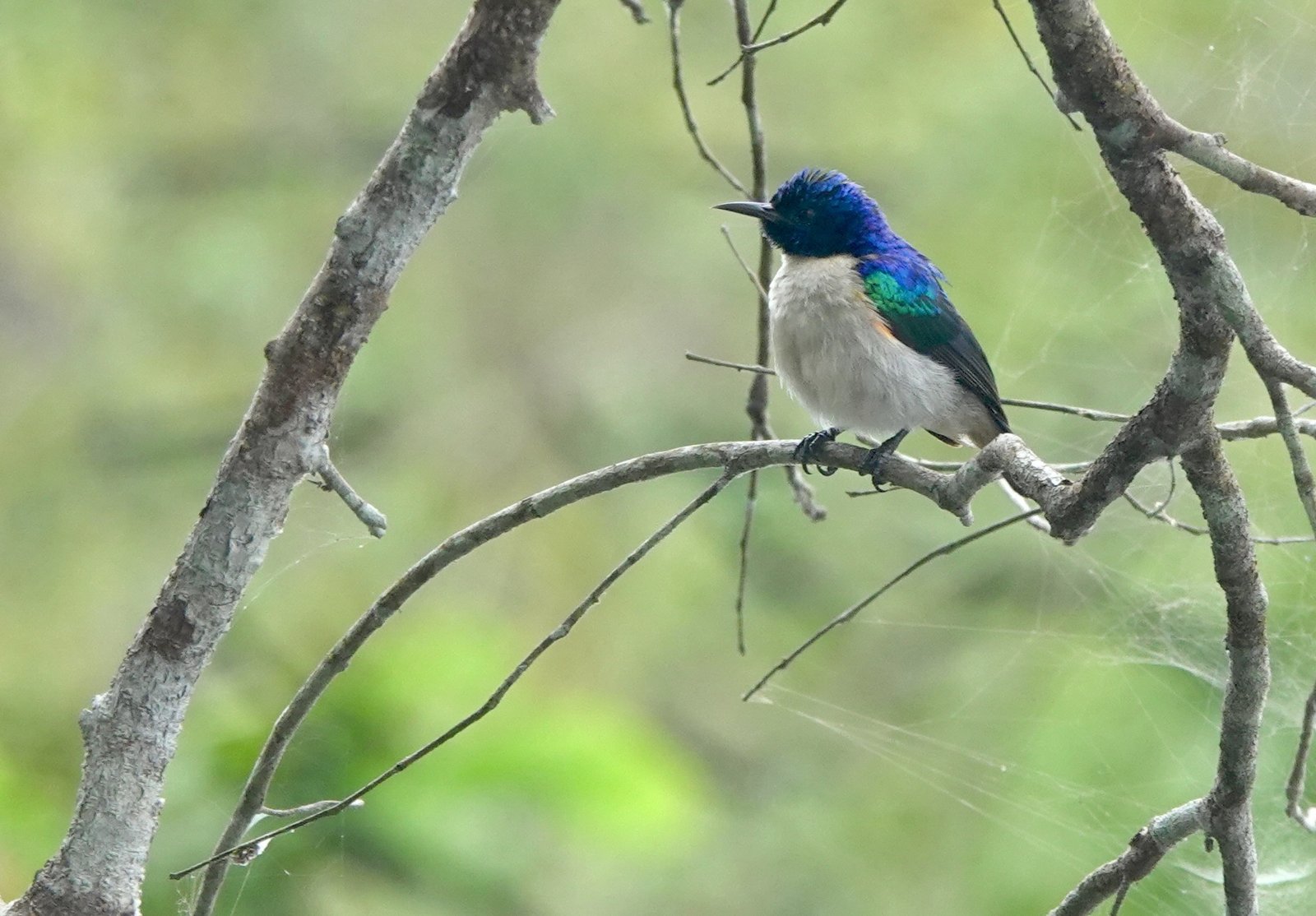
The Violet-Tailed Sunbird is a short-billed sunbird of rainforest near water in the Congo Basin. The male combines glossy violet-blue upperparts with orange-yellow underparts. Within the region the species is known only from the extreme north-west of Angola.
Voice
A sharp, metallic chip and a high tsee. The song is a short, fast, high twitter, often from a branch over water.
Recording: julien Birard — CC BY-NC-SA 4.0 · converted to mono · xeno-canto
Identification
About 13 cm, with a short, almost straight bill. The male has head, throat, back and tail glossy violet to steel-blue, with a greenish sheen on the mantle; the wings are brown. The breast is orange-yellow, paler yellow towards the belly, with yellow pectoral tufts. The female is grey-olive above with a violet-glossed tail, a narrow pale supercilium, a grey throat and bright yellow underparts. Juveniles resemble the female.
Confusion species
Western Violet-Backed Sunbird (Anthreptes longuemarei) also has violet upperparts, but is white below and lives in open miombo, not rainforest. The male Collared Sunbird (Hedydipna collaris) is smaller and metallic green, not violet. Mangrove Sunbird (Anthreptes gabonicus) of the mangroves is white below. Females are told from other yellow female sunbirds by the short straight bill and the violet tail.
Habitat
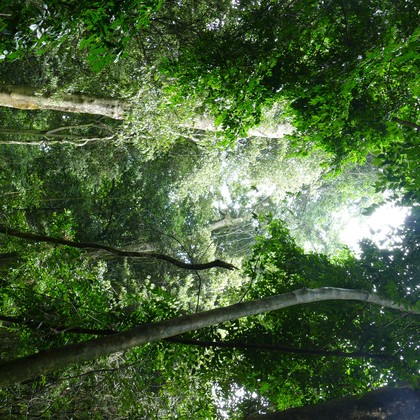
Riverine forest and rainforest along streams and rivers, swamp forest with raffia palms and the edges of creeks and mangroves. It forages in the middle and upper canopy for insects and at flowering trees and creepers.
Where the bird is most at home, classified by the vegetation units of southern Africa.

Range and movements
Within the region only in the extreme north-west of Angola, mainly in Cabinda and along the lower Congo; recent records are scarce. Beyond the region in the rainforest of southern Cameroon, Gabon, Congo-Brazzaville, the Central African Republic and Congo-Kinshasa.
How and when to look
A true rarity for the region. Search in Cabinda, for example in the Mayombe forest, along streams and riverbanks, and look for a short-billed sunbird that appears violet above and yellow below. A photograph or sound recording of any record in the region is valuable.
Conservation status
Not threatened and widespread in the Congo Basin. In Angola the species is poorly known; the forest of Cabinda is under pressure from logging.
Scientific name
Anthreptes aurantius | Verreaux & Verreaux, 1851
Verreaux & Verreaux described the species in 1851 and placed it straight away in the genus where it still stands. The genus Anthreptes was introduced in 1832 by Swainson. Anthreptes comes from the Greek anthos, 'flower', and threptēs, 'feeder' — for the habit of taking nectar from flowers. aurantius is Latin for 'orange', probably for the orange-yellow tones on the underparts or pectoral tufts; exactly what the describer had in mind is uncertain. The specimen the first description was based on came from Gabon.