All species › Passerines › Sunbirds › Western Violet-Backed Sunbird
Western Violet-Backed Sunbird | Anthreptes longuemarei
Violetrughoningzuiger | Suimanga Violeta
The Western Violet-Backed Sunbird is a fairly large, short-billed sunbird of miombo woodland. The male is glossy violet above and pure white below, a combination unique in the region. The female is grey-brown with a violet tail and a white supercilium.
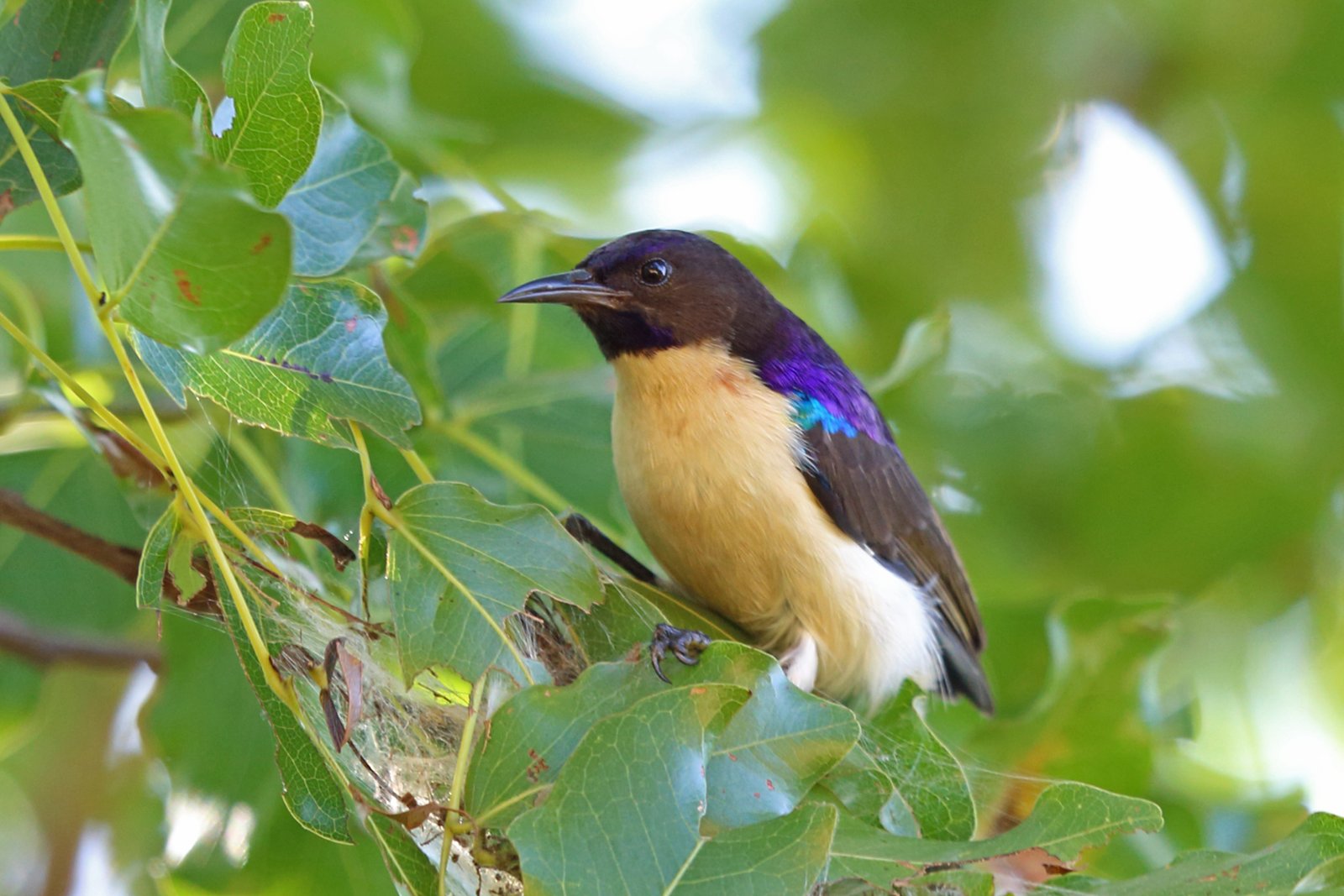
Click a thumbnail to switch the photo above.
Voice
A sharp chip or tswit, often repeated. The song is a short, fast series of hissing and chipping notes, like a thin tsee-tsee-tsirrr.
Recording: Dries Van de Loock — CC BY-NC-SA 4.0 · converted to mono · xeno-canto
Identification
About 13 cm, with a short, slightly decurved bill and a fairly long tail. The male has head, throat, back and uppertail coverts glossy violet-purple, bluish or reddish-purple depending on the light; the wings are brown, the tail dark violet. Breast and belly are white, with yellow pectoral tufts visible in display. The female is grey-brown above with a violet-glossed rump and tail, a clear white supercilium, a white throat and a pale yellow belly. Young males first acquire violet on the throat and back.
Confusion species
Violet-Tailed Sunbird (Anthreptes aurantius) of the Angolan rainforest has a violet back but orange-yellow underparts. The female recalls Mangrove Sunbird (Anthreptes gabonicus), which is smaller, white below and confined to mangroves. Other female sunbirds in miombo have a longer, more strongly curved bill and lack the violet tail.
Habitat
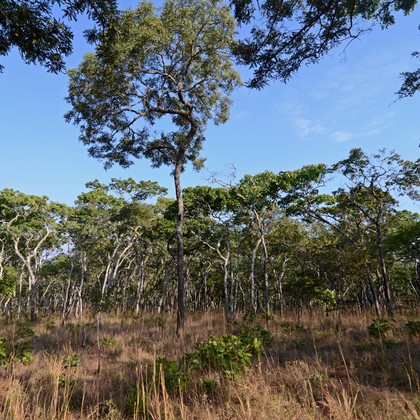
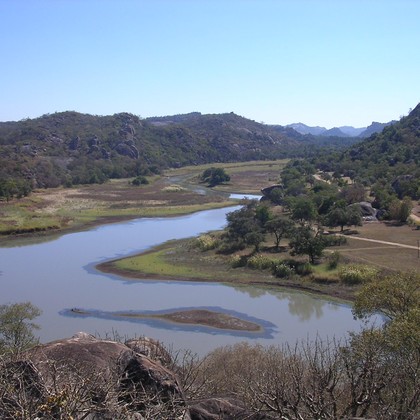
Miombo and other open broadleaved woodland, woodland edge, riverine forest and wooded grassland with scattered trees. It forages in the canopy, both at flowers and for insects, and often joins mixed flocks of flycatchers and tits.
Where the bird is most at home, classified by the vegetation units of southern Africa.
Range and movements
Within the region in northern and central Angola, over most of Zambia except the dry south-west, in Malawi, in northern and central Mozambique and in eastern Zimbabwe, including the Nyanga lowlands, the Honde Valley and Haroni-Rusitu. Beyond the region from West Africa to South Sudan, Uganda, Congo-Kinshasa and Tanzania.
- Resident
- dark = core range, pale = thinly spread
How and when to look
In miombo the male is usually easiest to find by listening for the dry chip and watching for a bird that shows white and violet high in the canopy. Good sites are Dzalanyama in Malawi, the miombo around Kasanka in Zambia and the eastern lowlands of Zimbabwe.
Conservation status
Not threatened and widespread over a large range. It declines locally with the clearance of miombo.
Scientific name
Anthreptes longuemarei | (Lesson, 1831)
Lesson described the species in 1831 as Cinnyris longuemarei; because it was later moved to another genus, the author and year stand in brackets. The genus Anthreptes was introduced in 1832 by Swainson. Anthreptes comes from the Greek anthos, 'flower', and threptēs, 'feeder' — for the habit of taking nectar from flowers. longuemarei honours the French naturalist and naval administrator Agathe-François Gouÿe de Longuemare (1792–1866). The specimen the first description was based on came from Upper Senegambia (Senegal/Gambia).