All species › Passerines › Cisticolas › Whistling Cisticola
Whistling Cisticola | Cisticola lateralis
Fluitgraszanger | Cistícola Silbador
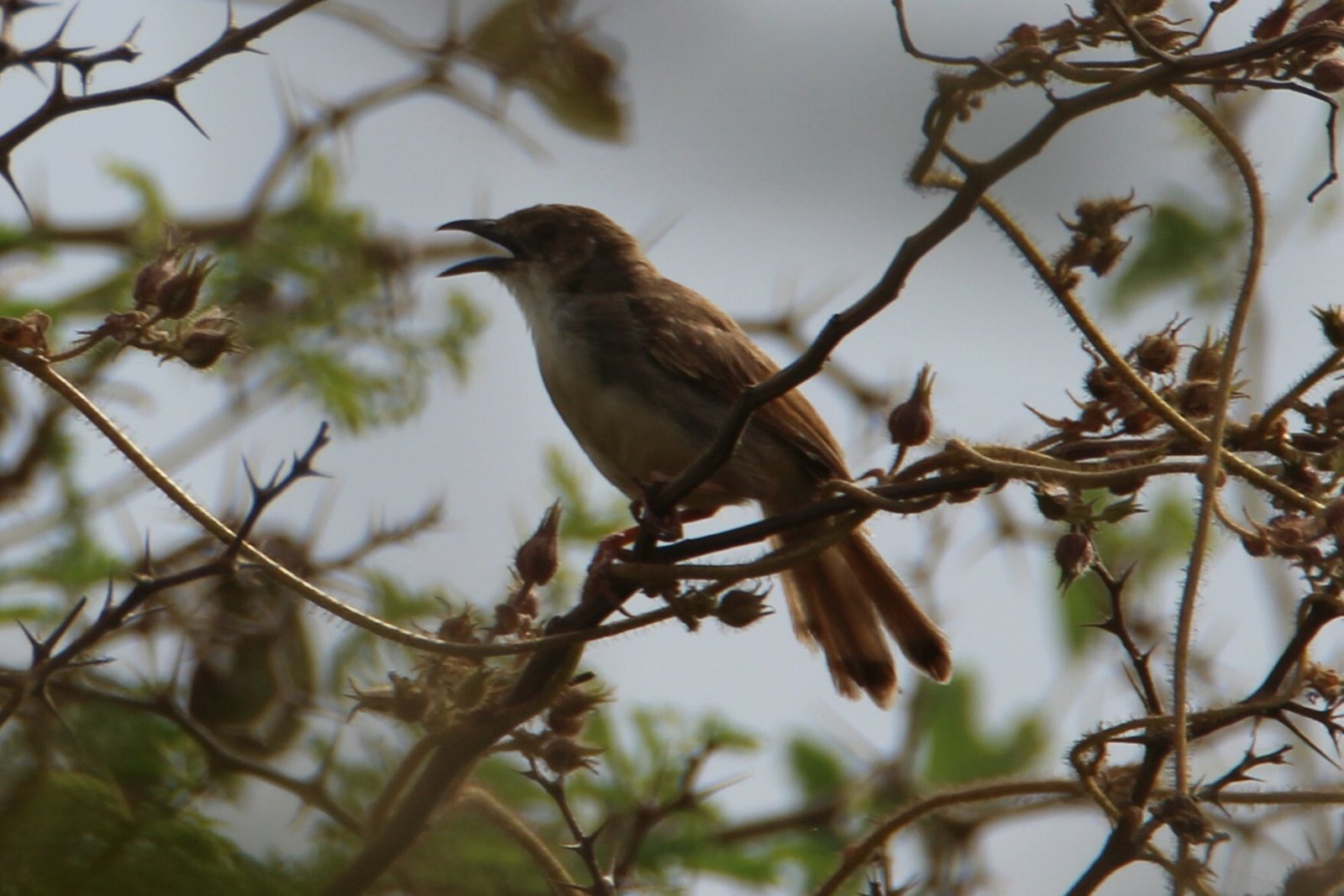
The Whistling Cisticola is a large, dark and unstreaked cisticola of rank forest edges and moist savanna in the north of the region, which delivers a rich, whistled song from a tree or tall bush. It often perches higher in trees than most cisticolas and has no display flight. Within the region it occurs only in Angola and northern and north-western Zambia.
Voice
The song is a loud, rich and melodious series of whistles, tu-tu-tu-chweeoo or twee-twee-tweeoo, often ending in a dry rattle or chrrr, sung from a high branch or treetop. The song varies greatly between individuals and regions. The alarm is a grating chrr-chrr. It sings mainly in the rains.
Recording: Bram Piot — CC BY-NC-SA 4.0 · converted to mono · xeno-canto
Identification
13–15 cm, the male clearly larger than the female. The upperparts are plain dark sooty brown to grey-brown without streaks, the crown barely warmer, a dull rufous-brown. There is no clear supercilium; the face is grey-brown with pale lores. The edges of the flight feathers are slightly warmer brown, without a bright wing panel. The underparts are pale grey to off-white, with a greyish breast and buffy-grey flanks. The rather long tail is dark with a black subterminal mark and pale tip. The bill is stout and dark, the legs pink. Outside the breeding season the plumage is slightly warmer brown. The sexes are alike in colour. The dark, grey, unstreaked impression is characteristic.
Confusion species
Croaking Cisticola Cisticola natalensis is also large and stout, but has a clearly streaked back, a heavy bill and a croaking call in open grassland. Rattling Cisticola Cisticola chiniana has a streaked back and rattles from a bush. Trilling Cisticola Cisticola woosnami is also unstreaked, but smaller and warmer brown, with a rufous crown and a trilling song in miombo. Chattering Cisticola Cisticola anonymus of forest edges in northern Angola is smaller, with a warmer rufous crown and a fast chattering song. Stout Cisticola Cisticola robustus lives in open grassland and has a streaked back. A large, dark grey, unstreaked cisticola whistling loudly high in a tree is a Whistling Cisticola.
Habitat
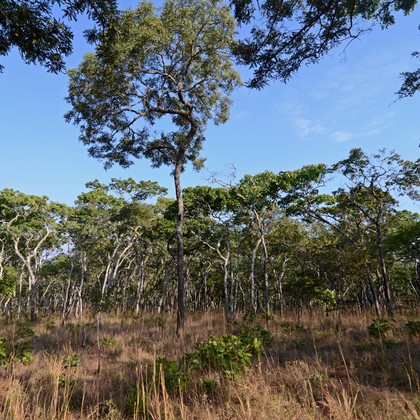
Rank tall grass with bushes and scattered trees in moist savanna and miombo, forest edges, the forest–savanna transition, clearings and abandoned fields with regrowth. It forages low in the vegetation for insects, but sings and rests higher in trees and bushes. Usually in pairs.
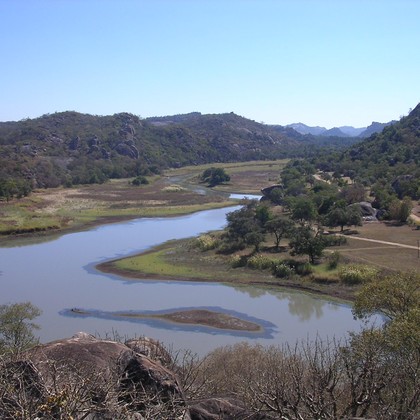
Where the bird is most at home, classified by the vegetation units of southern Africa.
Range and movements
Within the region in northern and central Angola, south to the central plateau, and in northern and north-western Zambia (including Mwinilunga and the Copperbelt). Beyond the region from Senegal east through West and Central Africa to South Sudan, Uganda and western Kenya, and south through Gabon and DR Congo.
- Resident
- dark = core range, pale = thinly spread
How and when to look
Year-round; in Angola search forest edges and moist savanna in the north, for example around Kalandula and in Uíge, and in Zambia the Mwinilunga area. Listen in the rains for a loud, whistled song from a tree; a dark, plain cisticola singing high in the canopy is characteristic. Its sturdy build can at first suggest a different kind of songbird.
Conservation status
Not threatened. Common over a large range and tolerant of disturbance: the species benefits from the opening up of forest and from rank growth on abandoned fields.
Scientific name
Cisticola lateralis | (Fraser, 1843)
Fraser described the species in 1843 as Drymoica lateralis; because it was later moved to another genus, the author and year stand in brackets. The genus Cisticola was introduced in 1829 by Kaup. Cisticola combines the Ancient Greek kisthos 'rock-rose' with the Latin colere 'to dwell'. lateralis is Latin for 'of the side', from latus, 'side'; probably for the coloured flanks, but the author's intent could not be verified. The specimen the first description was based on came from Cape Palmas, Liberia.