All species › Passerines › Cisticolas › Chattering Cisticola
Chattering Cisticola | Cisticola anonymus
Bosgraszanger | Cistícola Charlatán
The Chattering Cisticola is a cisticola of rank forest edges and clearings in the rainforest belt of Central Africa, reaching the region only in north-western Angola. Unlike most cisticolas it lives not in open grass but in tall rank growth, bushes and creepers at the forest edge, where pairs duet in loud chatters.

Voice
Noisy: pairs duet with fast, high series, chee-chee-chee-chee, interspersed with rattling and chirping notes, the birds answering each other in rapid succession. The male also sings a repeated two-note phrase from a high bush. When agitated, a sharp cher.
Recording: Jaap van der Waarde — CC BY-NC-SA 4.0 · converted to mono · xeno-canto
Identification
14–15 cm. The upperparts are plain dark grey-brown without streaking; crown and nape are rufous, slightly brighter than the back; there is an indistinct pale supercilium and dark lores. The flight feathers are edged rufous. The underparts are off-white, with greyish to buff breast and flanks. The fairly long tail is dark brown with a dark subterminal band and pale tips. The bill is dark, the legs pink. The sexes are alike and seasonal change in plumage is slight.
Confusion species
Singing Cisticola Cisticola cantans occurs in the same rank growth but has a brighter rufous wing panel contrasting with a paler back, a clearer white supercilium and a bright, two-note song. Red-Faced Cisticola Cisticola erythrops has a reddish face but no rufous crown, and a loud, crescendo song. Whistling Cisticola Cisticola lateralis is plain brown without a rufous crown and sings clear whistles. Bubbling Cisticola Cisticola bulliens has a streaked back and lives in drier savanna. The loud chattering duet from edge thickets is the best feature of Chattering Cisticola.
Habitat
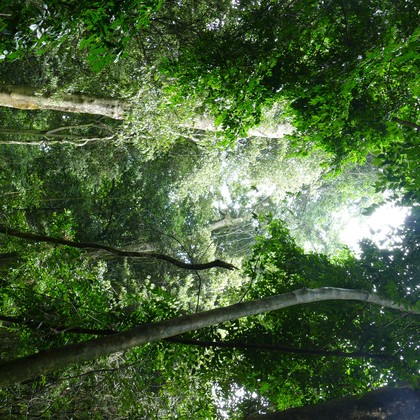
Tall rank growth and bushes at the edges of rainforest and gallery forest, clearings, abandoned fields and cassava plots with regrowth, and rank grassy patches in the forest–savanna mosaic. It forages in pairs or family parties low in the vegetation for insects.
Where the bird is most at home, classified by the vegetation units of southern Africa.

Range and movements
Within the region only in north-western Angola: Cabinda and the provinces of Zaire, Uíge and Cuanza Norte. Beyond the region from south-eastern Nigeria and Cameroon through Gabon, Congo-Brazzaville and the Central African Republic to eastern DR Congo.
- Resident
- dark = core range, pale = thinly spread
How and when to look
All year; search in Cabinda (Mayombe) and along forest edges around Uíge. The chattering duet from rank growth at a forest edge or an overgrown field betrays a pair; from a track or road along the edge the birds often pop up briefly on a protruding branch.
Conservation status
Not threatened. Common in a large range and a species that benefits from logging and secondary growth, since rank growth at forest edges and on abandoned fields is just the habitat it needs.
Scientific name
Cisticola anonymus | (Müller, 1855)
Müller described the species in 1855 as Drymoeca anonyma; because it was later moved to another genus, the author and year stand in brackets. The genus Cisticola was introduced in 1829 by Kaup. Cisticola combines the Ancient Greek kisthos 'rock-rose' with the Latin colere 'to dwell'. anonymus is Latin for 'nameless', from the Greek anōnumos; why Müller gave the species this name is not known. The specimen the first description was based on came from unknown (not stated in the source).