All species › Passerines › Cisticolas › Trilling Cisticola
Trilling Cisticola | Cisticola woosnami
Miombograszanger | Cistícola de Woosnam
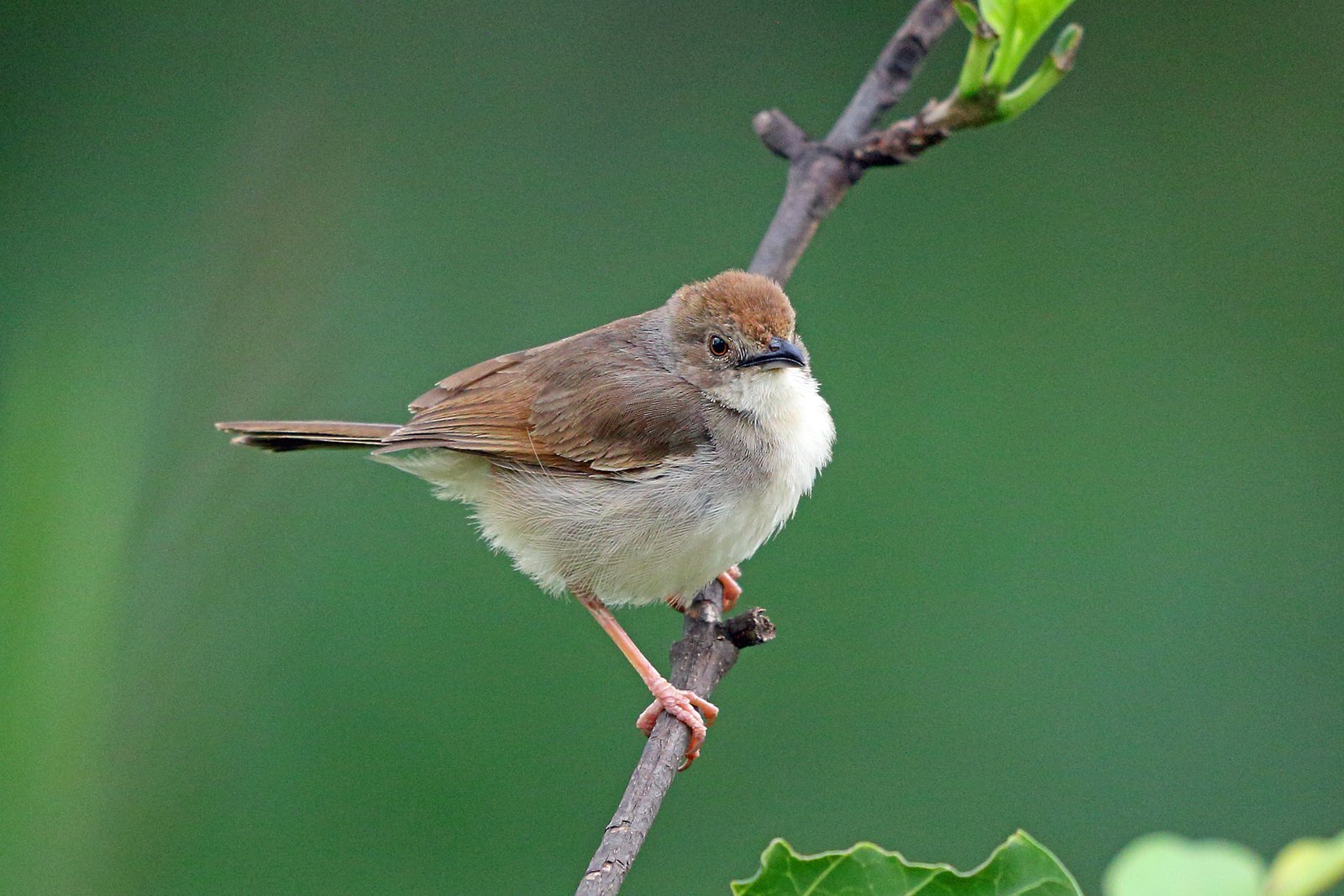
The Trilling Cisticola is a cisticola of open miombo and other broadleaf woodland with a grassy understorey, restricted within the region to Zambia and northern Malawi. It resembles Rattling Cisticola, but its song is an accelerating series ending in a long trill, and it sings more often from a branch in a tree than from a bush.
Voice
The song is a series of short notes that accelerates into a long, level or slightly rising trill: tsi-tsi-tsi-tsrrrrrrrr, often from a branch midway up or high in a tree. There is also a slower, repeated tew-tew-tew. The call is a sharp tsik; grating notes when agitated.
Recording: Ehren Eksteen — CC BY-NC-SA 4.0 · converted to mono · xeno-canto
Identification
13–14 cm, a compact cisticola with a fairly short tail. The upperparts are grey-brown, faintly or barely streaked; the crown is rufous and finely streaked, the pale supercilium indistinct and the flight feathers edged rufous. The underparts are white to pale buff with ochre flanks. The tail has a dark subterminal band and pale tips. The bill is stout and dark. The sexes are alike, the male slightly larger; seasonal change in plumage is slight.
Confusion species
Rattling Cisticola Cisticola chiniana is the main pitfall: it has a more clearly streaked back and a longer tail, usually sings low from bushes and ends its song in a dry rattle. Tinkling Cisticola Cisticola rufilatus has an unstreaked back, a rufous tail and a clear white supercilium and sings a soft, bell-like song. Neddicky Cisticola fulvicapilla is smaller, with an unstreaked back and a plain rufous head without a supercilium, and sings a fast, monotonous series. Croaking Cisticola Cisticola natalensis is much larger and lives in open grassland. In the field the song is decisive.
Habitat
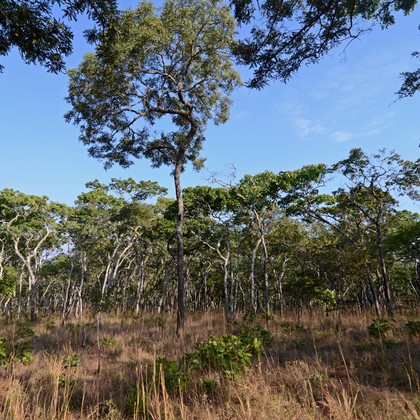
Open miombo and other broadleaf woodland with tall grass, especially on rocky hills and slopes, also grassy clearings and abandoned fields in woodland. It forages low in grass and bushes for insects but sings higher in the trees.
Where the bird is most at home, classified by the vegetation units of southern Africa.

Range and movements
Within the region in Zambia, mainly on the northern plateau and in the north and east, and in northern Malawi. Beyond the region from south-eastern DR Congo and south-western Tanzania north to north-eastern DR Congo, Uganda and central Tanzania.
- Resident
- Summer visitor (c. Oct–Mar)
- Winter visitor (c. Apr–Sep)
- Passage (Mar–Apr, Oct–Nov)
- dark = core range, pale = thinly spread
How and when to look
All year; search open miombo with tall grass on rocky hills in northern Zambia, for example around Kasanka and on the northern plateau, and in northern Malawi. Listen for the accelerating trill from a tree; where the species occurs alongside Rattling Cisticola, song is the only reliable feature. A cisticola singing high in a miombo tree is more likely this species than a Rattling Cisticola.
Conservation status
Not threatened. Fairly common in suitable miombo. Large-scale clearing of miombo for charcoal and agriculture can remove habitat locally, although the species also benefits from clearings and young regrowth.
Scientific name
Cisticola woosnami | Ogilvie-Grant, 1908
Ogilvie-Grant described the species in 1908 and placed it straight away in the genus where it still stands. The genus Cisticola was introduced in 1829 by Kaup. Cisticola combines the Ancient Greek kisthos 'rock-rose' with the Latin colere 'to dwell'. woosnami honours the British army officer and game warden Richard Bowen Woosnam (1880–1915), a member of the 1906 Ruwenzori expedition. The specimen the first description was based on came from southeastern Ruwenzori; the type is from Muhokya near Lake George, Uganda.