All species › Passerines › Cuckooshrikes › White-Breasted Cuckooshrike
White-Breasted Cuckooshrike | Ceblepyris pectoralis
Witborstrupsvogel | Oruguero Pechiblanco
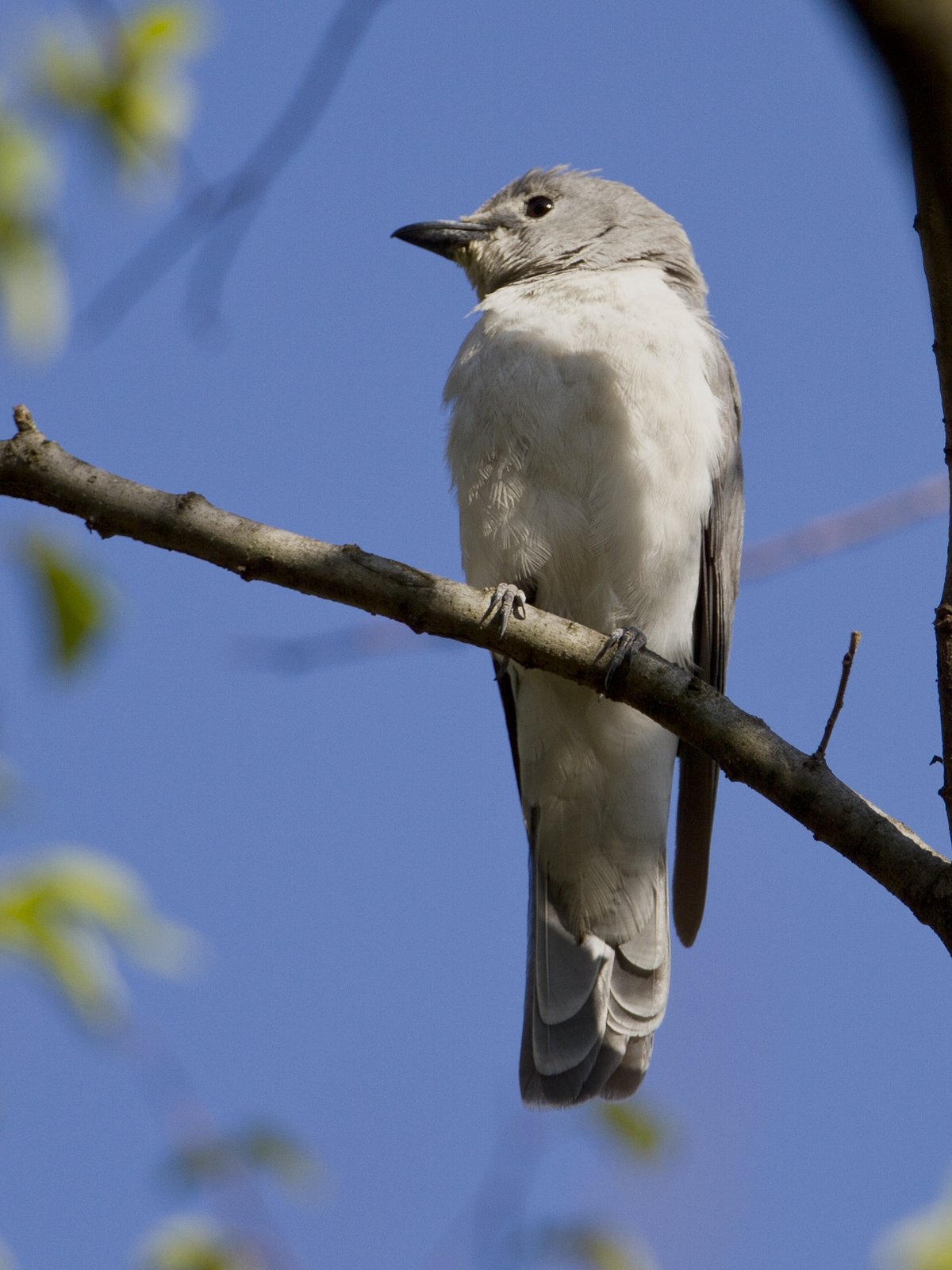
The White-Breasted Cuckooshrike is the cuckooshrike of open woodland: pale grey above, white below and usually high in the canopy of miombo or other broadleaved woodland. Pairs move quietly through the canopy, often as part of a mixed foraging flock, and are heard more often than seen.
Voice
A soft, descending tseeu-tseeu, a high whistled chee-chee and a dry trill, chrrrr. The male sometimes sings a rapid series of high notes from a bare branch in the canopy.
Recording: Dries Van de Loock — CC BY-NC-SA 4.0 · converted to mono · xeno-canto
Identification
25–27 cm, slender with a fairly long tail. The male is pale blue-grey on the head, back and wings, with a grey throat and upper breast sharply demarcated from a white belly and undertail coverts; the lores are black. The female is paler, with a whitish throat and breast and grey rather than black lores. Flight feathers are dark grey with pale edges; the tail is dark grey with white tips to the outer feathers. Juveniles are white below with fine dark barring and spotted on the back.
Confusion species
Grey Cuckooshrike Ceblepyris caesius is wholly grey, without a white belly, and lives in closed forest. The female Black Cuckooshrike Campephaga flava is olive-brown with yellow wing edges and heavily barred below. Ashy Flycatcher Fraseria caerulescens is much smaller and has a grey breast without a sharp division.
Habitat
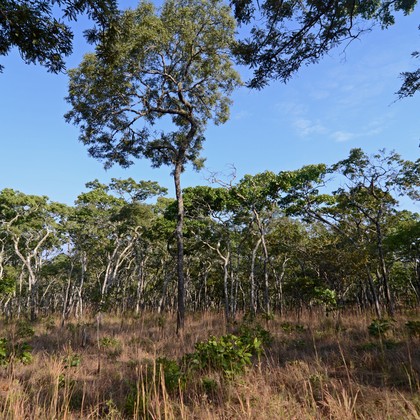
Tall, open broadleaved woodland, especially miombo, but also mixed woodland, riverine woodland and tall mopane. It forages in the canopy and mid-stratum for caterpillars, grasshoppers and other insects, mostly gleaned from leaves. The nest is a shallow cup of lichen and spider web on a horizontal branch, almost invisible.
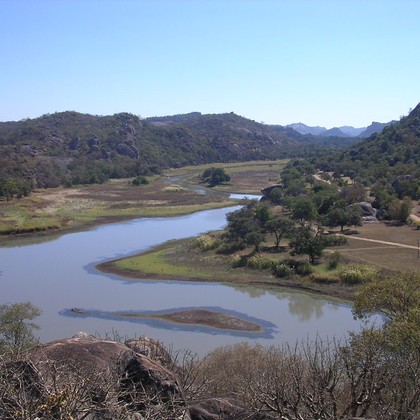
Where the bird is most at home, classified by the vegetation units of southern Africa.
Range and movements
Widespread in the miombo belt of Angola, Zambia, Malawi, Mozambique and Zimbabwe; in northern Botswana and north-eastern Namibia (Kavango, Zambezi Region); in South Africa scarce in north-eastern Limpopo and the Mpumalanga lowveld, further south to northern KwaZulu-Natal. Beyond the region in the savanna belt from Senegal to Ethiopia and in East Africa.
- Resident
- dark = core range, pale = thinly spread
How and when to look
Year-round in tall miombo, for example around Harare, at Kasanka or in the woodland of Nyika's lower slopes. Walk along with a mixed foraging flock and look in the highest branches for a grey bird with a white belly that barely moves. The male briefly flicks both wings on landing.
Conservation status
Not threatened; fairly common in intact miombo. Clearance for charcoal and agriculture is reducing the extent of its habitat across much of the region.
Scientific name
Ceblepyris pectoralis | (Jardine & Selby, 1828) (GBIF: Coracina pectoralis)
Jardine & Selby described the species in 1828 as Graucalus pectoralis; because it was later moved to another genus, the author and year stand in brackets. The genus Ceblepyris was introduced in 1816 by Cuvier, GLCFD. Ceblepyris goes back to the Greek keblēpuris, an unidentified bird in classical literature (Aristophanes); literally perhaps 'fire-head'. pectoralis is Latin for 'of the breast', from pectus, 'breast' — for the white breast and belly. The specimen the first description was based on came from Sierra Leone.