All species › Passerines › Drongos › Square-Tailed Drongo
Square-Tailed Drongo | Dicrurus ludwigii
Rechtstaartdrongo | Drongo de Ludwig
The Square-Tailed Drongo is the small, glossy black drongo of closed forest. Where Fork-Tailed Drongo sits on a bare branch in open woodland, this species keeps to the shade of the mid-stratum, and a hard, metallic call is often the first sign that a mixed bird party is nearby.

Voice
Noisy, with a wide range of hard, metallic and strident calls, such as a repeated chweep-chweep, a sharp tching and scratchy, chattering series. It also whistles clear notes and sometimes mimics other birds. It often calls from the canopy as the first member of a bird party.
Recording: Magnus Wadstein — CC BY-NC-SA 4.0 · shortened to the first 60 s, mono · xeno-canto
Identification
18–19 cm, compact with a relatively short tail. Entirely black with a blue gloss, strongest on the head, back and wings. The tail is square-cut or at most very slightly notched, without the splayed fork of Fork-Tailed Drongo. The eye is deep red, the bill black, broad-based and hooked. In flight it lacks the pale wing panel of Fork-Tailed Drongo. Juveniles are duller, with pale spots below and a dark eye. It sits upright and sallies from a branch after passing insects.
Confusion species
Fork-Tailed Drongo Dicrurus adsimilis is larger, with a deeply forked tail with outcurved tips, and lives in open woodland; both occur at forest edge and in riverine forest. Southern Black Flycatcher Melaenornis pammelaina is dull black without gloss, with a dark eye and a finer bill. The male Black Cuckooshrike Campephaga flava has a rounded tail and a yellow gape and moves sluggishly through the foliage. In Angola, Sharpe's Drongo Dicrurus sharpei is very similar but duller black with less gloss.
Habitat
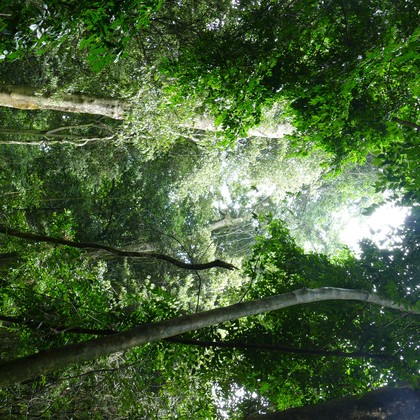
The mid-stratum and lower canopy of evergreen coastal and lowland forest, riverine forest, dense forest in ravines and the lower zones of Afromontane forest. It comes to the forest edge but rarely into open woodland. It catches insects in short sallies from a perch, often in mixed parties with flycatchers, cuckooshrikes and crested flycatchers.
Where the bird is most at home, classified by the vegetation units of southern Africa.


Range and movements
In South Africa from the Eastern Cape through KwaZulu-Natal and Eswatini to the escarpment forests of Mpumalanga and Limpopo; further in eastern Zimbabwe and the low-lying forests of the Save and Zambezi valleys, widespread in the coastal and riverine forests of Mozambique, in southern and eastern Malawi, in the Zambezi and Luangwa valleys and northern Zambia, and in the forests of Angola. Outside the region north along the east coast to Kenya and Somalia and in southern DR Congo.
- Resident
- Summer visitor (c. Oct–Mar)
- Winter visitor (c. Apr–Sep)
- Passage (Mar–Apr, Oct–Nov)
- dark = core range, pale = thinly spread
How and when to look
Year-round in coastal forests such as Ongoye, Dlinza and Hluhluwe or the riverine forests of Mozambique. Listen for the metallic calls and then find the bird party; the drongo often sits on a horizontal branch below the canopy and only becomes obvious when it sallies. Check for the square tail and red eye.
Conservation status
Not threatened and common in suitable forest. The species depends on indigenous forest and disappears where coastal forest is cleared for farming, building or plantations; in the coastal belt of South Africa and Mozambique fragmentation is a local risk.
Scientific name
Dicrurus ludwigii | (Smith, 1834)
Smith described the species in 1834 as Edolius ludwigii; because it was later moved to another genus, the author and year stand in brackets. The genus Dicrurus was introduced in 1816 by Vieillot. Dicrurus comes from the Greek dikros, 'forked', and oura, 'tail' — for the forked tail of most drongos. ludwigii honours Baron Carl Ferdinand Heinrich von Ludwig (1784–1847), a German-born pharmacist and patron of natural science in Cape Town. The specimen the first description was based on came from Durban, South Africa.