All species › Passerines › Drongos › Sharpe's Drongo
Sharpe's Drongo | Dicrurus sharpei
Sharpes drongo | Drongo de Sharpe
Sharpe's Drongo is the small drongo of the Central African rainforest, which within our region only reaches north-western Angola. Until recently it was treated as a subspecies of Square-Tailed Drongo; it is duller in colour and keeps to the mid-stratum of lowland forest, where it moves with mixed bird parties.

Voice
Hard, metallic and scratchy calls, such as a repeated chweep or tchink, mixed with clear whistles and rapid chattering; very like the calls of Square-Tailed Drongo. It often calls from within a bird party.
Recording: GABRIEL LEITE — CC BY-NC-SA 4.0 · converted to mono · xeno-canto
Identification
17–18 cm, the smallest drongo in the region. Black with only a weak blue gloss, mainly on the wings; the rest of the plumage looks matt sooty black. The tail is short and square-cut or very slightly notched. The eye is red, the bill black and broad-based. The sexes are alike. Juveniles are browner black with pale spots below and a dark eye. It sits upright on a horizontal branch and makes short sallies after insects.
Confusion species
Square-Tailed Drongo Dicrurus ludwigii is slightly larger and more obviously blue-glossed; in Angola the relationship between the two is not yet clear everywhere, and field marks are subtle. Velvet-Mantled Drongo Dicrurus modestus is much larger, deeply forked and strongly glossed with a velvety black mantle. Fork-Tailed Drongo Dicrurus adsimilis is larger, with a deep fork, and lives in open woodland. The male Purple-Throated Cuckooshrike Campephaga quiscalina has a purple gloss and a rounded tail.
Habitat
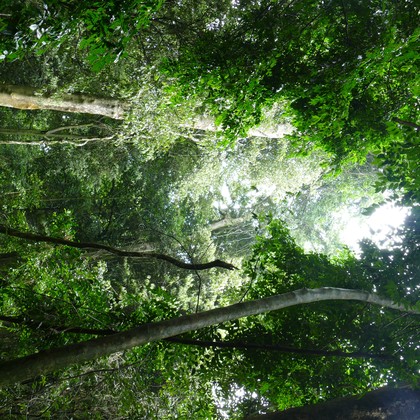
The mid-stratum and lower canopy of humid lowland forest, secondary forest, forest edge and gallery forest along rivers, also near clearings and in old coffee plantations under shade trees. It hunts flying insects from a perch and joins mixed bird parties.
Where the bird is most at home, classified by the vegetation units of southern Africa.

Range and movements
Within the region only in north-western Angola: in Cabinda and the forests of the north-western interior and the escarpment zone. Outside the region from Nigeria and Cameroon east through the Congo Basin to South Sudan, Uganda and western Kenya, and south to south-eastern DR Congo.
- Winter visitor (c. Apr–Sep)
- dark = core range, pale = thinly spread
How and when to look
Year-round, but only to be expected in north-western Angola. Follow mixed bird parties in the forest and look for a small, matt black drongo with a square tail. A good photograph and sound recording are useful, because in the field the species closely resembles Square-Tailed Drongo.
Conservation status
Not threatened; widespread and fairly common in its Central African range. In Angola the species depends on the remaining lowland and escarpment forest, which is under pressure from logging and farming.
Scientific name
Dicrurus sharpei | Oustalet, J-FÉ, 1879
Oustalet, J-FÉ described the species in 1879 and placed it straight away in the genus where it still stands. The genus Dicrurus was introduced in 1816 by Vieillot. Dicrurus comes from the Greek dikros, 'forked', and oura, 'tail' — for the forked tail of most drongos. sharpei honours the British ornithologist Richard Bowdler Sharpe (1847–1909) of the British Museum. The specimen the first description was based on came from upper Ogooué River, Gabon.