All species › Passerines › Drongos › Fork-Tailed Drongo
Fork-Tailed Drongo | Dicrurus adsimilis
Treurdrongo | Drongo Ahorquillado
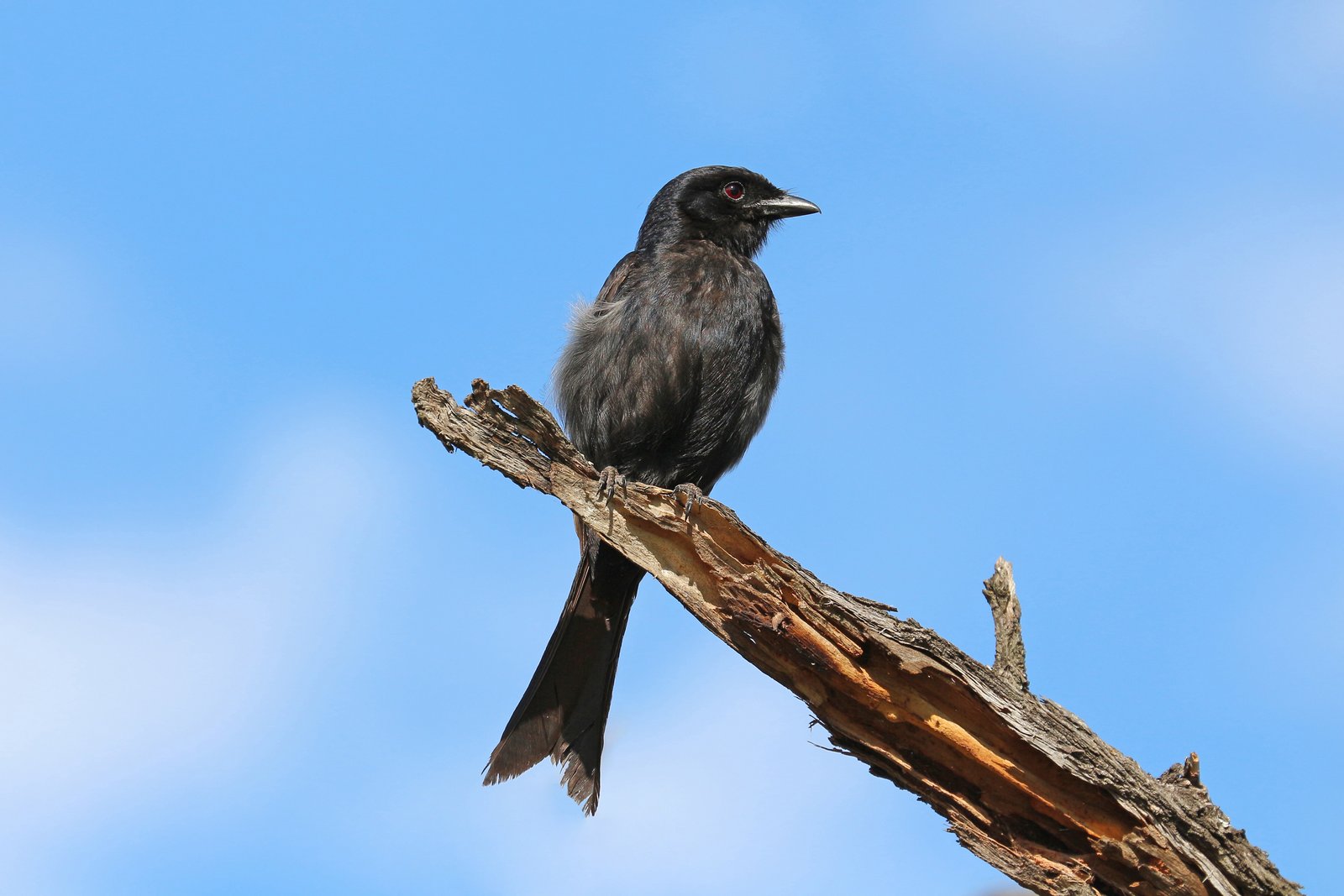
The Fork-Tailed Drongo is one of the most familiar birds of the African bushveld: a glossy black bird with a deeply forked tail, upright on a bare branch. It is bold and noisy, mobs eagles and crows, follows grazing game and bush fires and often starts singing before dawn.
Voice
An endless variety of metallic, grating and chirping sounds, often in quick series: tchink-cherrr-tchip. It readily mimics other birds, especially raptors such as Pearl-Spotted Owlet, and uses false alarm calls to steal prey from other animals. It often sings in the dark before dawn and on moonlit nights.
Recording: Walter Wallner — CC BY-NC-SA 4.0 · shortened to the first 60 s, mono · xeno-canto
Identification
23–26 cm. Entirely black with a blue gloss; the tail is long and deeply forked, with outcurved tips. The eye is red, the bill black and strong. In flight the silvery grey inner webs of the primaries show as a pale wing panel. The sexes are alike. Juveniles are duller, with pale fringes on the belly and wing coverts, a shallower fork, a yellowish gape and a brown eye. It perches conspicuously in the open and hunts from a lookout for insects in the air and on the ground.
Confusion species
Square-Tailed Drongo Dicrurus ludwigii is smaller, has a square tail and lives in closed forest. Southern Black Flycatcher Melaenornis pammelaina is dull black without gloss, with a dark eye, a square or slightly notched tail and a fine bill. The male Black Cuckooshrike Campephaga flava has a rounded tail and a yellow gape and stays hidden in foliage. In northern Angola, Velvet-Mantled Drongo Dicrurus modestus has a deeper blue gloss with a velvety black mantle and lives in forest.
Habitat
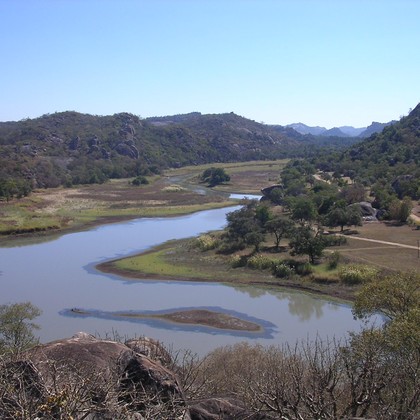
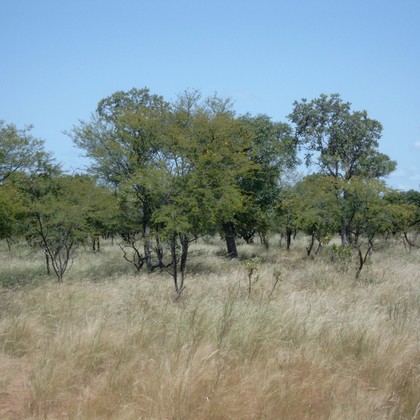
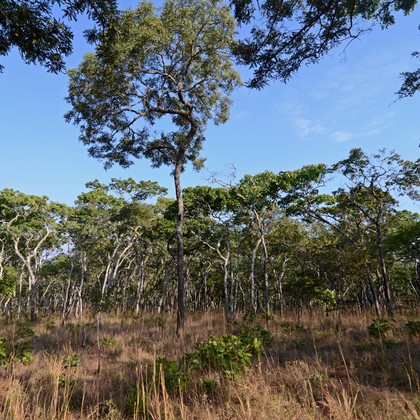
Almost every kind of open woodland and savanna: miombo, mopane, mixed woodland and acacia savanna, as well as forest edge, riverine forest, plantations, farmland with trees and gardens. It avoids closed forest, treeless grassland and bare desert. It hunts from a lookout, follows grazers, herds, people and fire fronts and eats mainly insects, sometimes also nectar and small vertebrates.
Where the bird is most at home, classified by the vegetation units of southern Africa.
Range and movements
Widespread and common throughout the region: across Angola, Zambia, Malawi, Mozambique, Zimbabwe and Botswana, in northern and central Namibia, and in South Africa in the north, east and along the east coast into the Eastern Cape. It is largely absent from the Namib, the high Karoo, the Lesotho highlands and the fynbos of the Western Cape. Outside the region across almost all of Africa south of the Sahara.
- Resident
- Summer visitor (c. Oct–Mar)
- Winter visitor (c. Apr–Sep)
- Passage (Mar–Apr, Oct–Nov)
- dark = core range, pale = thinly spread
How and when to look
Year-round and easy to see anywhere in the bushveld, for example in Kruger or the Okavango Delta. Watch its behaviour around large mammals and at bush fires, and listen at dawn for its song, often one of the first sounds of the day. It is a good school for mimicry: a 'raptor' in the bushveld often turns out to be a drongo.
Conservation status
Not threatened; common and in many areas one of the most frequently recorded birds. The species adapts well to farmland and areas with scattered trees; no large-scale threats are known.
Scientific name
Dicrurus adsimilis | (Bechstein, 1794)
Bechstein described the species in 1794 as Corvus adsimilis; because it was later moved to another genus, the author and year stand in brackets. The genus Dicrurus was introduced in 1816 by Vieillot. Dicrurus comes from the Greek dikros, 'forked', and oura, 'tail' — for the forked tail of most drongos. adsimilis is Latin for 'similar to', probably for its resemblance to other drongos. The specimen the first description was based on came from Duiwenhoks River, Western Cape, South Africa.