All species › Passerines › Drongos › Velvet-Mantled Drongo
Velvet-Mantled Drongo | Dicrurus modestus
Bosdrongo | Drongo Modesto
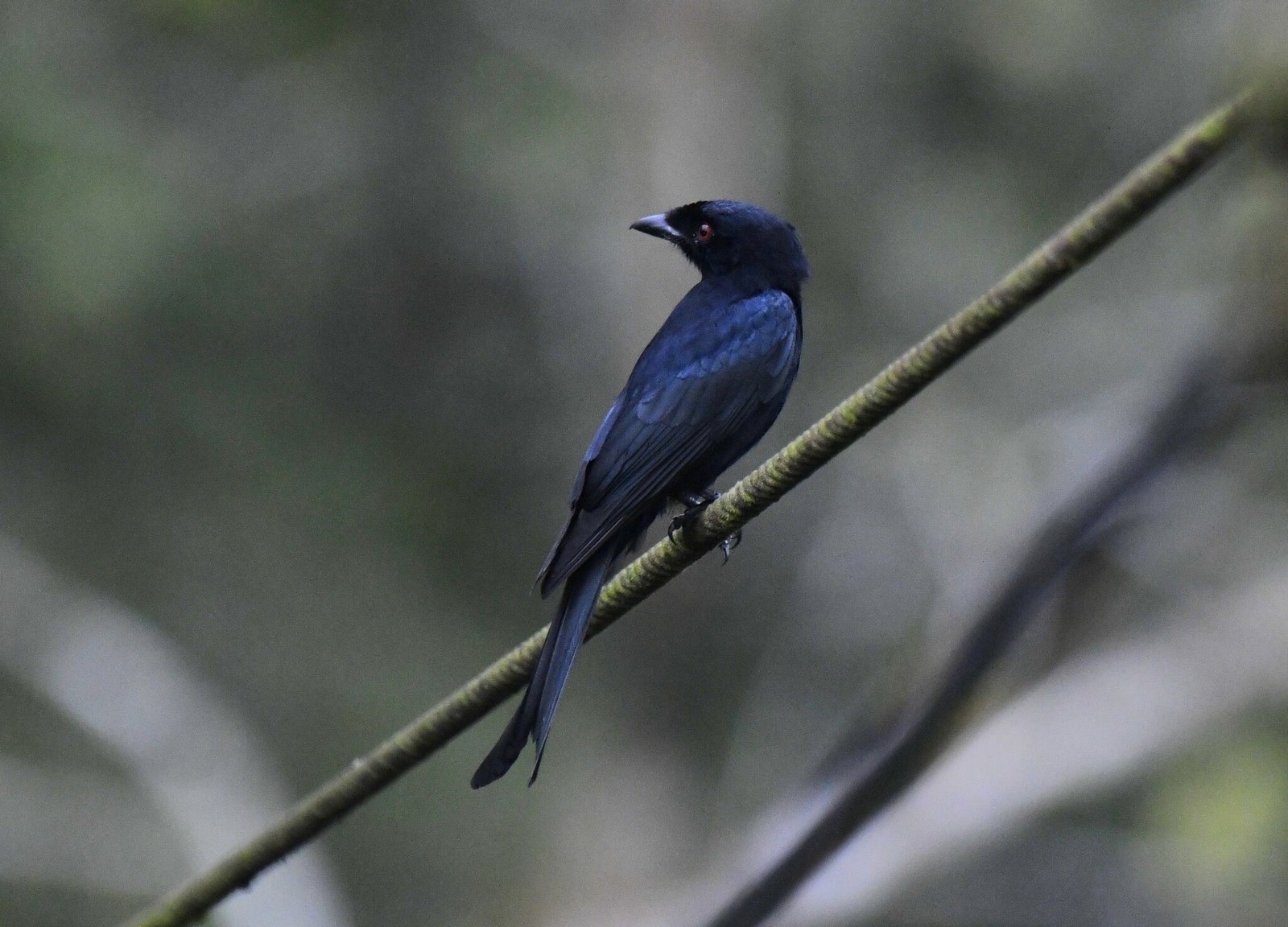
Velvet-Mantled Drongo is a large, strongly glossed drongo of the West and Central African rainforest, which within our region only occurs in northern Angola. It resembles Fork-Tailed Drongo, but sits high in the canopy along forest edges and clearings and shows a striking contrast between a matt mantle and glossy wings.
Voice
A varied repertoire of hard, metallic and nasal calls, whistles and scratchy chattering, such as cheek-chwerrr; less mimicry than Fork-Tailed Drongo but similar in tone. It often sings at dusk and dawn.
Recording: Matthew L. Brady — CC BY-NC-SA 4.0 · converted to mono · xeno-canto
Identification
24–26 cm. Black with a strong steel-blue gloss on the head, breast, wings and tail; the mantle is velvety matt black and contrasts clearly with it. The tail is long and deeply forked, with outcurved tips. The eye is red, the bill black and strong. The sexes are alike. Juveniles are duller, with less contrast on the back, pale fringes below and a dark eye. It perches high and in the open on dead branches at the forest edge and sallies from there after insects.
Confusion species
Fork-Tailed Drongo Dicrurus adsimilis is slightly smaller, lacks the contrast between matt mantle and glossy wings, shows a pale wing panel in flight and lives in open woodland; both may occur in transition zones. Sharpe's Drongo Dicrurus sharpei and Square-Tailed Drongo Dicrurus ludwigii are much smaller, with a square tail, and keep to the mid-stratum. The male Purple-Throated Cuckooshrike Campephaga quiscalina has a rounded tail.
Habitat
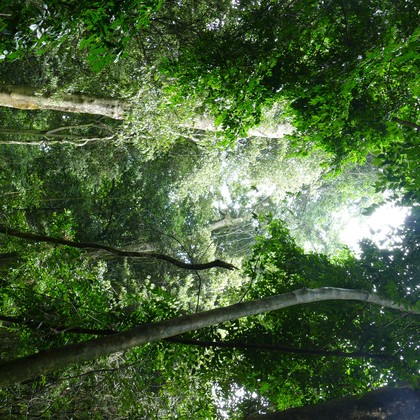
The canopy and edges of humid lowland and escarpment forest, forest clearings, secondary forest, gallery forest and old plantations under shade trees. It chooses high, bare lookouts and hunts flying insects from there, sometimes in mixed canopy parties.
Where the bird is most at home, classified by the vegetation units of southern Africa.

Range and movements
Within the region only in northern Angola: Cabinda and the forests of the north-western interior and the escarpment zone. Outside the region from Nigeria and the Cameroon highlands through the Congo Basin to Uganda and western Kenya, with a separate subspecies on the islands of the Gulf of Guinea.
- Resident
- dark = core range, pale = thinly spread
How and when to look
Year-round in the forests of Cabinda and north-western Angola. Scan tall dead trees along forest edges and clearings; a drongo perched high and in the open there, in forest country, with a matt back and glossy wings, is probably this species.
Conservation status
Not threatened; widespread and fairly common in the Central African rainforest. The species tolerates some disturbance and uses secondary forest and plantations, but in Angola it is confined to the shrinking forest area in the north.
Scientific name
Dicrurus modestus | Hartlaub, 1849
Hartlaub described the species in 1849 and placed it straight away in the genus where it still stands. The genus Dicrurus was introduced in 1816 by Vieillot. Dicrurus comes from the Greek dikros, 'forked', and oura, 'tail' — for the forked tail of most drongos. modestus is Latin for 'modest, plain', for the unremarkable, uniformly black plumage. The specimen the first description was based on came from Príncipe (São Tomé and Príncipe).