All species › Tubenoses › Petrels and shearwaters › White-Chinned Petrel
White-Chinned Petrel | Procellaria aequinoctialis
Witkinstormvogel | Fardela Negra Grande
The White-Chinned Petrel is the large, blackish-brown petrel that most often follows trawlers and longliners in southern Africa. The small white chin patch is usually visible only at close range; the pale bill catches the eye first.

Voice
Behind ships a fast, dry rattling chatter, tititititi, in squabbles over food; this clattering earned it the nickname 'Shoemaker'. At the colony moaning and rattling calls from the burrows.
Recording: Kevin Guille — CC BY-NC-SA 4.0 · converted to mono · xeno-canto
Identification
51–58 cm, large and heavily built, with long wings and a short, wedge-shaped tail. Wholly dark blackish-brown, including the underwing, where the flight feathers sometimes show a silvery sheen from below. The chin has a white patch of variable size, from almost absent to a broad band extending onto the cheeks. The heavy bill is ivory to pale greenish-yellow with dark lines between the horny plates; the legs are black. Sexes and ages are alike. It flies with slow, stiff wingbeats and long glides, arcing high in strong wind.
Confusion species
Spectacled Petrel (Procellaria conspicillata) has a white 'spectacle' around the eyes and across the forecrown; White-Chinned Petrels with much white on the head can resemble it, but their white is on the chin and throat. Flesh-Footed Shearwater Ardenna carneipes is slimmer, with a pink bill with a dark tip and pink feet. Sooty Shearwater Ardenna grisea has a silvery underwing and a thin dark bill. Great-Winged Petrel Pterodroma macroptera has a short, all-black bill and a greyish face. Young giant petrels, such as Northern Giant Petrel Macronectes halli, are much larger with a massive bill.
Habitat
Open ocean over and beyond the continental shelf, in cold and temperate waters; the commonest large petrel in the Benguela Current. It takes squid, fish and krill from the surface or by dives of more than ten metres, and much offal from fishing vessels. It breeds in burrows in boggy, vegetated ground on subantarctic islands.
Where the bird is most at home, classified by the vegetation units of southern Africa.
Range and movements
Breeds on Marion and Prince Edward Islands. Common all year off the Western Cape and along the west coast to Namibia and in smaller numbers Angola; less common along the south and east coasts, to KwaZulu-Natal and southern Mozambique. It also breeds circumpolarly on South Georgia, the Falklands, Crozet, Kerguelen and the Auckland, Campbell and Antipodes Islands, wandering north in winter into the subtropics, and beyond the tropic in the Humboldt and Benguela Currents.
- Resident
- dark = core range, pale = thinly spread
How and when to look
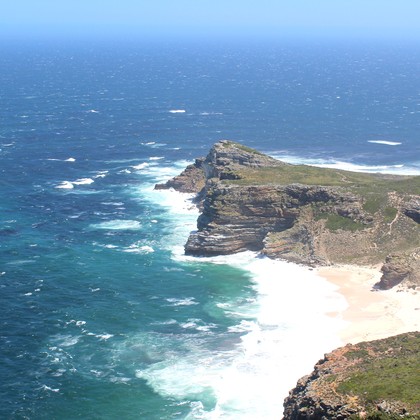
Present on almost every pelagic trip from Cape Town or Simon's Town, often in large numbers behind trawlers. Regularly seen from shore at Cape Point in strong wind. Check birds with much white on the head carefully: rare Spectacled Petrels mix in with them.
Conservation status
Vulnerable. The species is among the seabirds most often killed as bycatch in longline and trawl fisheries, including in South African waters, and the population has declined as a result. Introduced rats and cats on breeding islands and loss of breeding ground through trampling are additional threats. Measures such as bird-scaring lines and night setting of longlines reduce bycatch.
Scientific name
Procellaria aequinoctialis | Linnaeus, 1758
Linnaeus described the species in 1758 and placed it straight away in the genus where it still stands. He introduced the genus Procellaria in that same work. Procellaria comes from the Latin procella, 'storm' — sailors associated petrels with stormy weather at sea. aequinoctialis is Latin for 'of the equinox', i.e. the equatorial belt; Linnaeus believed the bird lived in those regions. The specimen the first description was based on came from Cape of Good Hope.