All species › Tubenoses › Petrels and shearwaters › Grey Petrel
Grey Petrel | Procellaria cinerea
Bruine stormvogel | Fardela Gris
The Grey Petrel is a large grey-and-white petrel with a dark underwing that plunges into the sea from several metres like a gannet and swims after squid underwater. Unusually for a subantarctic petrel, it breeds in the southern winter.

Voice
Silent at sea. At the colony at night a low, moaning, plaintive ooo-ah and clacking sounds from the burrow.
Recording: Derren Fox — CC BY-NC-SA 4.0 · converted to mono · xeno-canto
Identification
48–50 cm, bulky, with a powerful bill and a short, wedge-shaped tail. The upperparts are uniform ash-grey, slightly browner on wings and tail; the head is grey down to below the eye, so the bird appears to wear a dark cap. Throat, breast and belly are bright white. The underwing and undertail coverts are dark grey and contrast strongly with the white belly. The bill is pale green to yellowish with dark plates; the legs are pinkish-grey. Sexes and ages are alike. It flies with stiff, rapid wingbeats and long glides, arcing high in strong wind.
Confusion species
Great Shearwater (Ardenna gravis) has a sharply defined black cap with a white collar, a white band across the rump and a largely white underwing. Soft-Plumaged Petrel Pterodroma mollis is smaller, with a short black bill and a grey breast band. Scopoli's Shearwater Calonectris diomedea is browner, with a white underwing and a pale yellow bill. White-Headed Petrel Pterodroma lessonii has a white head and a white tail.
Habitat
Cold and temperate oceanic waters south of the subtropical convergence, usually over deep water beyond the continental shelf. It feeds mainly on squid and fish, taken by plunge-diving and underwater pursuit; it follows longliners and is therefore vulnerable to bycatch. It breeds in burrows on vegetated slopes of subantarctic islands.
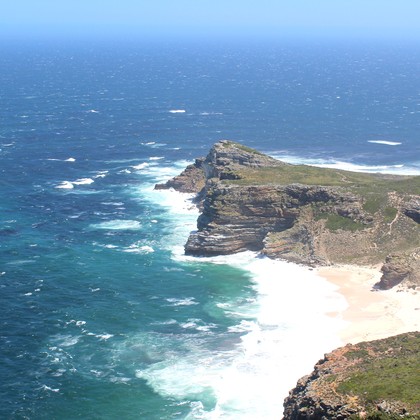
Where the bird is most at home, classified by the vegetation units of southern Africa.
Range and movements
Breeds on Marion and Prince Edward Islands, with chicks in the nest from April to November. Off the mainland a scarce winter visitor, mainly over deep water far off the Western Cape and along the shelf edge; rarely farther east along the south coast. It also breeds on Tristan da Cunha and Gough, Crozet, Kerguelen, and the Campbell and Antipodes Islands, ranging circumpolarly between about 30° and 60°S.
How and when to look
The best chance is on deep-water trips out of Cape Town in winter, when the boat goes beyond the shelf edge. It follows ships less persistently than White-Chinned Petrel, but watch for a grey petrel with a dark underwing diving into the wake from a height.
Conservation status
Near Threatened. Large numbers drown as bycatch on longlines, especially during the winter breeding season; introduced cats and rats on breeding islands have also greatly reduced populations. Following the eradication of cats on Marion the breeding population there is slowly recovering.
Scientific name
Procellaria cinerea | Gmelin, 1789
Gmelin described the species in 1789 and placed it straight away in the genus where it still stands. The genus Procellaria was introduced in 1758 by Linnaeus. Procellaria comes from the Latin procella, 'storm' — sailors associated petrels with stormy weather at sea. cinerea is Latin for 'ash-grey' — for the grey upperparts. The specimen the first description was based on came from New Zealand seas, 48° S.