All species › Tubenoses › Petrels and shearwaters › South Georgia Diving Petrel
South Georgia Diving Petrel | Pelecanoides georgicus
Zuid-Georgisch alkstormvogeltje | Potoyunco de Georgia del Sur
The South Georgia Diving Petrel is a small, stocky black-and-white seabird that, like an auk, uses its wings to fly underwater. It is the slightly smaller and barely separable twin of the Common Diving Petrel. In the region it breeds only on the Prince Edward Islands, and on Marion it has slowly been returning since the cats were removed.

Voice
Usually silent at sea. At the colonies at night it gives plaintive mewing calls and series of squeaky notes, also in flight, which sound different from the calls of Common Diving Petrel.
Recording: Johannes Fischer — CC BY-NC-SA 4.0 · xeno-canto
Identification
About 19 cm, a little smaller than Common Diving Petrel and built the same way: bullet-shaped, with a short neck, short narrow wings and a short tail. The upperparts are glossy black, the underparts white. Chin and throat are clean white, with just a grey patch on the side of the neck forming a partial collar. White tips to the secondaries give the wing a narrow pale trailing edge, and whitish tips to the scapulars form a pale line along the back. The underwing is white with pale grey flight feathers. The short bill is broad at the base, black with pale blue edges. The legs are blue with a black line down the back of the tarsus. The sexes are alike. It whirrs low over the sea, plunges into a wave without hesitating and bursts out again further on, still flying.
Confusion species
Common Diving Petrel (Pelecanoides urinatrix) also breeds on the Prince Edward Islands and looks very much the same. It averages larger and has a narrower bill with more parallel sides. It shows a more extensive grey wash across the neck and sides of the breast and a greyer underwing, and the pale trailing edge and scapular line are absent or faint. At sea the two are almost impossible to tell apart, and only sharp photographs of bill and wings offer much to go on. On land the breeding site helps: Common Diving Petrel digs into peaty, vegetated slopes near the shore, this species into bare cinder slopes high up. Storm petrels flutter above the water instead of diving into it, and prions are blue-grey with a dark M across the wings.
Habitat
Cold subantarctic seas around the breeding islands, where most birds stay outside the breeding season as well. It hunts by diving, using its wings as flippers and its feet and tail to steer, usually to about 20 m and occasionally to nearly 50 m. It feeds mainly on krill and other small crustaceans, along with small fish and young squid. It nests colonially in self-dug burrows more than a metre long in loose cinder and scree, high on slopes above the vegetation line. The single white egg is incubated for about seven weeks, and the chick fledges after six to eight weeks. Birds visit the colonies only at night.
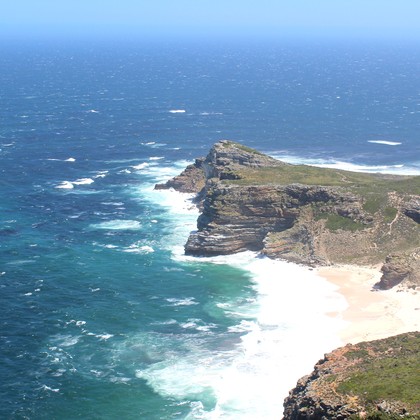
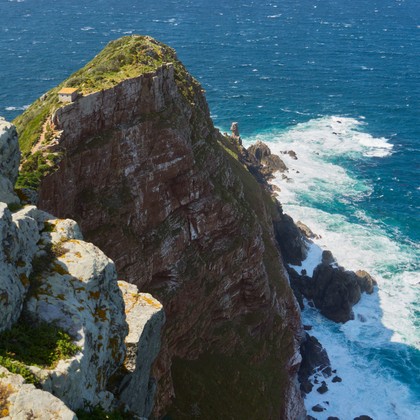
Where the bird is most at home, classified by the vegetation units of southern Africa.
Range and movements
Breeds on subantarctic islands in the southern Atlantic and Indian Oceans: South Georgia, the Prince Edward Islands, Crozet, Kerguelen and Heard. Vagrants have reached the Falklands and south-eastern Australia. In the region it breeds only on the Prince Edward Islands. On Marion it was still common in 1948, but cats were released soon afterwards to control the mice and the population collapsed: by 1979 only 44 burrows could be found. The last cat was caught in 1991. In 2011 breeding was confirmed for the first time in 32 years, and since then a small number of pairs has been nesting there again. Prince Edward Island has never had introduced predators; an undisturbed population is presumed to breed there, but its size is unknown.
How and when to look
This is a bird for ships around the Prince Edward Islands or for researchers on Marion. A diving petrel at sea usually cannot be named to species, so photograph flying birds from above and below whenever you can. Look for a pale trailing edge to the wing, a pale scapular line and a white underwing. On Marion, a burrow high on a bare cinder slope, far from the shore, points to this species rather than to Common Diving Petrel.
Conservation status
Not threatened (IUCN: Least Concern); the world population is large. South Africa's regional Red List, however, classes it as of conservation concern with a declining trend, because the national breeding population is small. Introduced cats and rats have damaged colonies on several islands. On Marion the house mouse still threatens eggs and chicks in the burrow, and a project is under way to rid the island of mice as well.
Scientific name
Pelecanoides georgicus | Murphy & Harper, 1916
Murphy & Harper described the species in 1916 and placed it straight away in the genus where it still stands. The genus Pelecanoides was introduced in 1799 by De Lacépède. Pelecanoides means 'pelican-like', from the Greek pelekan, 'pelican', and -oidēs, 'resembling' — for the expandable throat pouch in which these birds carry food to their young. georgicus is Latin for 'of Georgia' — after South Georgia, the island in the southern Atlantic where the species was discovered and where its type locality lies. The specimen the first description was based on came from Cumberland Bay, South Georgia.