All species › Passerines › Fairy flycatchers › White-Tailed Blue Flycatcher
White-Tailed Blue Flycatcher | Elminia albicauda
Witstaartkuifvliegenvanger | Elminia Blanquiazul
The White-Tailed Blue Flycatcher is a dark slate-blue bird with a crest and a long tail whose white outer feathers flash when it is spread. It is a species of gallery forest and dense cover in the miombo belt of Angola, Zambia and northern Malawi.

Voice
A high, rapid, chirping song, tsee-tsi-tsi-tsweee, mixed with soft trills. The contact call is a dry tsik or chit, often repeated. It calls a lot while foraging and in mixed flocks.
Recording: Catriona Leven — CC BY-NC-SA 4.0 · converted to mono · xeno-canto
Identification
14–15 cm, with a long tail. Dark slate-grey above with a blue gloss, strongest on the head and mantle; the short crest is often raised. Throat and breast are blue-grey, the belly dull white. The tail is black with much white in the outer feathers and white tips, obvious when it is fanned. The lores are blackish. Bill and legs are black. Sexes alike; juveniles are browner and lack the gloss. It moves restlessly with drooped wings and a fanning tail.
Confusion species
African Blue Flycatcher Elminia longicauda of northern Angola is much paler, bright turquoise-blue, with no white in the tail. White-Tailed Crested Flycatcher Elminia albonotata of the eastern mountains is greyer, with a blackish head and throat contrasting sharply with a white belly, and lives in higher montane forest. Blue-Mantled Crested Flycatcher Trochocercus cyanomelas has a black head and a white belly without white in the tail.
Habitat
Gallery forest and dense riverine growth along streams in miombo, edges of dry forest, montane forest and forest patches at middle altitudes, from about 900 to over 2000 metres. It forages at mid-levels and often joins mixed flocks of insectivorous birds.
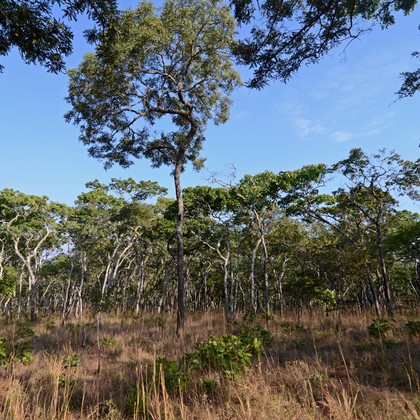
Where the bird is most at home, classified by the vegetation units of southern Africa.


Range and movements
Within the area in the central and eastern highlands of Angola, northern and north-western Zambia (including Mwinilunga, the Copperbelt and the north-east) and northern Malawi (Misuku, Nyika, Viphya). Beyond, in southern DR Congo and western and south-western Tanzania.
- Resident
- dark = core range, pale = thinly spread
How and when to look
Search the gallery forests of Mwinilunga and the forest edges on the Nyika Plateau. Watch for a dark, restless bird that spreads its tail to show white, and follow the chirping calls. It often joins roving mixed flocks, so stay with such a flock.
Conservation status
Not threatened; locally common within a fairly large range. Clearing of gallery forest and riverine growth can remove habitat locally, but there is no clear decline.
Scientific name
Elminia albicauda | Bocage, 1877
Bocage described the species in 1877 and placed it straight away in the genus where it still stands. The genus Elminia was introduced in 1854 by Bonaparte. Elminia is named after St Georges d'Elmina, a port on the former Dutch Gold Coast (present-day Ghana). albicauda is Latin for 'white-tailed', from albus, 'white', and cauda, 'tail' — for the largely white outer tail feathers. The specimen the first description was based on came from Caconda, Angola.