All species › Passerines › Fairy flycatchers › African Blue Flycatcher
African Blue Flycatcher | Elminia longicauda
Turkooiskuifvliegenvanger | Elminia Azul
The African Blue Flycatcher is a small, bright sky-blue bird with a long, graduated tail that it constantly fans and swings from side to side. It is a widespread species of West and Central Africa that reaches only northern Angola within the area covered.

Voice
A lively, chirping and whistled song of short, high notes, tsee-tsee-tsweee, often in a quick series. The contact call is a sharp tsip. Pairs and family parties call a lot and so give themselves away in the foliage.
Recording: Jonathan Onongo — CC BY-NC-SA 4.0 · converted to mono · xeno-canto
Identification
14–17 cm, over half of it tail. Almost entirely pale azure to turquoise-blue, slightly deeper above, with a short crest that is often raised. The lores are black, forming a narrow dark line in front of the eye. Belly and undertail coverts are whitish. The long graduated tail is blue with dark shafts and is repeatedly fanned as the bird darts through the canopy with drooped wings. Bill and legs are black. Sexes alike; juveniles are duller and greyer.
Confusion species
White-Tailed Blue Flycatcher Elminia albicauda is darker slate-blue, with much white in the outer tail feathers and greyer underparts; the two barely meet in Angola. African Paradise Flycatcher Terpsiphone viridis is larger, with a black head, a rufous or white back and, in the male, very long central tail feathers. Ashy Flycatcher Fraseria caerulescens is dull grey, without a crest and with a short tail.
Habitat
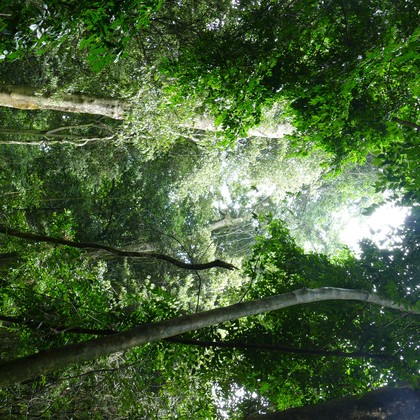
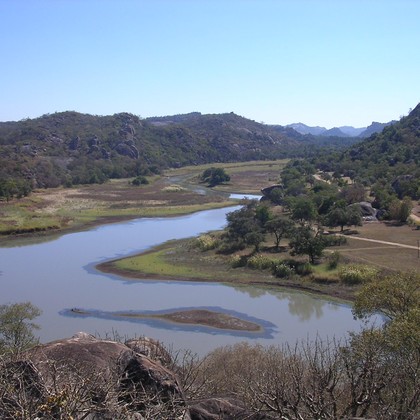
Forest edge, clearings in forest, gallery forest along rivers, old plantations and gardens with tall trees, and well-wooded savanna. It forages in the middle and upper canopy and takes insects in short, fluttering sallies.
Where the bird is most at home, classified by the vegetation units of southern Africa.

Range and movements
Within the area confined to northern and north-western Angola, from Cabinda and Zaire and Uíge provinces south to Cuanza Norte and Malanje, and east into Lunda. Beyond, from Senegal east through West and Central Africa to Uganda, western Kenya and north-western Tanzania.
- Resident
- dark = core range, pale = thinly spread
How and when to look
Search forest edges and well-wooded village gardens in northern Angola, for example around Uíge and Kalandula. Watch for a flash of blue and a tail fanned sideways; the bird rarely sits still for long. Its calls are the best clue.
Conservation status
Not threatened; widespread and common in suitable habitat. The species tolerates disturbed forest, plantations and gardens well. Little is known about numbers in Angola, but there is no evidence of decline.
Scientific name
Elminia longicauda | (Swainson, 1838)
Swainson described the species in 1838 as Myiagra longicauda; because it was later moved to another genus, the author and year stand in brackets. The genus Elminia was introduced in 1854 by Bonaparte. Elminia is named after St Georges d'Elmina, a port on the former Dutch Gold Coast (present-day Ghana). longicauda is Latin for 'long-tailed', from longus, 'long', and cauda, 'tail'. The specimen the first description was based on came from Senegal (originally given in error as 'New Holland').