All species › Passerines › Spotted creepers › African Spotted Creeper
African Spotted Creeper | Salpornis salvadori
Afrikaanse gevlekte boomkruiper | Agateador Moteado Africano
The African Spotted Creeper is a small, densely spotted trunk-climber of open broadleaved woodland, and the only member of its family in the region. It creeps up trunks and thick branches in jerky hops, spiralling round as it goes, and its cryptic plumage makes it hard to pick out against the bark.

Voice
Inconspicuous. A high, thin, sibilant tsee-tsee-tsee as a contact call, and a song of a few thin, descending whistles, sweepy-swee-swee-swee, easily lost against the background noise of the woodland.
Recording: Dries Van de Loock — CC BY-NC-SA 4.0 · converted to mono · xeno-canto
Identification
15 cm. The upperparts are dark greyish brown, densely speckled and barred with white and buff; the underparts are dirty white to pale buff with fine dark bars and spots. A pale supercilium and a dark eye-stripe mark the head. The bill is long, thin, pointed and clearly decurved. The wings are chequered white and blackish brown, giving a striking barred pattern in flight. The tail is fairly short, barred and not stiffened; the bird does not use it as a prop when climbing. The sexes are alike; juveniles are slightly duller and less crisply marked.
Confusion species
Cardinal Woodpecker Dendropicos fuscescens also climbs trunks, but has a straight, chisel-shaped bill, a stiff tail used as a prop and streaked rather than spotted underparts. Common Scimitarbill Rhinopomastus cyanomelas also has a strongly curved bill and forages on bark, but is larger, glossy black and long-tailed. No other creeper occurs in the region; the spiralling climb and the flight to the base of the next tree are distinctive.
Habitat
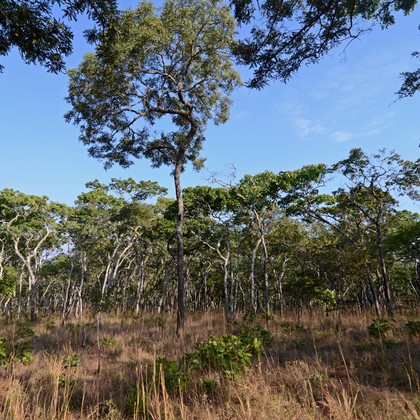
Open broadleaved woodland, especially miombo with Brachystegia and Julbernardia, also other tall dry deciduous woodland and at times mango orchards, roughly between 900 and 1800 m. It searches bark crevices for insects, spiders and larvae. The nest is a shallow cup on a horizontal branch, often in a fork, camouflaged with lichen, spider egg sacs and caterpillar droppings so that it resembles a knot.
Where the bird is most at home, classified by the vegetation units of southern Africa.

Range and movements
In the region in the north-east: on the central Angolan plateau, scattered through Zambia and Malawi, in western and central Mozambique, and in Zimbabwe on the Mashonaland Plateau and along the Zambezi Escarpment (subspecies xylodromus). Absent from Namibia, Botswana and South Africa. Beyond the region patchily from West Africa to the Ethiopian highlands and through Uganda, Kenya and Tanzania.
- Resident
- dark = core range, pale = thinly spread
How and when to look
All year, but scarce and easily overlooked. Walk slowly through miombo and watch for any small speckled bird creeping jerkily up a trunk; it often joins mixed foraging parties with tits, tchagras and flycatchers. When it flies off it nearly always lands low on the trunk of the next tree.
Conservation status
Not threatened, but scarce and local throughout the region. It depends on mature miombo with tall trees and declines where this woodland is cleared for firewood, charcoal and cultivation.
Scientific name
Salpornis salvadori | (Bocage, 1878)
Bocage described the species in 1878 as Hylypsornis salvadori; because it was later moved to another genus, the author and year stand in brackets. The genus Salpornis was introduced in 1847 by Gray. Salpornis is formed from the Greek salpinktēs, an ancient bird name interpreted as 'wren', and ornis, 'bird'. salvadori honours the Italian ornithologist Tommaso Salvadori (1835–1923). The specimen the first description was based on came from Caconda, Huíla Province, Angola.