All species › Passerines › Batises and wattle-eyes › Yellow-Bellied Wattle-Eye
Yellow-Bellied Wattle-Eye | Platysteira concreta
Geelbuiklelvliegenvanger | Batis Carunculado Ventrigualdo
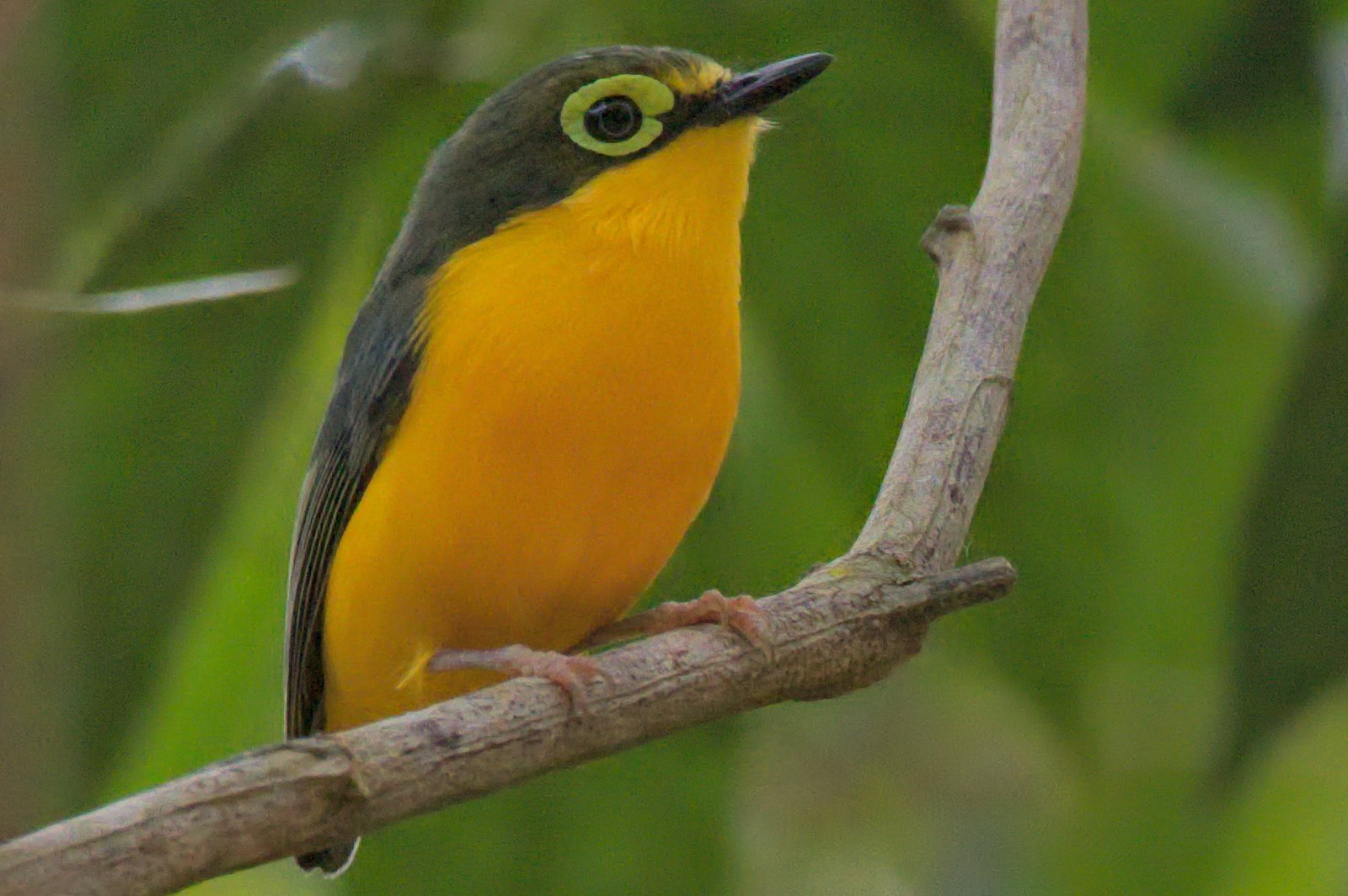
The Yellow-Bellied Wattle-Eye is a tiny, short-tailed wattle-eye of the understorey of moist forest, with a large pale green wattle around the eye. Within the region only the Angolan form occurs, on the forested escarpment of western Angola, where it is one of the sought-after specialities of Kumbira and Gabela.
Voice
A series of clear, rapidly repeated whistles, sometimes with a rattling or croaking element, and hard clicks and whirring wing noises in flight. Often hard to pinpoint in dense cover.
Recording: isaac kilusu — CC BY-NC-SA 4.0 · converted to mono · xeno-canto
Identification
9–10 cm, compact with a very short tail. The upperparts are dark olive-green with a darker head, the underparts bright yellow. In the Angolan form the throat and breast have a chestnut to orange-rufous tone, more extensive in the female than in the male. A large pale green to bluish-green wattle surrounds the eye and shows well in the gloom. Juveniles are duller, with a smaller wattle.
Confusion species
Chestnut Wattle-Eye Dyaphorophyia castanea is equally compact but black, grey, white and chestnut with no yellow, and has a purple wattle. Other wattle-eyes such as Brown-Throated Wattle-Eye Platysteira cyanea are black and white with a red wattle and a longer tail. Green Hylia Hylia prasina is also green but has a long yellow supercilium and no wattle.
Habitat
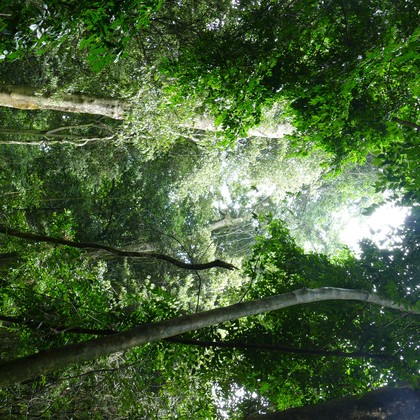
The understorey and lower strata of moist evergreen forest, especially dense, shady forest in ravines and along streams on the escarpment, and also forest with old shade coffee where the undergrowth is intact. It forages for insects, usually alone or in pairs, sometimes in mixed flocks.
Where the bird is most at home, classified by the vegetation units of southern Africa.

Range and movements
Within the region only in western Angola, on the escarpment of Cuanza Sul around Gabela and Kumbira and locally in Cuanza Norte. Beyond it very patchily in the rainforest of West and Central Africa, from Sierra Leone to the Albertine Rift and western Tanzania.
- Resident
- dark = core range, pale = thinly spread
How and when to look
Year-round. Kumbira Forest near Conda is the best site. Walk slowly through dense forest and listen for the whistled series and wing-whirring; the bird sits low and still, and the green eye wattle is often the first thing to catch the eye.
Conservation status
Not threatened; the IUCN lists it under the older name Dyaphorophyia concreta. The species is scarce and patchy throughout its range. In Angola the escarpment forest has declined sharply through clearance for farming and charcoal and the removal of undergrowth in coffee plantations, leaving the local population vulnerable.
Scientific name
Platysteira concreta | Hartlaub, 1855
Hartlaub described the species in 1855 as Platystira concreta; because it was later moved to another genus, the author and year stand in brackets. The genus Platysteira was introduced in 1830 by Jardine & Selby. Platysteira comes from the Greek platus, 'broad', and steira, 'ship's keel' — for the broad, flattened bill. concreta is Modern Latin for 'large, sturdy, strong', from the Latin concretus, 'hard, thickened' (from concrescere, 'to grow'). The specimen the first description was based on came from Guinea (West Africa); later restricted to Ghana.