All species › Gamebirds › Pheasants and partridges › White-Throated Francolin
White-Throated Francolin | Campocolinus albogularis
Witkeelfrankolijn | Francolín Gorjiblanco
The White-Throated Francolin is a small, little-known francolin that occurs in the region only in western Zambia and eastern Angola. It is one of the specialities of the Kalahari sands and the grassy plains of the upper Zambezi.

Voice
A harsh, crowing kerr-kik, kerr-kik in series, mainly in the early morning and evening, recalling the territorial song of Coqui Francolin but higher and scratchier. When disturbed a sharp chik.
Recording: selvino — CC BY-NC-SA 3.0 · converted to mono · xeno-canto
Identification
20–24 cm, small and compact, with yellow legs and a black bill with a yellow base. The male has a white throat, a pale eyebrow and a dark eye-stripe, plain orange-buff to rusty-buff breast and belly without barring, and rufous-brown upperparts spotted and streaked with black and grey. The female has the same white throat, but black-and-white barred breast and flanks, so that she closely resembles the female Coqui Francolin. In flight the rufous primaries stand out.
Confusion species
Coqui Francolin Campocolinus coqui is the main confusion risk: the male has a plain orange-yellow head without a white throat and entirely black-and-white barred underparts; the female has a narrow black line around the white throat, which is weaker or absent in White-throated. Shelley's Francolin Scleroptila shelleyi and Red-Winged Francolin Scleroptila levaillantii are larger, with a black throat surround and heavily marked underparts.
Habitat
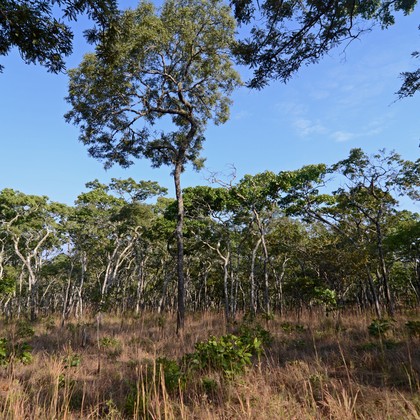
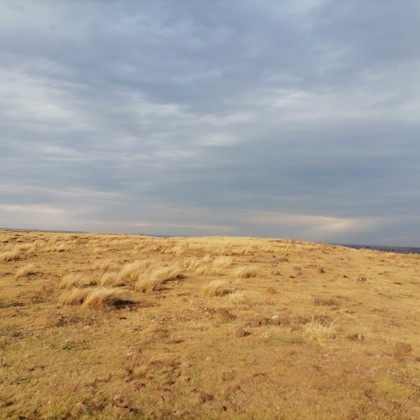
Open miombo and Kalahari woodland on sandy soils with a dense grass layer, grassy clearings, dambo edges and recently burnt ground. It forages in pairs or small groups on the ground for seeds, young shoots and insects, and crouches in the grass when threatened.
Where the bird is most at home, classified by the vegetation units of southern Africa.
Range and movements
In the region restricted to western and north-western Zambia, including around Liuwa Plain, Kafue and the upper Zambezi, and to eastern Angola. Beyond the region in southern DR Congo and in a separate belt in West Africa, from Senegal to Cameroon.
How and when to look
The best chances are in western Zambia at the transition from grassy plain to woodland, for example around Liuwa Plain and in the west of Kafue National Park. Arrive early in the morning and listen for calling birds; in the late rainy season and after fires they are most often seen on the ground.
Conservation status
Not threatened, but poorly known and local in the region. Fire, grazing and conversion to cropland may have local effects, and it is hunted. The lack of field data makes the trend uncertain.
Scientific name
Campocolinus albogularis | (Hartlaub, 1854)
Hartlaub described the species in 1854 as Francolinus albogularis; because it was later moved to another genus, the author and year stand in brackets. The genus Campocolinus was introduced in 2020 by Crowe, Mandiwana-Neudani, Donsker, Bowie & Little. Campocolinus was coined in 2020 from campo, 'savanna', and colinus, 'quail' — 'savanna quail', for these small francolins of open grassland. albogularis comes from the Latin albus, 'white', and gula, 'throat', for the white throat. The specimen the first description was based on came from Gambia.