All species › Gamebirds › Pheasants and partridges › Coqui Francolin
Coqui Francolin | Campocolinus coqui
Coquifrankolijn | Francolín Coqui
The Coqui Francolin is a small, secretive francolin of grassy woodland, named after the male's two-syllabled call. It is heard far more often than seen: when disturbed it crouches in the grass and flushes only at the last moment.

Voice
The male calls a clear, two-syllabled ko-kee, ko-kee, often repeated at length; the territorial song is a louder, rising kerr-aak, kerr-aak, ka-ka-ka-ka that fades at the end. It calls mainly in the early morning and evening, and during the day in the breeding season.
Recording: Rick Nuttall — CC BY-NC-SA 4.0 · converted to mono · xeno-canto
Identification
25–28 cm, small and compact, with short yellow legs. The male has a plain orange-brown to ochre-yellow head and neck without pattern, with a slightly darker crown, and densely black-and-white barred breast and belly; the upperparts are rufous-brown with grey and black vermiculation and pale shaft-streaks. The female has a white eyebrow, a white throat bordered by a narrow black line, a black stripe through the eye, a pinkish grey-brown breast and a barred belly. In flight the rufous primaries stand out. The bill is black with a yellow base.
Confusion species
The male White-Throated Francolin Campocolinus albogularis has a white throat and plain orange-buff underparts without black barring. Crested Francolin Ortygornis sephaena is larger, with a dark cap, a white eyebrow, a dark tail held cocked and red legs. Shelley's Francolin Scleroptila shelleyi is larger, with a black-and-white framed throat and black blotches on the belly. Harlequin Quail Coturnix delegorguei is much smaller, with a black breast and a black-and-white striped head.
Habitat
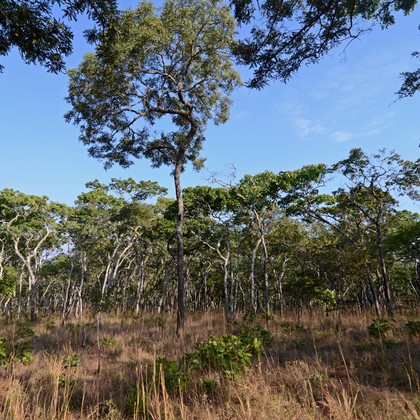
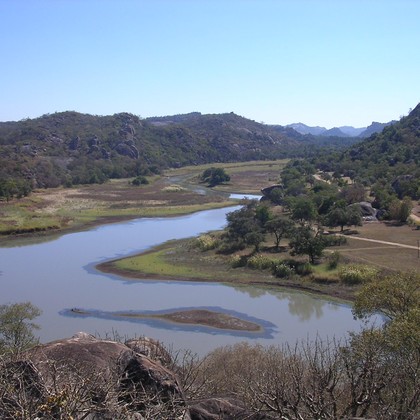
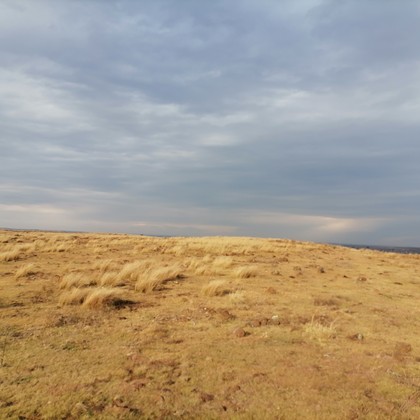
Open woodland with a dense grass layer: miombo, mixed broadleaf woodland, grassy savanna and the transition to grassland, often on sandy soils and on recently burnt ground where the grass is resprouting. It forages in pairs or small family groups on the ground for seeds, bulbs, termites and other insects.
Where the bird is most at home, classified by the vegetation units of southern Africa.
Range and movements
In the north and east of the region: Angola, Zambia, Malawi, Mozambique and Zimbabwe, and also northern Botswana, the Caprivi and Kavango strip of Namibia, Eswatini and north-eastern South Africa in Limpopo, Mpumalanga, Gauteng, North West and KwaZulu-Natal. Beyond the region across much of sub-Saharan Africa, from Nigeria and Kenya to Tanzania.
- Resident
- Summer visitor (c. Oct–Mar)
- Winter visitor (c. Apr–Sep)
- Passage (Mar–Apr, Oct–Nov)
- dark = core range, pale = thinly spread
How and when to look
Listen in the early morning in the rainy season for the ko-kee; the bird often calls from a termite mound or a fallen log. Drive slowly along woodland tracks with short grass or recently burnt strips, where pairs dash briefly across the road. Walking through the grass often flushes them right at your feet.
Conservation status
Not threatened and common over most of its range. Locally reduced by conversion of woodland to cropland, overgrazing and too frequent burning. It is hunted as small game.
Scientific name
Campocolinus coqui | (Smith, 1836)
Smith described the species in 1836 as Perdix Coqui; because it was later moved to another genus, the author and year stand in brackets. The genus Campocolinus was introduced in 2020 by Crowe, Mandiwana-Neudani, Donsker, Bowie & Little. Campocolinus was coined in 2020 from campo, 'savanna', and colinus, 'quail' — 'savanna quail', for these small francolins of open grassland. coqui is an onomatopoeic name that Andrew Smith (1836) adopted from the local people; Clinning (1989) suggested it honours a Mr Coqui of the eastern Cape frontier, but the form of the name argues against this. The specimen the first description was based on came from near Kurrichane, Transvaal (South Africa).