All species › Gamebirds › Guineafowl › Helmeted Guineafowl
Helmeted Guineafowl | Numida meleagris
Helmparelhoen | Pintada Común
The Helmeted Guineafowl is the commonest gamebird of the open plains and farmland of southern Africa, with slate-grey plumage densely spangled with white and a bare blue and red head carrying a horny casque. Outside the breeding season it moves in noisy flocks of tens to hundreds of birds.

Voice
A harsh rasping kek-kek-kek-kaaa and a two-syllable rattling kerrek-kerrek from the female. When disturbed the flock runs off under a sustained hoarse screeching. The whole group calls in chorus at sunrise and again as it moves to the roost trees.
Recording: Kileo Jumah — CC0 · converted to mono · xeno-canto
Identification
About 55 cm, squat, with a humped back and a short drooping tail. The plumage is slate grey with dense, regular white spotting. Head and upper neck are unfeathered and blue-grey, with red wattles either side of the bill and a bony casque on the crown. The sexes are alike, though the male is slightly larger with a taller casque. Chicks are rufous-brown with dark lengthwise stripes and a feathered head. The bird prefers to run rather than fly; when pressed it rises low on whirring wings and lands again after a few tens of metres.
Confusion species
Crested Guineafowl (Guttera edouardi) of forest edge and dense thicket in the east has a black curly crest instead of a casque, a red eye and no wattles, and its white spots are ringed with blue. Otherwise no confusion is possible within the region.
Habitat
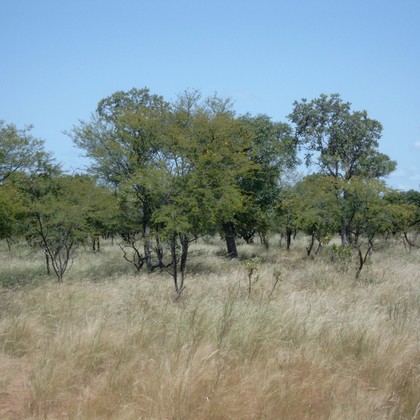
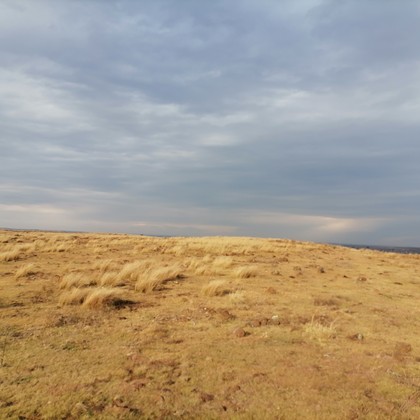
Grassland, open savanna, thornveld, fallow land, stubble fields and woodland edge. It scratches on the ground for seeds, grain, bulbs, tubers, insects and snails, and needs drinking water daily. It roosts in trees or tall bushes. Desert and closed forest are avoided.
Where the bird is most at home, classified by the vegetation units of southern Africa.
Range and movements
Found across virtually the whole region apart from the bare Namib and dense lowland forest; particularly numerous in the farming districts of South Africa, Zimbabwe, Botswana and Zambia, and also in Namibia, Mozambique, Malawi, Eswatini, Lesotho and Angola. Beyond the region it occurs across almost all of sub-Saharan Africa, and the domesticated form is kept worldwide.
- Resident
- Summer visitor (c. Oct–Mar)
- Winter visitor (c. Apr–Sep)
- Passage (Mar–Apr, Oct–Nov)
- dark = core range, pale = thinly spread
How and when to look
Early morning and late afternoon along farm tracks and grassy verges, when flocks feed in the open. Stand near a group of roost trees towards sunset and listen to the chorus as the birds fly up one by one. In the summer rains, November to March, family parties with chicks are on the move.
Conservation status
Not threatened and common. The species has benefited from the spread of grain farming and from stock watering points, which supply water in naturally dry districts. It is hunted for food and as a gamebird across much of its range; local losses come from poisoned seed grain and from traffic.
Scientific name
Numida meleagris | (Linnaeus, 1758)
Linnaeus described the species in 1758 as Phasianus Meleagris; because it was later moved to another genus, the author and year stand in brackets. The genus Numida was introduced in 1764 by Linnaeus. Numida is Latin for 'Numidian', after Numidia, the Roman province in North Africa from which the guineafowl was thought to originate. meleagris refers to the Meleagrides of Greek myth: the sisters of Meleager, who after his death were turned into guineafowl in their grief, their tears becoming the white speckles on the plumage. The specimen the first description was based on came from Nubia, upper Nile.