All species › Passerines › Bulbuls › White-Throated Greenbul
White-Throated Greenbul | Phyllastrephus albigularis
Witkeelloofbuulbuul | Bulbul Gorjiblanco
The White-Throated Greenbul is a small olive-green bulbul with a bright white throat, of the rainforests of West and Central Africa. It touches the region only in the far north of Angola; the related Angola Greenbul of north-western Angola was long treated as a subspecies of this species.

Voice
The song is a short, clear, slightly nasal phrase, chip-chip-chiweeh, often repeated; also a dry chrrr and a soft chuk as a contact call in mixed flocks.
Recording: Patrik Åberg — CC BY-NC-SA 4.0 · converted to mono · xeno-canto
Identification
15–17 cm. The crown and head are greyish olive, clearly greyer than the olive-green back; the rump and tail are slightly browner olive. The throat is pure white and sharply defined, the breast greyish olive washed yellow, the belly and undertail-coverts pale yellow. The bill is slender and dark with a paler lower mandible, the eyes brown to red-brown, the legs greyish pink. The sexes are alike; juveniles are duller and browner.
Confusion species
Angola Greenbul Phyllastrephus viridiceps has an olive-green, not grey, crown and yellower underparts, and differs in voice; in Angola it replaces this species south of the far north. Pale-Olive Greenbul Phyllastrephus fulviventris is larger and browner, with a buffy belly. Cabanis's Greenbul Phyllastrephus cabanisi is larger and longer-tailed, with a less sharply defined throat. In case of doubt, song and locality decide.
Habitat
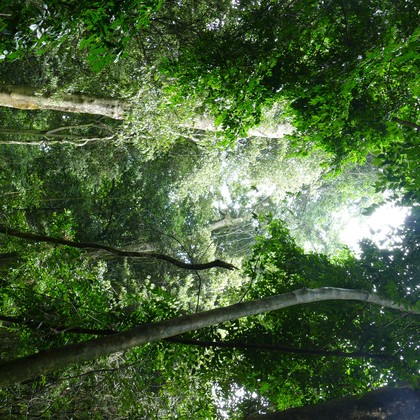
The mid-stratum and understorey of moist lowland forest, forest edge, riverine forest, old secondary forest and dense tangles in clearings. It forages actively for insects among leaves and creepers, in pairs or small groups, almost always in mixed foraging flocks.
Where the bird is most at home, classified by the vegetation units of southern Africa.

Range and movements
In the region only in the far north of Angola, mainly in Cabinda; older Angolan records further south belong largely to Angola Greenbul. Beyond the region from Senegal east through West Africa to Cameroon, Gabon, Congo-Brazzaville, DR Congo, the Central African Republic, South Sudan, Uganda and western Kenya.
How and when to look
All year. Anyone finding a mixed flock in the forests of Cabinda should look for a small greenbul with a crisp white throat and a grey crown. Record the sound and note the locality, as the boundary with Angola Greenbul is poorly known.
Conservation status
Not threatened and common over its large range. In Angola the species is barely studied; the loss of lowland forest in Cabinda to logging and farming is the main threat.
Scientific name
Phyllastrephus albigularis | (Sharpe, 1882)
Sharpe described the species in 1882 as Xenocichla albigularis; because it was later moved to another genus, the author and year stand in brackets. The genus Phyllastrephus was introduced in 1832 by Swainson. Phyllastrephus comes from the Greek phullon, 'leaf', and a form of strephō, 'to turn' — 'leaf-turner', for the way these birds search foliage for insects. albigularis comes from the Latin albus, 'white', and gula, 'throat' — for the white throat. The specimen the first description was based on came from Fante country, Ghana.