All species › Passerines › Bulbuls › Angola Greenbul
Angola Greenbul | Phyllastrephus viridiceps
Groenkruinloofbuulbuul | Bulbul Angoleño
The Angola Greenbul is a small olive-green bulbul with a white throat that occurs only in north-western Angola. It was described in 1955 as a subspecies of White-Throated Greenbul and is now recognised as a separate species on the basis of differences in voice and appearance.
No photograph of a living wild bird of this species with a suitable Creative Commons licence exists. Do you have one that meets the rules? Send it in.
Voice
The song is a short, clear series of whistled and chattering notes, different in rhythm from that of White-Throated Greenbul; also dry chrr calls and a soft chuk in mixed flocks. The voice is poorly described; recordings are welcome.
No recording with a suitable Creative Commons licence is available for this species yet.
Identification
15–17 cm. The crown is olive-green, the same colour as the back, lacking the grey head of White-Throated Greenbul; the cheeks are olive-grey. The rump and tail are slightly browner olive. The throat is white, the breast olive washed yellow, the belly and undertail-coverts brighter yellow than in White-Throated Greenbul. The bill is slender and dark with a paler lower mandible, the eyes brown, the legs greyish pink. The sexes are alike.
Confusion species
White-Throated Greenbul Phyllastrephus albigularis has a greyer head contrasting with the green back and less yellow underparts, and sings differently; in Angola it is known from the far north. Pale-Olive Greenbul Phyllastrephus fulviventris is larger and browner, with a buffy belly, and lives in the same forests. Cabanis's Greenbul Phyllastrephus cabanisi is larger and longer-tailed. Given its restricted range, locality in north-western Angola is the most important feature; sound confirms the identification.
Habitat
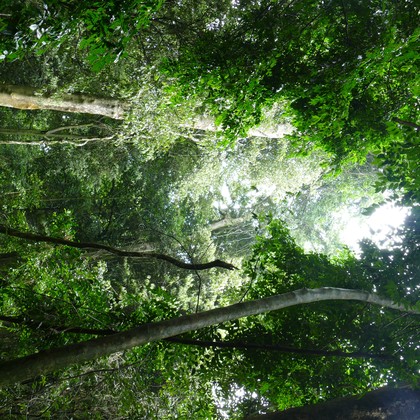
The mid-stratum and understorey of moist lowland and escarpment forest and mid-altitude forest, also old secondary forest and shady coffee plantations. It forages for insects among leaves and creepers, in pairs or small groups, usually with mixed foraging flocks.
Where the bird is most at home, classified by the vegetation units of southern Africa.

Range and movements
Endemic to north-western Angola, in the forests of Cuanza Norte and adjacent provinces and along the western escarpment; the exact limits of the range are poorly known. It does not occur outside Angola.
How and when to look
All year. The species is a target for visitors to the escarpment forests of north-western Angola; search mixed flocks in the mid-stratum and look for a small greenbul with a white throat and a green, not grey, crown. A sound recording and a photograph of the head make a record valuable.
Conservation status
Near Threatened on the Red List, owing to its small range and the rapid loss of forest in north-western Angola to logging, farming and the removal of shade trees from coffee plantations. The species is little studied and its population size is unknown.
Scientific name
Phyllastrephus viridiceps | Rand, 1955
Rand described the species in 1955 and placed it straight away in the genus where it still stands. The genus Phyllastrephus was introduced in 1832 by Swainson. Phyllastrephus comes from the Greek phullon, 'leaf', and a form of strephō, 'to turn' — 'leaf-turner', for the way these birds search foliage for insects. viridiceps comes from the Latin viridis, 'green', and -ceps, '-headed' — for the greenish head. The specimen the first description was based on came from Cantele near Camabatela, Angola.