All species › Passerines › Bulbuls › Yellow-Streaked Greenbul
Yellow-Streaked Greenbul | Phyllastrephus flavostriatus
Gestreepte loofbuulbuul | Bulbul Listado
The Yellow-Streaked Greenbul is a slender olive-green bulbul of montane and mid-altitude forest in the east of the region. It creeps like a nuthatch along trunks, creepers and branches, constantly flicking one wing at a time, a habit that gives it away at a distance.

Voice
A sharp, repeated chip or cheep and a dry rolling chrrrr. The song is a series of accelerating high notes ending in a lower flourish, chip-chip-chip-cheep-cheeuw. It calls often and at length, especially from mixed foraging flocks.
Recording: Bram Piot — CC BY-NC-SA 4.0 · converted to mono · xeno-canto
Identification
19–20 cm. The head is grey to olive-grey, with pale lores and a narrow pale eye-ring; the long, slender, slightly decurved bill is dark. The upperparts are olive-green, the tail and wings browner olive. The throat is pale yellow to off-white, the breast greyish yellow with fine, diffuse yellow streaks, the belly and undertail-coverts yellower. The eyes are dark, the legs grey to pinkish grey. The sexes are alike, though the male is noticeably larger; juveniles are greener on the head and less streaked. In the field the combination of grey head, long bill and single-wing flicking is decisive.
Confusion species
Sombre Greenbul Andropadus importunus has a shorter bill, a pale eye and a uniformly olive head, and does not climb trunks. Terrestrial Brownbul Phyllastrephus terrestris is brown with a crisp white throat and lives on the ground. Lowland Tiny Greenbul Phyllastrephus debilis is much smaller, with a shorter bill and bright yellow underparts, and occurs in lowland forest. In the montane forests, Stripe-Cheeked Greenbul Arizelocichla milanjensis and Black-Browed Mountain Greenbul Arizelocichla fusciceps differ in their shorter, heavier bill and their behaviour in the canopy.
Habitat
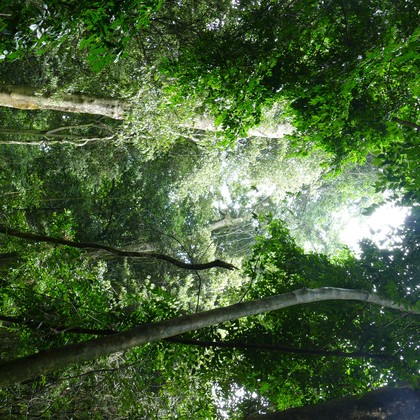
Montane and mid-altitude evergreen forest and mist-belt forest, especially the mid-stratum, creepers and mossy trunks; in Mozambique and Malawi also lowland and riverine forest. It gleans insects and spiders from bark, moss and leaf axils, clinging to trunks and hanging from branches. Often the core of mixed foraging flocks.
Where the bird is most at home, classified by the vegetation units of southern Africa.

Range and movements
In South Africa from the Eastern Cape through the forests of KwaZulu-Natal to Eswatini and the eastern escarpment of Mpumalanga and Limpopo, including Magoebaskloof and the Soutpansberg. Further in the eastern highlands of Zimbabwe, in Mozambique in the highlands and in forests north to the far north, in the montane forests of Malawi and in the extreme east of Zambia. Beyond the region north to Tanzania, Kenya, Uganda and eastern DR Congo.
- Resident
- Summer visitor (c. Oct–Mar)
- Winter visitor (c. Apr–Sep)
- Passage (Mar–Apr, Oct–Nov)
- dark = core range, pale = thinly spread
How and when to look
All year. In montane forest look for mixed flocks; the greenbul is often the noisy bird creeping up a mossy trunk and flicking one wing after the other. In South Africa, Magoebaskloof, the Woodbush and the mist-belt forests of KwaZulu-Natal are reliable sites, in Zimbabwe the Bvumba.
Conservation status
Not threatened and fairly common in large, undisturbed forest. It is sensitive to forest fragmentation, as it needs the understorey and canopy of closed forest; it is absent from plantations of exotic trees.
Scientific name
Phyllastrephus flavostriatus | (Sharpe, 1876)
Sharpe described the species in 1876 as Andropadus flavostriatus; because it was later moved to another genus, the author and year stand in brackets. The genus Phyllastrephus was introduced in 1832 by Swainson. Phyllastrephus comes from the Greek phullon, 'leaf', and a form of strephō, 'to turn' — 'leaf-turner', for the way these birds search foliage for insects. flavostriatus is Latin for 'yellow-streaked', from flavus, 'yellow', and striatus, 'streaked' — for the fine yellow streaks on breast and belly. The specimen the first description was based on came from Macamac, Mpumalanga, South Africa.