All species › Passerines › Cisticolas › Yellow-Bellied Eremomela
Yellow-Bellied Eremomela | Eremomela icteropygialis
Geelbuikeremomela | Eremomela Ventrigualda
Yellow-Bellied Eremomela is the most widespread of the small, fine-billed warblers of dry woodland: grey above, pale grey on the breast and lemon-yellow on the belly. It is a busy, restless bird that moves through the acacias with a dry, chattering song, often together with crombecs and tits.

Voice
A short, fast and clear song, chirri-chee-chee-chee or chee-chee-chiririr, often repeated from a tree canopy. The contact call is a soft, dry tsip, and when excited it gives a rasping chatter. The song is the best identification aid when the bird is foraging high in the foliage.
Recording: Frowin Becker — CC BY-NC-SA 4.0 · converted to mono · xeno-canto
Identification
9–10 cm. Head and upperparts grey, the back and rump with a faint olive tinge. A pale whitish supercilium and dark lores and eye-stripe. Throat white, breast pale grey, grading into bright lemon-yellow on the belly, flanks and undertail; the extent of yellow varies and in birds from the south and west is often restricted to the lower belly. The tail is short but clearly visible. Bill fine and dark, eye brown, legs dark. The sexes are alike. Birds from western Angola and Zambia (the salvadorii group, sometimes treated as a separate species) have a greener back and more extensive yellow.
Confusion species
Karoo Eremomela Eremomela gregalis has a longer tail, a greenish-grey back, a pale eye and white underparts with only the undertail coverts yellow, and lives in small groups in the Karoo. Long-Billed Crombec Sylvietta rufescens is cinnamon below, with a long decurved bill and virtually no tail. Cape Penduline Tit Anthoscopus minutus has a short conical bill, a black forehead with a speckled throat and is rounder. Green-Capped Eremomela Eremomela scotops is green on the crown and yellow on the throat and breast.
Habitat
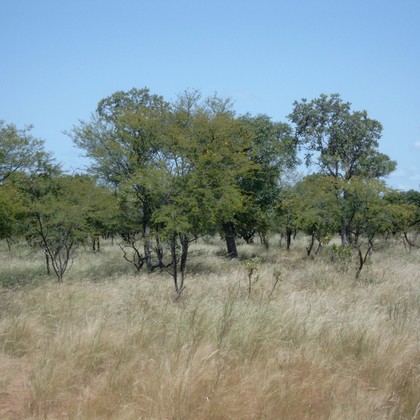
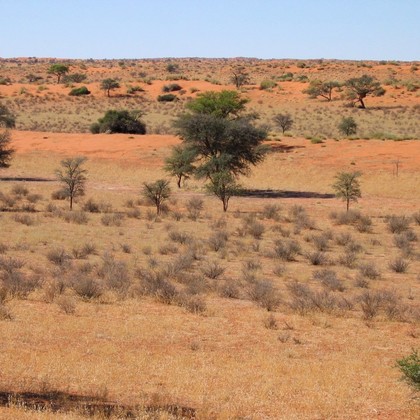
Dry savanna and thornveld, Kalahari thornveld, mopane and open woodland, Nama Karoo scrub, dry watercourses lined with acacias, and in the north also open miombo. It forages in the outer branches of bushes and trees for small insects, often in mixed flocks.
Where the bird is most at home, classified by the vegetation units of southern Africa.

Range and movements
Widespread in the drier parts of the region: Namibia, Botswana, northern, western and central South Africa (including the Karoo, but not the wet eastern seaboard or the south-western Cape), Zimbabwe, southern and western Mozambique, Zambia, Angola and Malawi. Beyond, north through East Africa to Sudan and Ethiopia.
- Resident
- Summer visitor (c. Oct–Mar)
- Winter visitor (c. Apr–Sep)
- Passage (Mar–Apr, Oct–Nov)
- dark = core range, pale = thinly spread
How and when to look
Found year-round in dry reserves such as Kgalagadi Transfrontier Park, Etosha, Pilanesberg and Karoo National Park. Search acacia canopies for a small grey bird that moves constantly and shows its yellow belly when it looks up. The song, not the colour, often decides against Karoo Eremomela.
Conservation status
Not threatened; common and widespread. The species tolerates grazing and disturbance of scrub well; no major threats are known.
Scientific name
Eremomela icteropygialis | (de Lafresnaye, 1839)
De Lafresnaye described the species in 1839 as Sylvietta icteropygialis; because it was later moved to another genus, the author and year stand in brackets. The genus Eremomela was introduced in 1850 by Sundevall. Eremomela comes from the Greek erēmos, 'desert', and melos, 'song' — 'desert songster', for the arid regions where the first species were found. icteropygialis comes from the Greek ikteros, 'yellow', and pugē, 'rump' — for the yellow lower belly and vent. The specimen the first description was based on came from Orange River, South Africa.