All species › Passerines › Cisticolas › Wing-Snapping Cisticola
Wing-Snapping Cisticola | Cisticola ayresii
Dwerggraszanger | Cistícola de Ayres
The Wing-Snapping Cisticola is the smallest cisticola of the region and one of the smallest passerines in Africa. The male displays so high that he is often visible only as a speck against the sky, and is the only ‘cloud-scraper’ to punctuate this with loud, cracking volleys of wing-snaps, which give the species its English name.

Voice
The display song is a rapid, monotonous series of high, thin notes, see-see-see-see-see or soo-see-see-see, repeated endlessly. Between these come volleys of loud wing-snaps, prrt-prrt, especially just before and during the steep dive to the ground. The call is a soft, dry chik.
Recording: Tim Cockcroft — CC BY-NC-SA 4.0 · converted to mono · xeno-canto
Identification
About 9 cm, with a very short tail, in the breeding season so short that the bird looks almost tailless. The crown is dark brown and heavily streaked, the mantle and back black with narrow buff edges, darker than in related species; the rump is rusty brown. The underparts are buff, warmer brownish on breast and flanks. The tail has a black subterminal spot and pale tips. The legs are pale pink. Outside the breeding season the tail is slightly longer and the upperparts warmer brown. The sexes are almost alike. The best character is behaviour: a very high display flight with a monotonous high song, alternating with bursts of loud wing-snaps, and a steep dive in which the wings snap again.
Confusion species
Cloud Cisticola Cisticola textrix is slightly larger, paler and longer-legged, sings a phrase of whistles followed by dry clicks and dives without wing-snapping. Pale-Crowned Cisticola Cisticola cinnamomeus chooses wetter grassland; the male has an unstreaked, pale crown and black lores. Desert Cisticola Cisticola aridulus is much paler, lives in dry, open grassland and may also snap its wings in low flights, but sings a thin zink-zink. Zitting Cisticola Cisticola juncidis is longer-tailed, chooses taller grass and displays low with a rhythmic zit…zit.
Habitat
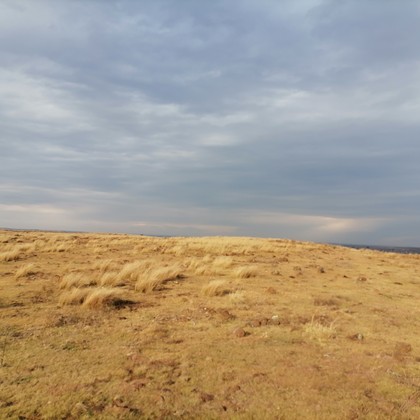
Short, open grassland on plateaus and in the mountains, especially on closely grazed or recently burnt grassland, slopes and summits with low grass, to above 2500 m in the Drakensberg. It avoids tall grass, scrub and very wet places. The nest is placed low in a grass tuft.
Where the bird is most at home, classified by the vegetation units of southern Africa.

Range and movements
Within the region in South Africa on the highveld and in the Drakensberg, in KwaZulu-Natal, the Free State, Mpumalanga, Gauteng and the north-eastern Eastern Cape, also in Lesotho and Eswatini, in the highlands of eastern and central Zimbabwe, the highlands of central Mozambique, Malawi, northern and eastern Zambia and on the central plateau of Angola. Beyond the region north through the Democratic Republic of the Congo and Tanzania to Uganda and Kenya, and in Gabon and Congo-Brazzaville.
- Resident
- Summer visitor (c. Oct–Mar)
- Winter visitor (c. Apr–Sep)
- Passage (Mar–Apr, Oct–Nov)
- dark = core range, pale = thinly spread
How and when to look
Best from October to February on calm mornings in short-grazed grassland on the highveld, for example around Wakkerstroom, Memel or on the Nyika Plateau in Malawi. Listen for the cracking wing-snaps from the sky; only then will binoculars find the speck circling endlessly high above. After a burn the birds are often the first to return.
Conservation status
Not threatened. Common in suitable short grassland; afforestation, ploughing and the loss of grazing or burning, which lets the grass grow too tall, locally reduce its habitat.
Scientific name
Cisticola ayresii | Hartlaub, 1863
Hartlaub described the species in 1863 and placed it straight away in the genus where it still stands. The genus Cisticola was introduced in 1829 by Kaup. Cisticola combines the Ancient Greek kisthos 'rock-rose' with the Latin colere 'to dwell'. ayresii honours the English collector Thomas Ayres (1828–1913), who collected birds in Natal and the Transvaal. The specimen the first description was based on came from Natal (KwaZulu-Natal), South Africa.