The habitats of Europe
Every species in this guide is linked to the habitats where it most occurs in Europe, following the EUNIS classification of the European Environment Agency. It has ten main groups, from open sea to built-up land, and beneath them a few dozen broader formations. Each species carries at most seven of those: not everywhere it has ever turned up, but where it truly belongs.
Select a habitat to read its description.
Marine habitats A
Every habitat governed by sea water, from the high-water mark down to the deep-sea floor. The subdivision follows substratum and depth: hard rock and loose sediment in the intertidal zone, the same pair below the low-water mark, and beneath that the deep-sea bed. Two formations are not tied to the seabed at all: the open water column and sea ice. For mammals the range runs from the seals that haul out on the drying flats and hunt in shallow water to the walrus and the polar bear, which use the pack ice as solid ground.
-
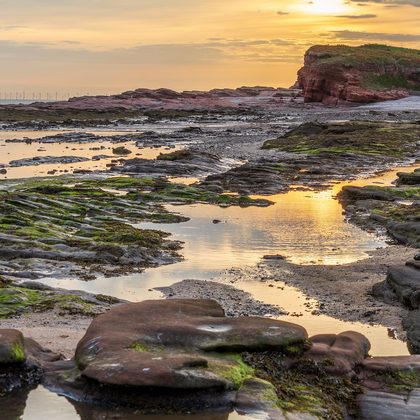 Littoral rock and other hard substrata A1
Hilbre Island, Dee-estuarium, Engeland
6 species
Littoral rock and other hard substrata A1
Hilbre Island, Dee-estuarium, Engeland
6 species
Bedrock, boulders and cobbles between the high- and low-water marks, together with the splash zone above them. EUNIS puts the upper limit at the top of the lichen belt and the lower one where the kelp begins; below that lies infralittoral rock. Sand and mud at the same level belong to littoral sediment. On Atlantic and northern coasts the belts stack up: lichens, barnacles and mussels on the exposed headlands, dense fucoid weed in sheltered bays, and rockpools throughout. Seals use the rock not to feed but to lie on: dry, sloping boulders close to deep water are the safest haul-out there is. Harbour and grey seal rest and suckle their pups there, the Mediterranean monk seal withdraws into sea caves with a beach inside, and in the north ringed and bearded seal come out on the rocks of the fjords.
-
 Littoral sediment A2
Waddenzee bij Föhr, Duitsland
9 species
Littoral sediment A2
Waddenzee bij Föhr, Duitsland
9 species
Gravel, sand, muddy sand and mud that dry out at low tide, in every mixture between them. What separates it from littoral rock is the substratum; what separates it from sublittoral sediment is the drying out, since ground that stays submerged falls outside. Coarse, mobile sediment holds little life; fine sand and mud retain water and are full of worms, bivalves and small crustaceans. Along the upper edge the flats grade into eelgrass beds and saltmarsh. The large European examples are the Wadden Sea, the British estuaries, the bay of Mont-Saint-Michel and the mouths of the Tagus and the Guadalquivir. For seals the flats are the haul-out itself: harbour and grey seal come out on them in groups at low tide, suckle and moult there, and in the north the walrus uses the same drying banks. Bearded, ringed and harp seal dive for the worms, shellfish and shrimps in the sediment.
-
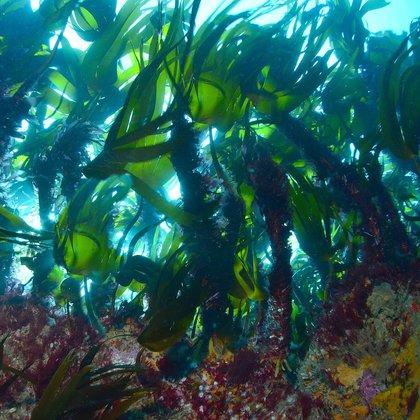 Infralittoral rock and other hard substrata A3
Kelpwoud bij Molène, Iroise-zee, Bretagne
3 species
Infralittoral rock and other hard substrata A3
Kelpwoud bij Molène, Iroise-zee, Bretagne
3 species
Bedrock, boulders and cobbles just below the low-water mark, down to the depth at which kelp and dense seaweed give out, roughly the top ten to thirty metres. The upper limit is the top of the kelp zone, with littoral rock above it; below the lower limit begins rock without an algal cover. Off Norway, Iceland and the British and Irish coasts this is kelp forest with red seaweeds beneath; in turbid estuarine water the kelp fails and sponges and barnacles take over. In the Mediterranean the cover is lower-growing. Mammals hunt here: the harbour seal works the kelp for flatfish and squid, and the Mediterranean monk seal fishes over the rocky bottom just outside the caves it rests in.
-
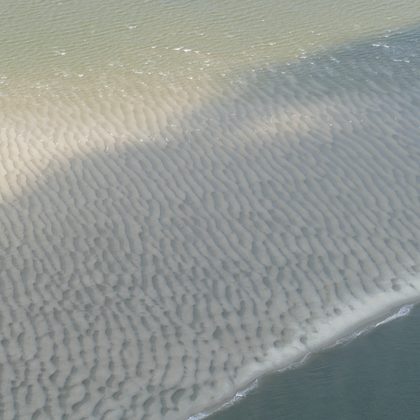 Sublittoral sediment A5
Zandbank bij Wangerooge, Duitse Waddenzee
15 species
Sublittoral sediment A5
Zandbank bij Wangerooge, Duitse Waddenzee
15 species
Sand, mud, gravel and mixed sediment on the seabed below the low-water mark, down to the edge of the bathyal zone at about two hundred metres. It differs from littoral sediment in never drying out, and from infralittoral rock in being loose ground. The North Sea, the Baltic and the banks of the Irish Sea carry wide sand plains with shellfish beds, along with seagrass in sheltered bays and maerl on coarse gravel. This is the seals' hunting ground. What they take lies in or just above the sediment: flatfish, sandeel, shrimps and shellfish. Harbour and grey seal hunt here in the North Sea and the Baltic, the walrus ploughs the sandy bottom with its whiskers for bivalves, and hooded and harp seal dive deeper than the rest.
-
 Pelagic water column A7
Golf van Biskaje, Atlantische Oceaan
21 species
Pelagic water column A7
Golf van Biskaje, Atlantische Oceaan
21 species
The water itself, independent of seabed and shore: from coastal water and inlets to the ocean above the deep sea. EUNIS divides the pelagic water column by salinity, stratification and depth, from the lit surface layer down to the abyssopelagic zone, and notes that the same place falls under a different type at different times of year, because the stratification shifts with the seasons. In Europe this means the North Sea and the Baltic, the Bay of Biscay, the shelf edge and the deep Atlantic water around the Azores and Madeira. Mammals cross this open space: hooded and harp seal spend most of the year in it and come onto the ice only to pup and moult, and the polar bear swims tens of kilometres through it to get from one floe to the next.
-
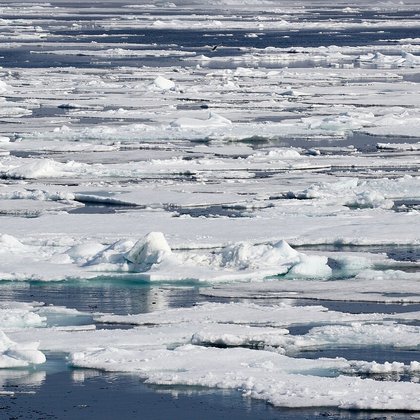 Ice-associated marine habitats A8
Drijfijs op zee bij Spitsbergen, Svalbard
7 species
Ice-associated marine habitats A8
Drijfijs op zee bij Spitsbergen, Svalbard
7 species
Sea ice, icebergs and everything that goes with them: drifting pack ice, loose floes, the underside of the ice and the open leads between the plates. It is the ice as a habitat that is meant, not the water column or the seabed below it. In Europe it lies around Svalbard, Franz Josef Land and Novaya Zemlya and along the east coast of Greenland, and every winter in the northern Baltic and the White Sea as well; the edge withdraws northward in summer and comes back down in winter. Algae grow on the underside of the ice and feed krill and amphipods, and through them fish as well. For mammals this ice is not an obstacle but the ground their lives rest on. The ringed seal keeps breathing holes open and pups in a snow lair on the fast ice, harp and hooded seal pup in great herds on the drift ice, the walrus uses the floes as a haul-out above shallow water, and the polar bear hunts the whole of it on foot.
Coastal habitats B
Everything above the spring high tide line that owes its character to the sea nearby: dunes and wooded dunes, sandy beaches, shingle banks, sea cliffs and rocky shores, including the strip reached only by spray. Strandlines and damp dune slacks belong here; supralittoral rock pools and ground near the sea that gets no salt do not. EUNIS divides the group by substrate: sand, shingle or solid rock. For mammals it is a narrow, restless strip: loose sand and crevices offer burrows and daytime lying-up places, but salt, wind and human use limit what can hold on.
-
 Coastal dunes and sandy shores B1
Tràigh Baile Aonghais, Isle of Harris, Schotland
31 species
Coastal dunes and sandy shores B1
Tràigh Baile Aonghais, Isle of Harris, Schotland
31 species
Coastal dunes and sandy shores cover the sand above the driftline and the whole dune system behind it: embryonic and white dunes, fixed grey dunes, damp dune slacks, and the heath, scrub and woodland that develop on older sand. Below the driftline the tidal shore takes over; where the beach is pebbles it becomes coastal shingle, and where it is solid rock, cliff and rocky shore. Inland dunes are excluded. The belt runs from Norway to the Black Sea, marram binding the young dunes, moss, lichen and thin grassland covering the grey ones. Loose sand is easy to dig and grazing keeps the sward short: European rabbit has its warrens here and, with Brown hare, keeps the grey dunes open, while on Iberian coasts Granada hare takes over that role.
-
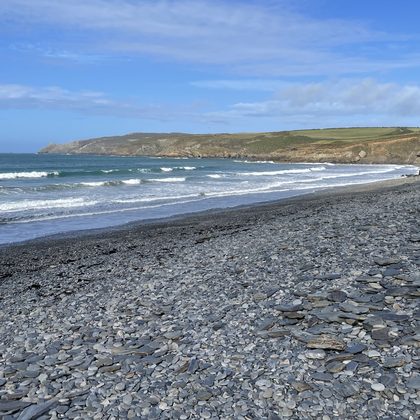 Coastal shingle B2
Aber Mawr, Pembrokeshire, Wales
3 species
Coastal shingle B2
Aber Mawr, Pembrokeshire, Wales
3 species
Coastal shingle consists of beaches built of pebbles, sometimes of larger boulders, thrown up by wave action along open coasts, enclosed seas and coastal lagoons. Grain size is what separates it from a sandy shore: shingle holds no water and does not blow, so no dune forms behind it. Unlike rocky shore, the material lies loose. The largest European examples are the shingle ridges of southern England and the Channel, the gravel beaches of the Baltic, Iceland and the northern fjords, and the steep pebble beaches of the Mediterranean. Plant cover is thin: sea kale, yellow horned-poppy, sea pea. Mammals come here to rest. The grey seal pups on remote shingle banks no one visits, the Mediterranean monk seal uses the pebble beach at the back of a sea cave, and in the north the walrus hauls out in groups on the gravel shores.
-
 Rock cliffs, ledges and shores B3
Handa Island, Sutherland, Schotland
11 species
Rock cliffs, ledges and shores B3
Handa Island, Sutherland, Schotland
11 species
Rock cliffs, ledges and shores take in cliff faces, ledges, caves and rock platforms at the sea's edge or set just back from it, above the spring high tide line. Below that line lies littoral rock, which EUNIS calls marine; loose pebbles belong to coastal shingle. Bare cliffs and rocky islets are included, as are cliffs with salt-tolerant vegetation and soft cliffs of clay and till. The zone runs from Svalbard and Iceland through Norway and Brittany to the limestone cliffs of the Mediterranean and the volcanic coasts of Macaronesia, with lichens, thrift and rock samphire along the rim. For mammals this coast is mostly ground to pass through; only Common otter holds on, along the shores of Scotland, Ireland and Norway, where it fishes in the sea and lies up in crevices and holts above the tideline.
Inland surface waters C
All above-ground open water inland: rivers, streams, lakes, ponds, pools and springs, together with the banks that flood often enough to stop closed terrestrial vegetation from forming. Fresh and brackish water both count, and so do dug waterbodies — canals, reservoirs, ponds — once they hold a semi-natural community. Permanent snow and ice fall outside it. EUNIS divides the group into surface standing waters, surface running waters and the littoral zone between them. For mammals it comes down to this: some species hunt or build in the water itself, while the rest drink there and take insects above the surface.
-
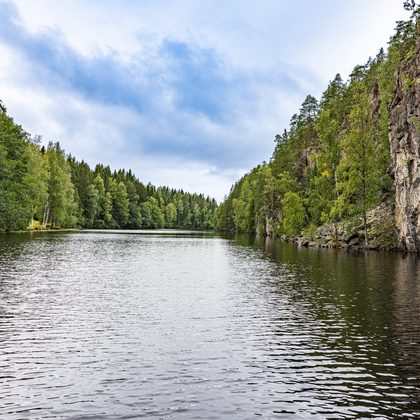 Surface standing waters C1
Torisevan rotkojärvi, Virrat, Finland
28 species
Surface standing waters C1
Torisevan rotkojärvi, Virrat, Finland
28 species
Lakes, ponds and pools with an open water surface, fresh, brackish or salt, formed naturally or dug — canals, reservoirs and ponds count as surface standing waters once they carry a semi-natural community. What separates them from running waters is movement: here the water stands, or moves too slowly to matter. The vegetated fringe itself belongs to the littoral zone. In Europe the range runs from glacial lakes in Scandinavia and the Alps to lowland peat pools and brackish steppe lakes in southern Russia; depth, lime content and nutrient level decide what grows. For mammals what counts is the shoreline and the insect life above the water: Common otter hunts fish here, Eurasian beaver builds its lodge into the bank, and Common pipistrelle works low over the surface at dusk after midges.
-
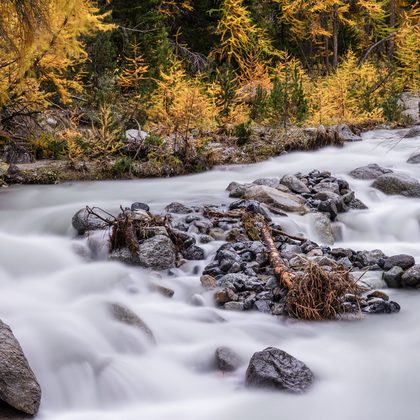 Surface running waters C2
Clemgia bij S-charl, Engadin, Zwitserland
32 species
Surface running waters C2
Clemgia bij S-charl, Engadin, Zwitserland
32 species
Running water in all its forms: springs, streams, rivers and watercourses that carry water only after rain or snowmelt. What sets surface running waters apart is the current itself — once the water stands, or is held behind a dam as a reservoir, it belongs with standing waters, while the gravel bars and the fringing vegetation fall to the littoral zone. In Europe the series runs from steep boulder-strewn mountain becks with white water through braided gravel rivers to slow, silt-bedded lowland rivers. Mammals follow the current from the bank: Common otter hunts clear headwaters and fish-rich lower reaches, Eurasian beaver dams narrow streams and digs into steep banks, and along German and French rivers Raccoon has established itself as an introduced species.
-
 Littoral zone of inland surface waterbodies C3
Oezero Dobre, Wolynië, Oekraïne
54 species
Littoral zone of inland surface waterbodies C3
Oezero Dobre, Wolynië, Oekraïne
54 species
The strip that floods often enough to keep closed terrestrial vegetation from forming: reedbeds and other water-fringing growth along lakes, rivers and streams, the exposed bottoms of dried-up rivers and lakes, and the rock, gravel, sand and mud in and beside the bed. It is the transition between open water and the land behind it, and it ends where scrub or grassland closes over. In Europe it ranges from broad delta reed marshes to narrow rush fringes, bare mud margins of drawn-down reservoirs and gravelly river beaches. For mammals the littoral zone is where water and land meet: Common otter has its holts and resting places under overhanging banks, and Eurasian beaver finds the willow and the reed and herb growth it lives on.
Mires, bogs and fens D
Wet ground where the water table stands at or above the surface for at least half the year and where herbs, sedges or dwarf shrubs dominate; open water, woodland and scrub are excluded. The subdivisions follow where the water comes from: peat fed by rain alone, peat fed by groundwater or seepage, the patterned mires of the far north, sedge and reedbeds, and saline marshes far from any coast. For mammals these are places where burrowing is barely possible and cover comes from the vegetation rather than from the ground.
-
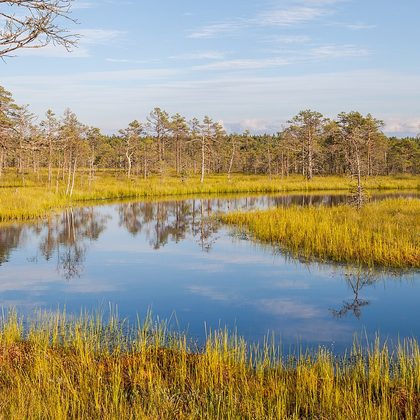 Raised and blanket bogs D1
Viru raba, Nationaal Park Lahemaa, Estland
12 species
Raised and blanket bogs D1
Viru raba, Nationaal Park Lahemaa, Estland
12 species
Peat fed by rainfall rather than by water draining in from higher ground: that is what separates raised and blanket bogs in EUNIS from fens and transition mires. The peat is acid and nutrient-poor, and the code covers bogs that have stopped growing too. In the lowlands of Ireland, the Baltic states, Poland and Fennoscandia they rise as domes above the surrounding land; in the wet west of Ireland, Scotland and Norway the peat lies like a blanket over whole hillsides. Sphagnum, cross-leaved heath, cotton-grass and bog rosemary grow there, with hummocks, hollows and peat pools between. Mammals find an acid, nutrient-poor ground here, hard to dig in and long under winter. Field vole and tundra vole keep to the drier hummocks and sedge tussocks, the wood lemming lives off the bog moss itself, and in peak years the Norway lemming passes through in great numbers.
-
 Valley mires, poor fens and transition mires D2
Holmtjärnen, natuurreservaat Stockholmsgata, Ångermanland, Zweden
5 species
Valley mires, poor fens and transition mires D2
Holmtjärnen, natuurreservaat Stockholmsgata, Ångermanland, Zweden
5 species
Weakly to strongly acid peatland that, unlike a raised bog, does receive water from the land around it: seepage off a slope, drainage in a valley bottom, or the margin between land and open water. EUNIS also places quaking bogs and non-calcareous spring mires here; where the incoming water is lime-rich the ground belongs with the base-rich fens instead. These are small wet hollows in valleys and infilling lakes, with Sphagnum, cotton-grass, sedges and marsh cinquefoil on mats that give way underfoot. For mammals that means cover and a sward that gives underfoot: the tundra vole holds its last Dutch strongholds here, the wood lemming seeks out the thickest bog moss, and the northern birch mouse climbs in the sedges and the tall herbs.
-
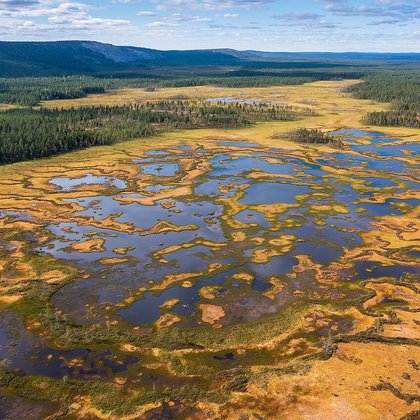 Aapa, palsa and polygon mires D3
Joutsenenpesäaapa bij Sodankylä, Fins Lapland
3 species
Aapa, palsa and polygon mires D3
Joutsenenpesäaapa bij Sodankylä, Fins Lapland
3 species
Patterned mire complexes of the arctic, subarctic and northern boreal zone. What sets aapa, palsa and polygon mires apart from ordinary bog is the pattern frost and slow-moving water impose on the surface: in aapa mires long peat ridges across the slope with wet flarks between, in palsa mires mounds a few metres high with an ice core that cracks and collapses, and on the tundra polygon mires. They lie in northern Fennoscandia and Russia, with dwarf birch and cotton-grass on the dry parts and sedges in the wet. For mammals what counts most is the snow lying over that pattern in winter: under it the cold just stays bearable. The Norway lemming digs its winter runs in that snow and breeds beneath it, and in peak years the whole complex fills with its tracks.
-
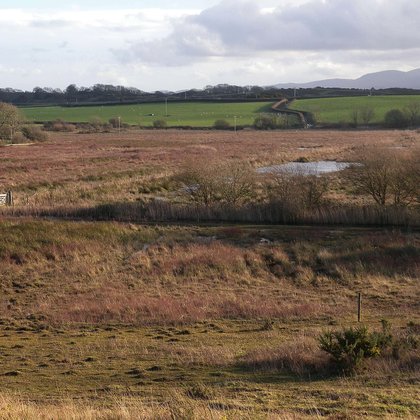 Base-rich fens and calcareous spring mires D4
Cors Bodeilio, Anglesey, Wales
1 species
Base-rich fens and calcareous spring mires D4
Cors Bodeilio, Anglesey, Wales
1 species
-
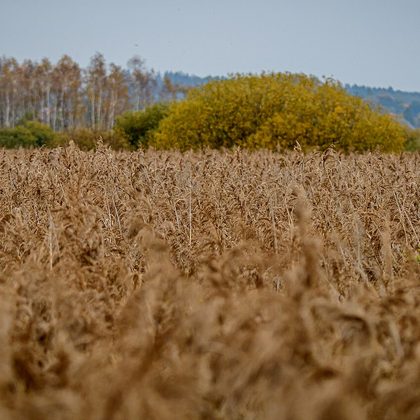 Sedge and reedbeds without free-standing water D5
Federsee, Bad Buchau, Baden-Württemberg, Duitsland
39 species
Sedge and reedbeds without free-standing water D5
Federsee, Bad Buchau, Baden-Württemberg, Duitsland
39 species
Stands of reed, reedmace, club-rush and large sedges on wet, often peaty ground that normally carries no standing water. That last point is the boundary: where the same stems rise out of open water along a lake or river, EUNIS treats them as fringing vegetation instead. Such marshes occupy infilling lakes, old river courses, polders and deltas — the Danube delta, the Biebrza, Lake Neusiedl, the Dutch and Baltic peat districts — often over many square kilometres at a stretch, with tall herbs and willow scrub along the drier edges. Dense reed gives cover where little else does: Wild boar lies up here by day and roots for rhizomes, Common otter runs its paths through it, Common shrew hunts in the litter layer, and Eurasian beaver uses the drier edges.
-
 Inland saline and brackish marshes and reedbeds D6
Nationalpark Neusiedler See-Seewinkel, Burgenland, Oostenrijk
5 species
Inland saline and brackish marshes and reedbeds D6
Nationalpark Neusiedler See-Seewinkel, Burgenland, Oostenrijk
5 species
Saline and brackish marshes well away from the sea: the inland counterpart of coastal saltmarsh and saline reedbed. The vegetation may be closed or open, but the ground has to stay wet; once it dries out EUNIS calls it inland salt steppe or saline scrub. They form where salt lies in the subsoil and evaporation outruns rainfall: the Pannonian plain, the lagoons of La Mancha and the Ebro valley, the steppe lakes of Anatolia and the Caspian lowland. Glasswort, sea-blite and saltmarsh grass grow in patches, with salt crusting on the bare ground between them. Mammals are few, for the ground is wet and salt and digging goes badly; the tundra vole keeps to the taller sedge and reed fringes along the edges, exactly as it does in the brackish parts of the Dutch fen country.
Grasslands E
All non-coastal land that is dry, or wet for only part of the year, carrying more than thirty per cent vegetation cover of grasses, herbs, sedges, ferns, mosses and lichens. Tilled arable land is excluded. The subdivisions run from dry and mesic grasslands through wet meadows and alpine swards to woodland fringes, inland salt steppes and sparsely wooded grasslands. For mammals it is open, low country where a living is made by burrowing and grazing, and where management — grazing or mowing — decides what survives.
-
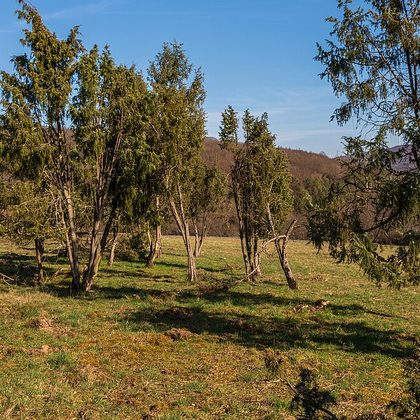 Dry grasslands E1
Dreisbach bij Ehringshausen, Lahn-Dill-Kreis, Hessen, Duitsland
133 species
Dry grasslands E1
Dreisbach bij Ehringshausen, Lahn-Dill-Kreis, Hessen, Duitsland
133 species
Well-drained or dry ground carrying grasses and herbs, usually unfertilised and of low productivity, wormwood steppe included. The limit is set by shrubs: on dry Mediterranean ground, once scrub of other genera covers more than a tenth EUNIS calls it garrigue, and where the soil turns damper and richer the mesic grasslands begin. In Europe these are limestone slopes with thyme and fescue, the Pannonian sand steppes and the open steppe plains of Iberia and Anatolia. The short, open sward is easy to dig and keeps sightlines clear: European ground squirrel and Bobak marmot set up their colonies in the Pannonian and Ponto-Sarmatic steppes, Common vole reaches high densities here in good years, and Brown hare lies up in a form between the tussocks.
-
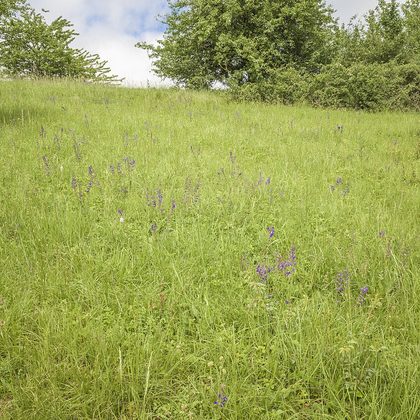 Mesic grasslands E2
Spitzberg bij Limbach, Odenwald, Duitsland
107 species
Mesic grasslands E2
Spitzberg bij Limbach, Odenwald, Duitsland
107 species
Pastures and hay meadows of lowland and mountain, on moderately to highly fertile soils that are not wet all year, in the boreal, nemoral, warm-temperate humid and Mediterranean zones. They are richer than dry grasslands and drier than the wet ones; reseeded and heavily fertilised fields, sports pitches and lawns belong here too. In Europe this is ordinary farmland: grazed swards, hay meadows with buttercup and oxeye daisy, and the ryegrass leys that have replaced them. Worms, leatherjackets and insects make the soil worth working, though the mowing date decides what survives: Common mole works its way through the sward, Common vole and Brown hare keep to the rougher margins, and Eurasian badger comes out at night for earthworms.
-
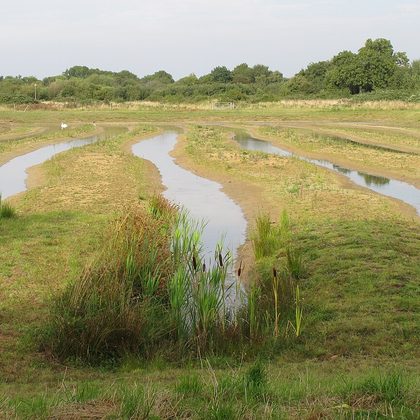 Seasonally wet and wet grasslands E3
Attenborough Nature Reserve, Nottinghamshire, Engeland
27 species
Seasonally wet and wet grasslands E3
Attenborough Nature Reserve, Nottinghamshire, Engeland
27 species
Unimproved or lightly improved wet meadows and tall herb stands on ground that lies waterlogged or flooded through winter and spring, from the boreal zone to the Mediterranean and the steppes. The water table is what separates them from mesic grasslands; where the water stands all year the habitat passes into marsh and reedbed. In Europe they are washlands and polders, marsh-marigold and purple moor-grass meadows, and the seasonally flooded plains of the Pannonian and Iberian basins. For mammals the winter flooding is the constraint: anything that burrows must keep to the higher ground. Common mole works the raised margins and the drier knolls, where the saturated soil is full of worms and larvae.
-
 Alpine and subalpine grasslands E4
Lac Noir, Sainte-Foy-Tarentaise, Savoie, Frankrijk
51 species
Alpine and subalpine grasslands E4
Lac Noir, Sainte-Foy-Tarentaise, Savoie, Frankrijk
51 species
Grass and sedge swards of the alpine and subalpine belt of the European mountains, the Caucasus and Anatolia, covering both the natural swards above the treeline and the pastures kept open just below it by centuries of grazing. Where the cover thins out and rock and scree take over, the formation ends. They are short, flower-rich turfs of fescue and sedge, broken by snowbeds and boulder fields, in the Alps, Pyrenees, Carpathians, the Scandinavian fjell and the Balkans. For mammals it is the short summer that counts, when a whole year's feeding has to be done: Alpine marmot digs its burrows into the sward and sleeps out the rest of the year, Chamois grazes up to the snowline, and Mountain hare keeps to the boulder fields along the edge, with Broom hare taking that place in the Cantabrian mountains.
-
 Woodland fringes, clearings and tall forb stands E5
Emmeringer Leite bij Emmering, Opper-Beieren, Duitsland
69 species
Woodland fringes, clearings and tall forb stands E5
Emmeringer Leite bij Emmering, Opper-Beieren, Duitsland
69 species
The herbaceous seam between woodland and open country: forest edges, glades and felled patches, and the stands of tall herbs and ferns that come up there and along streams. Scrub and closed woodland fall outside it, and so does mown grassland; what is meant is the narrow, yearly shifting transition. In Europe it means bracken and bramble on clear-fells, fringes of rosebay willowherb and woodland herbs, damp stands of meadowsweet, and subalpine tall-forb fields with monkshood. The fringe gives cover and food at once, which for mammals is the useful combination: Roe deer takes the herbs and young shoots, Common dormouse climbs through the bramble and honeysuckle of the edge, Bank vole lives in the litter layer, and Wildcat hunts mice along the woodland margin.
-
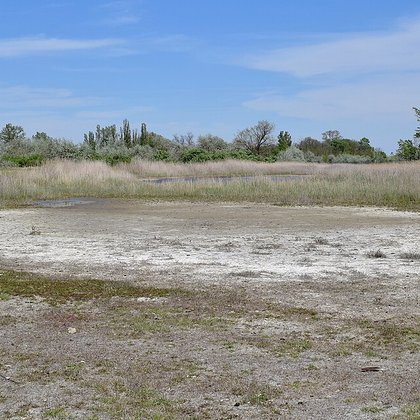 Inland salt steppes E6
Zoutkorst in de Seewinkel, Nationaal Park Neusiedler See, Burgenland, Oostenrijk
21 species
Inland salt steppes E6
Zoutkorst in de Seewinkel, Nationaal Park Neusiedler See, Burgenland, Oostenrijk
21 species
Inland grasslands and steppes on saline or gypsum-rich soils, where evaporation brings the salt to the surface as a crust. Unlike coastal saltmarsh the salt here comes from climate and subsoil rather than from the tide, and unlike ordinary dry steppe the sward is thin and broken by bare patches. In Europe this means the Hungarian szik puszta, the Ponto-Sarmatic plains north of the Black Sea, and the salt basins of Los Monegros and La Mancha, with glasswort, saltmarsh grass and sea lavender around shallow lakes that dry out in summer. Little grows on the salt crust and mammals are scarce: Little ground squirrel digs its tunnels into the drier, slightly raised margins of the Ponto-Sarmatic salt basins, and in the far south Cape hare ranges out onto the bare plains.
-
 Sparsely wooded grasslands E7
Dehesa in Extremadura, Spanje
35 species
Sparsely wooded grasslands E7
Dehesa in Extremadura, Spanje
35 species
Grassland with a scattered tree layer that normally covers less than a tenth of the ground. Let the canopy close further and it becomes woodland; take the trees away and ordinary grassland is left. The best-known example is the Iberian dehesa or montado: old holm oaks and cork oaks standing well apart over a grazed sward, with cattle, sheep and pigs beneath them. The old parklands of England and southern Sweden and the wood pastures of central Europe belong here as well. For mammals the dehesa is open hunting ground with cavities above it: European rabbit digs its warrens in the sandy soil and forms the base of the food chain, Granada hare and Common vole graze the sward, and Greater horseshoe bat takes dung beetles above the grazed land, roosting in old buildings and hollow oaks.
Heathland, scrub and tundra F
Non-coastal land that is dry, or under water for only part of the year, with more than thirty per cent cover of shrubs, dwarf shrubs or tundra vegetation; the woody plants stay below five metres. It runs from tundra over permafrost through arctic, alpine and temperate scrub and heathland to the Mediterranean forms, maquis, garrigue and phrygana, and on to riverine scrub, hedgerows and shrub plantations. For mammals it provides cover and food close to the ground, in open country without woodland.
-
 Tundra F1
Hardangervidda, Noorwegen
12 species
Tundra F1
Hardangervidda, Noorwegen
12 species
Vegetated ground lying over permafrost: grasses and sedges, dwarf shrubs, mosses and macrolichens. In Europe that is limited to Spitsbergen and northern Russia. Where the same plants grow without permafrost, on boreal mountains and in Fennoscandia and Iceland, the ground counts as alpine grassland or as arctic scrub. The picture is low and open: peat mounds, wet hollows, thousands of pools and small lakes, and a growing season of ten weeks at most. For mammals the permafrost is the obstacle: deep burrowing is impossible and the vegetation stays low and sparse. What holds on lives off dwarf shrubs and willow twigs and shelters between the peat mounds; Mountain hare reaches this northernmost vegetation and changes coat with the snow.
-
 Arctic, alpine and subalpine scrub F2
Malá Fatra, Slowakije
25 species
Arctic, alpine and subalpine scrub F2
Malá Fatra, Slowakije
25 species
Scrub above or north of the climatic tree line but outside the permafrost zone, together with scrub just below that line where trees are held back by late-lying snow, wind or repeated browsing. That climatic limit is what separates it from temperate scrub F3. In Fennoscandia it takes the form of belts of dwarf birch, willow and juniper beyond the mountain birch zone; in the Alps, the Pyrenees and the Caucasus of alpenrose, bilberry and creeping mountain pine. The shrub layer is dense enough to disappear into and low enough to see over. Mountain hare browses willow and dwarf birch, Chamois takes cover at the uppermost bushes and Broom hare keeps to the broom scrub of the Cantabrian mountains; Alpine marmot digs its burrow in the openings between.
-
 Temperate and mediterranean-montane scrub F3
Eselsburger Tal bij Herbrechtingen, Schwäbische Alb, Duitsland
23 species
Temperate and mediterranean-montane scrub F3
Eselsburger Tal bij Herbrechtingen, Schwäbische Alb, Duitsland
23 species
Scrub of the nemoral zone and of the submediterranean and supramediterranean mountains: deciduous and evergreen shrubs on ground where woodland has gone or has not yet returned. EUNIS keeps out heaths dominated by Ericaceae (F4) and the Mediterranean maquis, garrigue and phrygana. What is left is blackthorn and hawthorn along field edges, bramble and rose thickets on abandoned arable land, hazel and juniper on limestone slopes, and dense woodland margins. Thorny cover, berries and nuts make scrub both shelter and larder for mammals. Common dormouse lives on hazelnuts and blackberries and builds its summer nest among the thorny twigs, Bank vole keeps to the litter layer, European rabbit digs its burrows under the densest bushes, and Red fox uses the margins as hunting ground.
-
 Temperate shrub heathland F4
Lüneburger Heide, Nedersaksen, Duitsland
9 species
Temperate shrub heathland F4
Lüneburger Heide, Nedersaksen, Duitsland
9 species
Heathland in the strict sense: shrub communities in which Ericaceae dominate, on acid, nutrient-poor soil. The core lies in the Atlantic and sub-Atlantic zone, from Ireland and Scotland through the Netherlands and northern Germany to Denmark, with outliers in the Iberian and French mountains. That marks it off from the thorn scrub of F3, where heathers are absent; from arctic and alpine scrub F2, which carries heathers as well, it is separated not by the plants but by lying above or north of the tree limit. Dry heather, wet cross-leaved heath and bog myrtle alternate, usually kept open by grazing, cutting or burning. For mammals heathland is poor in cover and in food of good quality; what lives here must make do with dwarf shrubs. Mountain hare grazes young heather on the Scottish moors, Broom hare keeps to the heath and broom slopes of the Cantabrian mountains, and Red-necked wallaby, escaped from captivity, grazes on a few British heaths.
-
 Maquis, arborescent matorral and thermo-Mediterranean brush F5
Noordwest-Corsica, Frankrijk
76 species
Maquis, arborescent matorral and thermo-Mediterranean brush F5
Noordwest-Corsica, Frankrijk
76 species
Tall, closed sclerophyllous scrub of the Mediterranean lowlands: strawberry tree, mastic, phillyrea, myrtle, kermes oak and broom stand so thick that the ground is almost wholly covered, with scattered trees above. That height and closed canopy are what separate maquis from the open, low garrigue F6. It clothes slopes too dry, too stony or too often burnt for woodland, from Portugal to the Levant. Mammals find cover here all year and acorns and berries in late summer. Wild boar roots under the kermes oak, European rabbit digs its burrows along the open edges, Wildcat uses the dense scrub to hunt unseen, and Crested porcupine comes out at night for tubers and roots.
-
 Garrigue F6
Pinet, Hérault, Frankrijk
44 species
Garrigue F6
Pinet, Hérault, Frankrijk
44 species
Open sclerophyllous scrub with bare ground between the bushes: low cistus, lavender, rosemary and thyme, many winter annuals and spring geophytes, and here and there a larger shrub or a scattered tree. That open structure is what separates garrigue from closed maquis F5. It appears where evergreen forest has been cleared, grazed or burnt, mostly on limestone, and runs from Iberia and southern France to the Pontic coast and Anatolia. For mammals what counts is the alternation of stone and bush: crevices and burrows to pass the day in, and herbs, bulbs and insects at night. Cape hare lies up by day in a form under a cistus bush, Corsican hare does the same on Corsica and in southern Italy, and Crested porcupine digs out bulbs and roots after dark.
-
 Spiny Mediterranean heaths F7
Bij Elafonisi, zuidwesten van Kreta, Griekenland
15 species
Spiny Mediterranean heaths F7
Bij Elafonisi, zuidwesten van Kreta, Griekenland
15 species
Low spiny shrubs and cushion-forming dwarf shrubs on summer-dry ground, from the coast to high on dry mountains in the Mediterranean and Anatolian regions. The spines and the cushion shape are what separate it from garrigue F6, where cistus and labiates set the tone. Hard cushions of Sarcopoterium and Astragalus are typical, flowering in spring and drying off by July, and almost all this ground has been grazed for centuries. For mammals what counts is what grows between and under the spiny cushions: the thorns keep livestock and predators off, so there is grazing and digging in their shelter. Cape hare takes the fresh growth after the first rain, Rock hyrax lives in the rock outcrops between the cushions, and Common gundi shelters by day in the crevices.
-
 Riverine and fen scrub F9
Kerspetal, Bergisches Land, Duitsland
23 species
Riverine and fen scrub F9
Kerspetal, Bergisches Land, Duitsland
23 species
Woody vegetation under five metres along rivers and lakes, in fens and on marshy floodplains. Height sets the limit: once it becomes woodland it falls under group G, and where reed and sedge take over without shrubs the mires of group D begin. The picture is irregular: willow beds and bog-myrtle scrub in the north, fringes of tamarisk and oleander along Mediterranean beds that run dry in summer, and dense thickets on gravel bars that shift with every flood. Bushes, water and reed lie immediately next to one another, which puts everything a mammal needs within one night's round. Eurasian beaver fells willow and poplar here and sinks the twigs as a winter store, Common otter follows the bank from pool to pool, and Roach's mouse-tailed dormouse lives in the scrub of the Thracian lowlands.
-
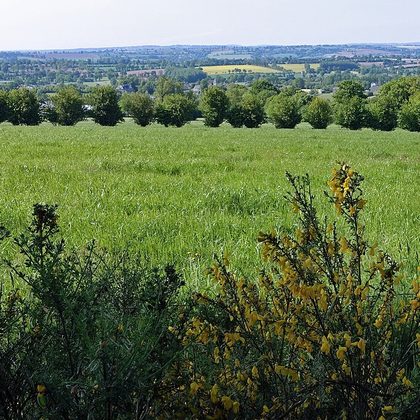 Hedgerows FA
Le Bény-Bocage, Normandië, Frankrijk
42 species
Hedgerows FA
Le Bény-Bocage, Normandië, Frankrijk
42 species
Strips of woody vegetation within a matrix of fields, grassland and roads, planted to control livestock, mark boundaries or give shelter. They differ from lines of trees (G5.1) in being made up of shrub species or, where tree species are used, in being cut back regularly to under five metres. In Europe they run from the bocage of Normandy and Brittany through British and Irish hedges to the banked hedgerows of the sandy soils. Often they are the only woody element in open arable land, and for mammals they are above all a route: a strip of cover that links one wood to the next. Greater horseshoe bat follows hedgerows as flight lines and hunts along them, Eurasian badger keeps to fixed paths through them, Common dormouse stays in the thickest stretches of hazel and honeysuckle, and Western European hedgehog nests at the foot of the stems.
-
 Shrub plantations FB
Bořetice, Zuid-Moravië, Tsjechië
16 species
Shrub plantations FB
Bořetice, Zuid-Moravië, Tsjechië
16 species
Plantations of dwarf trees, shrubs, espaliers and perennial woody climbers, mostly grown for fruit or flowers, either meant to keep a permanent woody cover when mature or harvested whole on a regular cycle. Vineyards make up the bulk of it, along with bush orchards and nurseries. What separates it from hedgerows (FA) is that the crop covers the whole surface instead of forming a strip. How many mammals it holds depends on management: old vineyards with herbs between the rows and dry stone walls carry far more than clean-sprayed blocks. Granada hare lies up by day between the stocks, Roach's mouse-tailed dormouse lives in the orchards and vineyards of Thrace, and Caucasian squirrel comes to the nuts and fruit in the plantations of Anatolia and the Caucasus.
Woodland and forest G
All vegetation in which trees set the canopy: at least ten per cent cover by woody plants that can reach five metres at maturity. Recently felled or burnt ground belongs here too, as long as woodland will return. EUNIS divides the group by leaf type — broadleaved deciduous, broadleaved evergreen, coniferous and mixed woodland — and keeps lines of trees, small woods and young growth apart. Canopy, understorey and dead wood each hold their own mammals, and holes in old trunks provide shelter that open country lacks.
-
 Broadleaved deciduous woodland G1
Berg Pangaion, Macedonië, Griekenland
121 species
Broadleaved deciduous woodland G1
Berg Pangaion, Macedonië, Griekenland
121 species
Woodland of summer-green broadleaved trees that shed their leaves in winter. Evergreen broadleaves may be mixed in as long as the deciduous cover is the greater; once conifers take more than a quarter of the crown cover, EUNIS treats the stand as mixed woodland. Broadleaved deciduous woodland covers much of lowland and hill-country Europe: oak and beech, hornbeam and lime, birch towards the north, and alder, willow and poplar along the rivers. The canopy closes only in May, so the ground flora flowers in spring. Old trunks provide holes and the oak and beech mast falls just before winter: Edible dormouse fattens on it and sleeps seven months in a cavity, Wild boar turns over the litter for acorns, Roe deer browses the understorey, and Greater mouse-eared bat picks its prey off the woodland floor.
-
 Broadleaved evergreen woodland G2
Fanal, Madeira, Portugal
42 species
Broadleaved evergreen woodland G2
Fanal, Madeira, Portugal
42 species
Woodland of broadleaved trees that keep their leaves all year: hard-leaved species such as holm oak and cork oak around the Mediterranean, and laurel-leaved trees in the humid warm-temperate zone. That separates broadleaved evergreen woodland from deciduous woodland, where the leaves fall in winter, and from coniferous stands. On the mainland it means dark, closely shaded oak woods with a thin understorey of mastic and phillyrea; on Madeira, the Azores and the Canaries it means laurel forest in the cloud belt, with epiphytes and ferns. Acorns and laurel fruit hold mammals through the winter and the old crowns provide places to sleep: Barbary macaque lives in the cork oak woods of North Africa and on the rock of Gibraltar, Edible dormouse feeds on acorns and sleeps in the cavities, Eurasian red squirrel lays up stores of acorns, and Crested porcupine works the thin understorey at night for roots and bulbs.
-
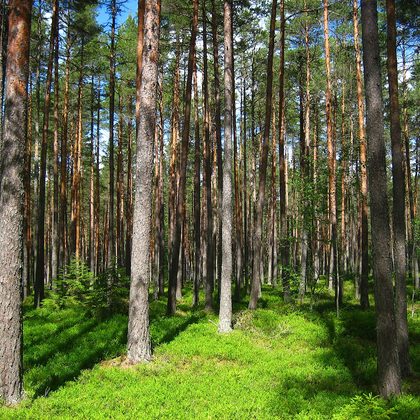 Coniferous woodland G3
Satakunta, Finland
74 species
Coniferous woodland G3
Satakunta, Finland
74 species
Woodland in which conifers hold the canopy: spruce, pine, fir, cedar, juniper and yew, together with deciduous larch. Where broadleaves take more than a quarter of the crown cover, the stand becomes mixed woodland. Coniferous woodland runs from the taiga of Fennoscandia and Russia, where Norway spruce and Scots pine stand unbroken for kilometres, to islands of silver fir and black pine, the Corsican among them, in the Alps, the Pyrenees, the Balkans and the mountains of the Mediterranean. Soils are acid and the ground carries moss, bilberry and heather. Cone seed, standing dead wood and dense cover decide what can live here: Eurasian red squirrel lives on spruce and pine seed and gives itself away by the stripped cones, Russian flying squirrel glides from trunk to trunk in the Finnish and Baltic taiga, Mountain hare turns white among the dark stems in winter, and Eurasian lynx hunts roe deer in the closest stands.
-
 Mixed deciduous and coniferous woodland G4
Massief van de Śnieżnik, Sudeten, Polen
74 species
Mixed deciduous and coniferous woodland G4
Massief van de Śnieżnik, Sudeten, Polen
74 species
Woodland in which conifers and broadleaves share the canopy, with neither group above three quarters of the cover. If conifers stay under a quarter, the stand counts as broadleaved deciduous woodland; if broadleaves do, as coniferous woodland. Its heartland is the boreonemoral belt between taiga and temperate deciduous forest — southern Scandinavia, the Baltic states, Belarus and central Russia — and beyond that the mountains of central and southern Europe, where beech, silver fir and spruce grow on one slope. The mixture supplies holes in old broadleaves and cover in dense conifer crowns at the same time: Russian flying squirrel nests in cavities in old aspens and feeds in the crowns, Greater mouse-eared bat uses the same holes as a nursery roost, Brown bear lives on berries and mast here in late summer, and Grey wolf hunts roe deer in the wide stands of Belarus and the Baltic states.
-
 Lines of trees, small woods, felled and early-stage woodland G5
Bij Kilby, Leicestershire, Engeland
44 species
Lines of trees, small woods, felled and early-stage woodland G5
Bij Kilby, Leicestershire, Engeland
44 species
Narrow strips and small patches of woodland: lines of trees along roads, ditches and fields, wooded banks with standard trees, copses and plantations of less than half a hectare, and alongside them ground recently felled, coppice, and young regrowth that will become woodland again. Parkland with widely spaced trees is not included; that sits with the grasslands. This is the wood of the farmed landscape, present all over Europe and almost always managed. The edge matters more than the interior here: much margin, much light, many insects, old pollards with holes. Clearings and young growth have mammals of their own: Roe deer finds the best browse of the year in the low leaf, Brown hare uses the openings and the wood edge beside them, Eurasian badger digs its sett into the bank under old trees, and Common pipistrelle hunts midges and moths along the lines of trees.
Inland unvegetated or sparsely vegetated habitats H
Land without a closed plant cover: less than thirty per cent of the ground is vegetated, and it is dry or wet for only part of the year. The subdivisions follow the substrate and the way it was formed: caves, screes, inland cliffs and rock pavements, snow and ice, other bare ground and drifting sand, and terrain of recent volcanic origin. For mammals it means little food and little cover, but crevices, holes and loose stone to retreat into.
-
 Terrestrial underground caves and cave systems H1
Ingang van de Malancagrot, Kras, Slovenië
43 species
Terrestrial underground caves and cave systems H1
Ingang van de Malancagrot, Kras, Slovenië
43 species
Natural caves and cave systems, with the passages, shafts and underground waters that belong to them, and the interstitial spaces within rock and gravel. EUNIS includes disused underground mines and tunnels here as substitute habitat; the rock face in which the entrance lies belongs with inland cliffs, rock pavements and outcrops. In Europe most lie in limestone — the Dinaric karst, the Alps, the Pyrenees, the Cantabrian mountains, the Carpathians — alongside gypsum caves and lava tubes. Inside it is dark, the temperature barely varies through the year and the air is saturated; nothing grows, and all the food comes from outside. That is exactly what hibernation requires. Greater horseshoe bat hangs free from the roof with its wings wrapped around it, while Greater mouse-eared bat creeps into crevices and in the south forms nursery colonies of hundreds.
-
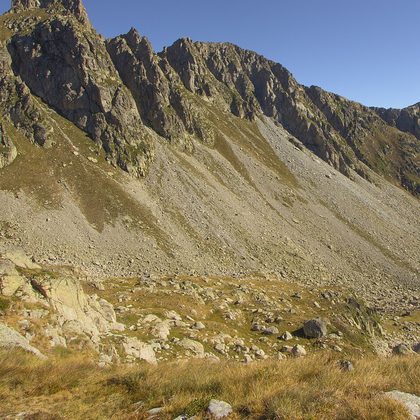 Screes H2
Serra de Rius, Catalaanse Pyreneeën, Spanje
44 species
Screes H2
Serra de Rius, Catalaanse Pyreneeën, Spanje
44 species
Slopes of rock debris, gravel and blocks that collect below cliffs and keep moving under frost and gravity. EUNIS separates screes from the rock face itself, where the rock is in place, and from stable block fields, moraine and inland sand, which belong to H5. In Europe they lie mainly in the high mountains — Alps, Pyrenees, Carpathians, Balkans, Scandinavia — and in the limestone ranges around the Mediterranean, with material from fine grit to metre-wide blocks. The vegetation is sparse: plants with long rootstocks grow up through the shifting stone. For mammals the cavities between the stones are what count, together with the security of a steep slope. Chamois crosses them without difficulty and retreats onto the scree when threatened, Alpine marmot digs its burrow in the finer ground at the edge and uses the blocks as lookouts, and Mountain hare lies up by day in a hollow among the debris.
-
 Inland cliffs, rock pavements and outcrops H3
Vega de Liordes, Picos de Europa, Spanje
71 species
Inland cliffs, rock pavements and outcrops H3
Vega de Liordes, Picos de Europa, Spanje
71 species
Cliffs, rock faces and bare rock pavements away from the coast: rock that is in place, unvegetated or carrying no more than lichens, mosses and plants rooted in the crevices. That is what separates inland cliffs, rock pavements and outcrops from scree, where the rock has broken away and moved downhill. Parts of sea cliffs beyond the reach of salt spray are included; recent volcanic rock is not. In Europe it takes in limestone gorges and karst pavements, granite tors, canyon walls and high mountain faces. What matters to mammals is the crevice: a hole in the face is dry, cool and unreachable from below. Chamois keeps its footing on the narrow ledges, Barbary macaque sleeps on the gorge walls of the Atlas and the Rif, Garden dormouse nests in fissures in limestone, and in the hill country of the Levant Rock hyrax lives in colonies among the blocks at the foot of the face.
-
 Snow or ice-dominated habitats H4
Gletsjertong van de Vatnajökull, IJsland
3 species
Snow or ice-dominated habitats H4
Gletsjertong van de Vatnajökull, IJsland
3 species
Ground that lies under snow or ice the year round: glaciers, ice caps and snowfields that do not melt out in summer. That is the boundary with the bare rock and scree around them, which do clear in summer; sea ice falls outside the group. In Europe this means the Alps and the Caucasus, the ice caps of Iceland and Norway, Svalbard and Novaya Zemlya. Nothing grows there, though algae live in the snow and insects are blown onto the ice by the wind. Mammals do not live on it; they cross it, or hunt at its edge. The polar bear walks over glaciers and firn fields from one coast to the next, and the Saimaa ringed seal pups in a lair it digs out of the snowdrift against a lake shore — without that snow there is no pup.
-
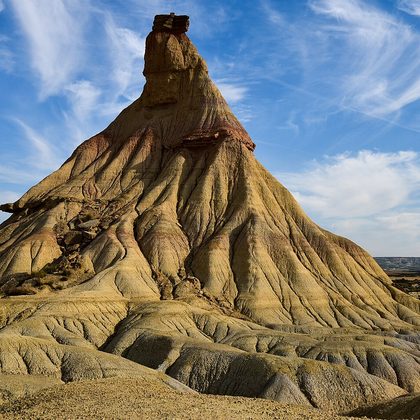 Miscellaneous inland habitats with sparse or no vegetation H5
Castildetierra, Bardenas Reales, Navarra, Spanje
60 species
Miscellaneous inland habitats with sparse or no vegetation H5
Castildetierra, Bardenas Reales, Navarra, Spanje
60 species
The catch-all of the group: bare or nearly bare inland ground that is not cliff, scree, snowfield or fresh volcanic terrain. Miscellaneous inland habitats with sparse or no vegetation take in inland dunes and drifting sand, moraines and block fields, stony desert and bare steppe soil, burnt ground and trampled patches; sealed urban surfaces belong to group J. In Europe this runs from the sand plains and sandar of Iceland to the hammada and reg of the Levant, with the bare sand and gravel steppes of Iberia, Anatolia and the Pannonian plain in between. Mammals find no cover above ground and either go below it or rely on speed. Little ground squirrel digs its burrows in bare sand and gravel steppe and vanishes at the first alarm, Cape hare has no burrow and presses itself into a shallow form, and North African sengi runs fixed paths across the stony desert.
Cultivated agricultural, horticultural and domestic habitats I
Everything kept open by regular tilling, together with ground that has only recently gone out of cultivation: arable fields, kitchen gardens, ornamental gardens and parks. Cropland that is flooded, such as rice fields, is included. Orchards, tree nurseries and tree-crop plantations fall outside it, as do lawns and sports fields. EUNIS divides the group into two formations: arable land and market gardens, and cultivated areas of gardens and parks. These are man-made habitats, and what they are worth to mammals depends above all on how intensively they are worked.
-
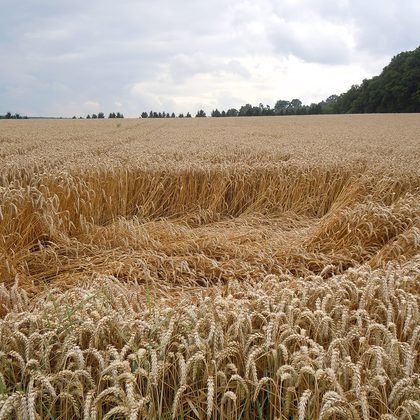 Arable land and market gardens I1
Bij Trendelburg, Hessen, Duitsland
143 species
Arable land and market gardens I1
Bij Trendelburg, Hessen, Duitsland
143 species
Land sown with crops that are harvested annually or at regular intervals and that carry no trees or shrubs: cereals, sunflower and other oilseeds, beet, potatoes, legumes and fodder. Orchards and permanent grassland fall outside arable land and market gardens; bare tilled and fallow fields belong to it, and so do wet crops such as the rice fields of the Po plain and the Guadalquivir. Scale ranges from blocks of tens of hectares to narrow strips with weedy margins and hedges, and those margins decide which mammals are there. Common vole lives off the crop itself and in good years reaches densities of hundreds per hectare, Brown hare lays its young in a shallow form between the furrows, Wild boar feeds heavily in maize and cereals, and in the arable steppes of central and eastern Europe European ground squirrel keeps its colonies on the untilled margins.
-
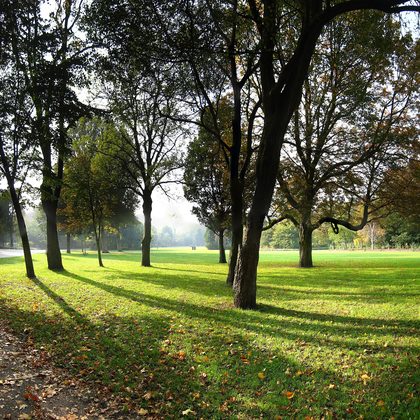 Cultivated areas of gardens and parks I2
Oosterpark, Amsterdam, Nederland
63 species
Cultivated areas of gardens and parks I2
Oosterpark, Amsterdam, Nederland
63 species
Cultivated ground in gardens and parks: kitchen gardens, ornamental gardens, planted squares in towns and larger laid-out parks. EUNIS places allotment gardens with arable land rather than here, and lawns and sports fields belong to the grasslands. What is left is a mixture of mown grass, borders, hedges, ornamental shrubs and planted trees, often exotic, with heavy trunks, cavities and dead wood in old town parks. For mammals this works as woodland edge: cover at several heights, shelter, and food all year. Western European hedgehog crosses garden after garden at night and winters under a brush pile, Common mole throws up its heaps on the mown grass, Eurasian red squirrel holds on in old town parks with heavy trees, and Common pipistrelle hunts along the avenues and over the ponds for insects drawn to the lamps.
Constructed, industrial and other artificial habitats J
Everything built or laid out by people: towns and villages, scattered rural buildings, quarries and mines, roads, railways and other hard-surfaced ground, artificial waters with constructed beds or heavily polluted water, and waste tips. Disused underground mines are not included; EUNIS places those with caves. The group is divided into six formations, J1 to J6, running from dense urban building to landfill. For mammals these places work mainly as substitutes for rock, cavity and cave, and as a source of food that is available all year.
-
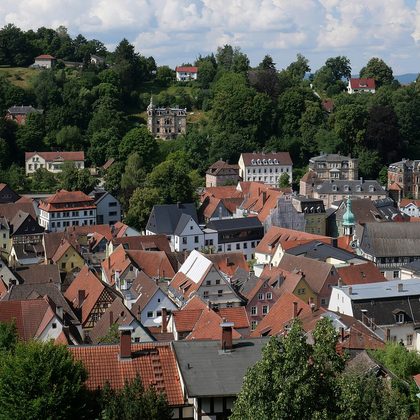 Buildings of cities, towns and villages J1
Kulmbach, Beieren, Duitsland
36 species
Buildings of cities, towns and villages J1
Kulmbach, Beieren, Duitsland
36 species
The dense building of cities, towns and suburbs: houses, offices, churches, factory sheds, walls, roofs and building sites, with the paving between them. Density is what separates it from low-density buildings: where field or pasture still dominates between the houses, the ground belongs there instead. Gardens and parks are counted separately. What buildings do for mammals is imitate rock — cavity walls, gaps behind cladding, lofts and cellars serve as day roosts and winter quarters. Common pipistrelle squeezes into the cavity wall and hunts under the street lights, House mouse lives indoors and in storerooms, Red fox holds fixed earths under sheds and railway embankments in many cities, and Raccoon dens in lofts and chimneys in German towns.
-
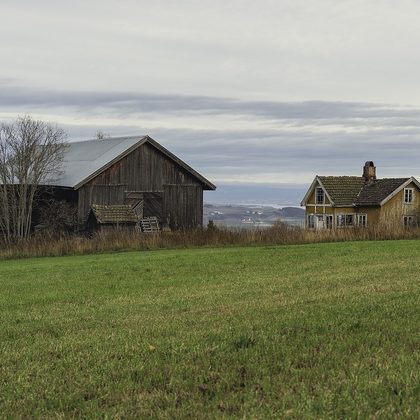 Low density buildings J2
Holmstadengen, Østre Toten, Noorwegen
63 species
Low density buildings J2
Holmstadengen, Østre Toten, Noorwegen
63 species
Scattered building in the countryside: farms, barns, byres, chapels, isolated houses and the walls and fences around them. The difference from dense urban building lies not in the building but in what surrounds it — here land, yard or orchard keeps the upper hand and the buildings stand apart. In Europe this runs from mixed farms in the north-west to stone hamlets around the Mediterranean. Open byres, undisturbed lofts and insects over the yard give shelter the city lacks. Greater mouse-eared bat has its nursery colonies in church and farmhouse lofts, Greater horseshoe bat hangs in warm roof spaces and hunts along the hedgebanks around them, Edible dormouse winters in barns and cavity walls, and Western European hedgehog forages along the muckheap and the woodpile.
-
 Extractive industrial sites J3
Duinger Berg bij Marienhagen, Nedersaksen, Duitsland
18 species
Extractive industrial sites J3
Duinger Berg bij Marienhagen, Nedersaksen, Duitsland
18 species
Quarries and mines in use or recently abandoned: stone quarries, sand and gravel pits, opencast workings, spoil heaps and the ground around them. Once a pit grows over or fills with water it passes into the corresponding natural type, and disused underground mines are placed with caves. What is there is bare and steep: fresh faces of limestone, loam or sand, scree slopes, pools on the floor and little vegetation. For mammals the value lies not in the steepness but in what is left underground: passages and recesses that are cool and damp and hold the same temperature all year. Greater horseshoe bat and Greater mouse-eared bat hibernate in them, and in autumn they gather at the entrances of quarries and mines still in use.
-
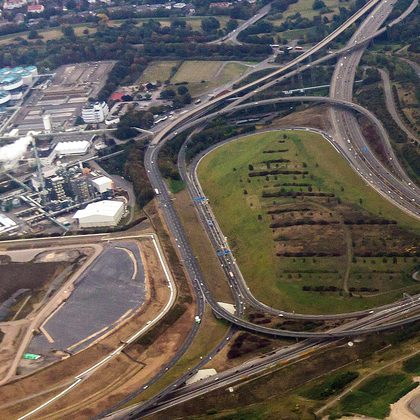 Transport networks and other hard-surfaced areas J4
Autobahnkreuz Leverkusen-West, Duitsland
11 species
Transport networks and other hard-surfaced areas J4
Autobahnkreuz Leverkusen-West, Duitsland
11 species
The hard surface itself: roads, car parks, railways, paved paths and the runways and aprons of airports, ports and recreation grounds. Verges, embankments and other vegetated edges belong with grassland or tall-herb ground, not here; this is asphalt, concrete, setts and ballast. Such surfaces are warm, open and sparsely vegetated, which makes them resemble steppe or shingle. For mammals this is above all dangerous ground: traffic takes large numbers and wide corridors cut habitats in two. Even so, the short, compacted strips on airfields and along railway lines are occupied by ground squirrels: European ground squirrel and Speckled ground squirrel dig their colonies there, and Common vole moves along the ballast from one verge to the next.
-
 Highly artificial man-made waters J5
Embalse de Guadalcacín, Cádiz, Spanje
9 species
Highly artificial man-made waters J5
Embalse de Guadalcacín, Cádiz, Spanje
9 species
Inland waters with a wholly constructed bed or heavily polluted water, together with the conduits, basins and tanks that go with them; coastal saltworks are included. Man-made waters that behave as semi-natural — pools, ponds and canals with a bed of sand or peat — stay with the standing and running waters of group C. So this means concrete reservoirs, settling basins, fish farms and the pans of salinas. For mammals what counts is mostly what can be taken in and along such waters. Common otter forages at night in fish farms and settling basins and uses the feeder canals to move between them, and Eurasian beaver settles in revetted canals and conduits as soon as willow or poplar grows along the bank.
-
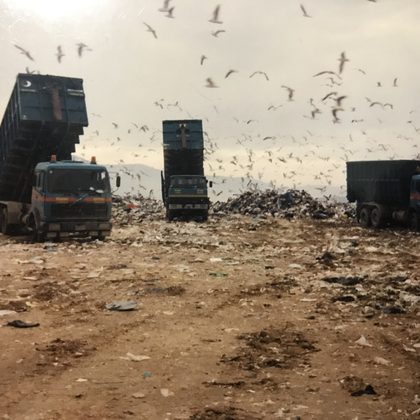 Waste deposits J6
Vuilstort bij Thessaloniki, Griekenland
2 species
Waste deposits J6
Vuilstort bij Thessaloniki, Griekenland
2 species
The dumped material itself: tips, landfill sites, sludge lagoons and heaps of residue from households, industry and farming. It is not the works that produce the waste that counts but the place where it comes to rest; once an old tip grows over it passes into tall-herb ground or scrub. In Europe this ranges from capped, gas-managed landfills in the north-west to open tips beside cities in the south and south-east. For opportunists such a site is a steady food supply available all year. Among mammals it is House mouse above all that persists there: dumped household waste supplies grain, bread and seed, and the loose packing of refuse and cover soil gives runs and nest space right beside it.
Classification: EUNIS Habitat Classification (European Environment Agency), the A–J version. The English names are those of EUNIS; the Dutch and Spanish names were translated for this guide. The descriptions were written for this guide from the EUNIS factsheets, which are linked for each habitat.