All species › Rodents › Mice and rats › Arabian spiny mouse
Arabian spiny mouse | Acomys dimidiatus
Sinaïstekelmuis | Acomys dimidiatus
The Arabian Spiny Mouse is a spiny mouse of the rocky country of Sinai, the Negev and the Arabian Peninsula. Externally it is barely separable from the Cairo Spiny Mouse. In suitable rocky habitat it is often numerous and easy to see. Where it occurs together with the Golden Spiny Mouse, the latter is active by day; this is a much-studied example of temporal partitioning between two species.

Tracks
The signs are those of a rock dweller and are found in three places. First the latrines: black, glossy, spindle-shaped droppings three to five millimetres long, heaped on a fixed ledge, a flat stone or the lip of a crevice, often by the dozen. They show that a crevice is occupied and remain recognisable for months, because little rain falls in this region. Second, food remains in front of the crevice: legs and wing cases of crickets and beetles, gnawed grains, and snail shells with the aperture gnawed widely open while the rest of the shell remains whole. Third, pellets: under Barn Owl and Eagle Owl perches in the Negev and Sinai they often contain the skulls and the recognisable spines of this species, and half an hour of analysis gives more information on the population of a wadi than a night of watching. Prints are rarely found, because the animal is light and the ground hard, but in fine dust under an overhang trails barely a centimetre wide sometimes show. Two signs are characteristic of the genus: broken-off tail tips at the entrance of a run, and tufts of shed back skin where a snake or owl has missed the animal.
In its habitat
Head close-up
Identification
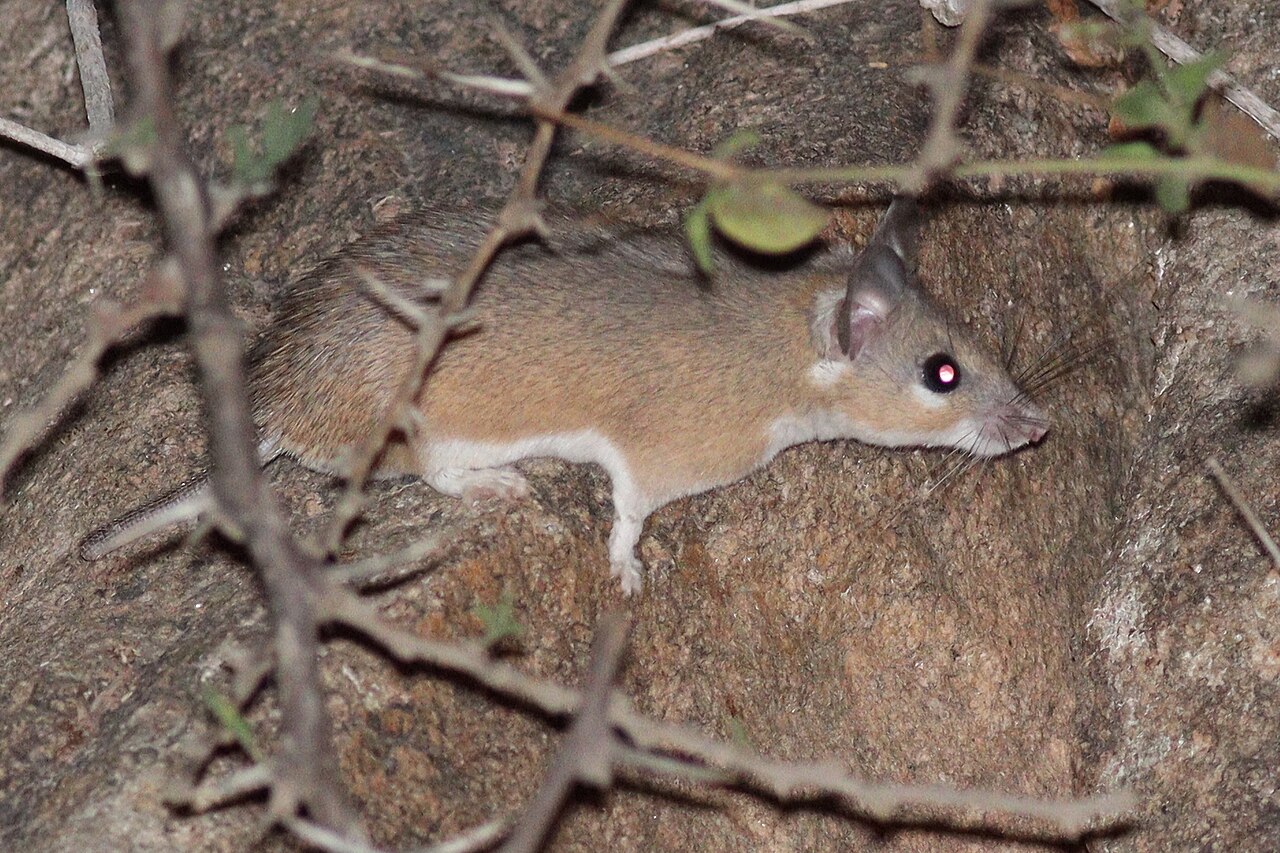
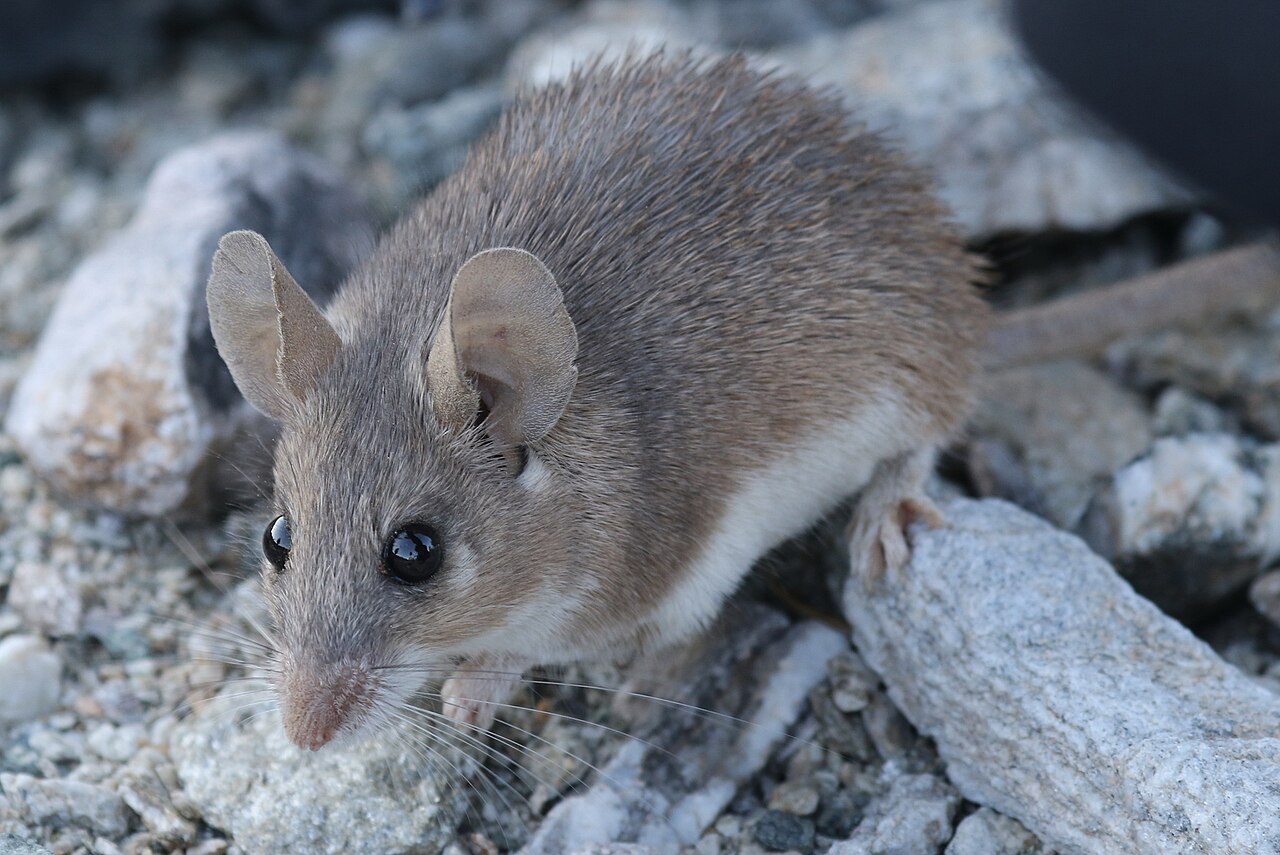
A mouse of eight to thirteen centimetres with a tail of almost the same length. The back is pale sandy fawn, a little darker over the head, with the flat, stiff spines of the genus over back and flanks; the belly is pure white. Two characters are usable in the field: a white patch behind the base of the ear and a second below the eye, both sharply demarcated against the sandy face. The ears are large and thin (18 to 22 mm), the eyes large, black and slightly bulging, the muzzle pointed. The tail is thinly haired, finely ringed and breaks off easily: a large share of the animals in any population have a stump or no tail, which is itself a character of the genus. Hind foot 19 to 22 mm, weight thirty to forty-five grams.
Similar species
The Cairo Spiny Mouse (Acomys cahirinus) is the only species with a real risk of confusion, and in the field it cannot be resolved: it averages slightly greyer and larger, with less sharply defined white patches, but the measurements overlap completely and separation rests on karyotype and DNA. Range helps: this species occurs east of the Nile and the Suez Canal, cahirinus in the western desert, Libya and on the islands. The Golden Spiny Mouse (Acomys russatus) often lives on the same rocks and is separated at once: rusty to golden-orange instead of pale sandy, a short tail under eight centimetres, and diurnal. The gerbils of the same country (mainly Gerbillus dasyurus) have a much longer tail ending in a pencil, longer hind legs, a bounding gait and no spines in the coat. The House Mouse is smaller, has a musty smell and a bare, supple tail.
Habitat
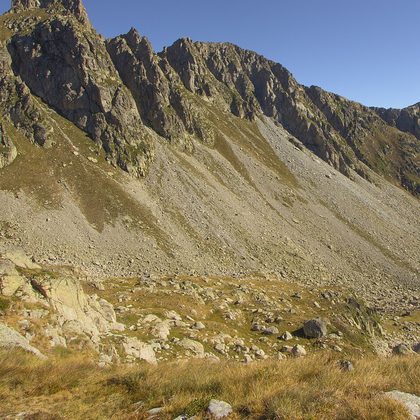
Dry rocky terrain of all types: wadi beds with large boulders, granite boulder fields, limestone and sandstone faces with crevices, scree, old terrace walls and stone heaps along field margins, from below sea level at the Dead Sea to about nineteen hundred metres in the mountains of Sinai. In sandy areas without rock the species is absent. In oases, monastery gardens and Bedouin villages it enters sheds and date stores, and in southern Israel and Jordan it is common around field stations and campsites, where walls offer the same crevices as rock faces.
Where the animal is most at home, classified with EUNIS — the European standard for habitats.



Distribution
From Sinai through Israel, Palestine and Jordan across the whole Arabian Peninsula, east to southern Iran and south-western Pakistan, and north into Lebanon, where the species has only recently been confirmed. Within the guide area this means Sinai, the Negev, the Jordan Valley, the Judean Desert and the Jordanian rock desert as far as Wadi Rum and Petra. There it is common: in suitable rocky habitat it is often the most numerous small mammal, and a single canyon above the Dead Sea may hold dozens of animals. The spiny mice in laboratories around the world belong to this species.
- Native
- dark = core range, pale = thinly spread
Way of life
Nocturnal. Where this species and the Golden Spiny Mouse share the same rocks, the Golden Spiny Mouse is active by day, although it is originally nocturnal; the shift is caused by the scent of this species. It is one of the best-known examples of competition in desert ecology. The animals live in small groups with a core of females. An omnivore with a strong preference for insects: in measured diets crickets supply half to nearly sixty per cent, barley grains a quarter, green leaf a good tenth and snails the rest. Breeding is seasonal near Taif and year-round elsewhere, with a decline in winter. After a gestation of about six weeks one to five young are born, furred and with their eyes open, weaned within two weeks; other females in the group help to suckle them. At two months the young are adult. In the wild a spiny mouse rarely lives beyond three years, in captivity five. In danger it sheds tail or skin. It does not hibernate and remains active at night in the coldest months.
Where and when to look
After sunset, sit at a rock face in a wadi with some seed on a stone in front of you and a red lamp. In the canyons above the Dead Sea, in Wadi Rum, around the monasteries of Sinai and at almost any field station in the Negev animals usually come to the seed within half an hour; they show little fear and approach to within a metre. By day you can search for latrines: walk the ledges of a rock face and look for heaps of black droppings, which are visible even when the animals themselves are not active. Also collect pellets under an overhang; the spines are visible to the naked eye and are the simplest evidence that the species lives there.
Conservation status
Least Concern (2016), common and widespread. The habitat, bare rock in a dry climate, is barely changed by human use, and building usually produces additional crevices. The species is a widely used laboratory animal, because its skin and wound healing differ from those of other mice; this use has no effect on wild populations. There is a taxonomic problem: the boundary with Acomys cahirinus runs through Egypt and cannot be drawn on field characters, so that older literature on 'Acomys cahirinus' in Israel and Arabia actually concerns this species.
Scientific name
Acomys dimidiatus | (Cretzschmar, 1827)
Cretzschmar described the species in 1827 as Mus dimidiatus; because it was later moved to another genus, the author and year stand in brackets. Acomys is Greek, from akē, 'point, sharp tip', and mys, 'mouse', after the spiny hairs on the back. dimidiatus is Latin for 'halved', from dimidium, 'half', after the coat, which divides sharply into a dark upper and a white lower half. The specimen the first description was based on came from Egypt, Sinai.