All species › Even-toed ungulates › Deer › Chital
Chital | Axis axis
Axishert | Axis axis
The chital (Axis axis) is a spotted deer from India, Nepal, Bangladesh and Sri Lanka. In the guide area it is an introduced species: since 1911 a population has lived on the Brijuni Islands off the coast of Istria in Croatia, and the species also occurs on the Croatian island of Rab. Since 2022 the chital has been on the European Union list of invasive alien species of Union concern.

Tracks
The print is a narrow cloven slot, larger than that of roe deer and smaller than that of red deer. Chital gnaw on cast antlers and bones to obtain minerals; chewed antler beams indicate the species. The most conspicuous sign is sound: hinds and young give a shrill alarm bark when in danger, and stags bellow during the rut.
Identification
A medium-sized deer of 150 to 170 cm head-body length and 65 to 100 cm shoulder height; stags weigh 98 to 110 kg, hinds 25 to 45 kg. The coat is reddish brown to golden brown with white spots retained all year, in rows along the flanks. A dark stripe runs along the back, and the throat carries a white patch. The tail is about 20 cm long, with a dark stripe on top and white below. Only the stag carries antlers: almost a metre long, with three tines per beam, the brow tine set almost at right angles to the beam.
Similar species
The fallow deer is also spotted in summer coat, but loses the spots in winter or keeps them only faintly. The fallow buck has palmate antlers; fallow deer have a white rump patch bordered in black in a horseshoe shape and a tail that is black on top. The chital has round antlers with three tines, clear spots all year and a white throat patch. The sika deer is also spotted in summer, but has a white, black-bordered rump patch that is flared when alarmed, branched antlers with more tines, and an almost unspotted, dark coat in winter.
Habitat
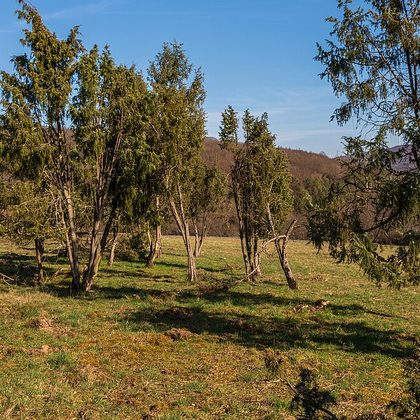
In the native range deciduous and semi-evergreen forest with grassland, where the animals graze along the forest edge. On the Brijuni Islands the chital lives in a park-like landscape of grassland, copses and Mediterranean scrub. Water nearby is important: the animals drink twice a day.
Where the animal is most at home, classified with EUNIS — the European standard for habitats.



Distribution
Originally the Indian subcontinent, from Nepal and India to Bangladesh and Sri Lanka. Outside Asia it has been released in many places, including Australia, Argentina and the United States. In the guide area chital live only in Croatia: on the Brijuni Islands, where they were brought in 1911, and on the island of Rab. Attempts to introduce the species to the Croatian mainland for hunting have failed.
- Established introduction
- dark = core range, pale = thinly spread
Way of life
The chital is active by day. In warm weather it rests in the hottest hours and forages early in the morning and late in the afternoon. It is mainly a grazer; in the dry season it also eats herbs, leaves and fallen fruit. The animals live in herds centred on a group of hinds with young, usually small but up to a hundred animals; stags form their own groups. Breeding is possible all year, with peaks that differ between areas. Gestation lasts about 7.5 months; one or two young are born. In India the chital responds to the alarm calls of langurs, monkeys that see predators approaching from the trees.
Where and when to look
In the guide area the chital is easiest to see in Brijuni National Park, reached by boat from Fažana. The animals graze on the open grassland of the main island, especially in the morning and late afternoon, and are used to people. In a group of spotted deer, check the throat patch and the antlers to separate them from fallow deer.
Conservation status
Least Concern (LC, 2015), because the chital occurs over a large area with many large populations. Since 2 August 2022 the species has been on the European Union list of invasive alien species of Union concern; import, keeping, breeding and release are therefore prohibited throughout the EU. In its native range the chital is protected in India and Bangladesh.
Scientific name
Axis axis | (Erxleben, 1777)
Erxleben described the species in 1777 as Cervus Axis; because it was later moved to another genus, the author and year stand in brackets. Axis comes from Pliny, who used the name for a spotted animal of India; the word is not Latin and was presumably picked up there. The specific name repeats the genus name. The specimen the first description was based on came from India, Bihar.