All species › Hedgehogs, shrews and moles › Hedgehogs › Desert hedgehog
Desert hedgehog | Paraechinus aethiopicus
Abessijnse egel | Paraechinus aethiopicus
The Desert Hedgehog is a hedgehog of the Sahara and the deserts of the Middle East. In the north of its range it occurs in North Africa, the Negev and the Jordan Valley. It is recognised by a dark mask around muzzle and eyes below a white forehead band.
Tracks
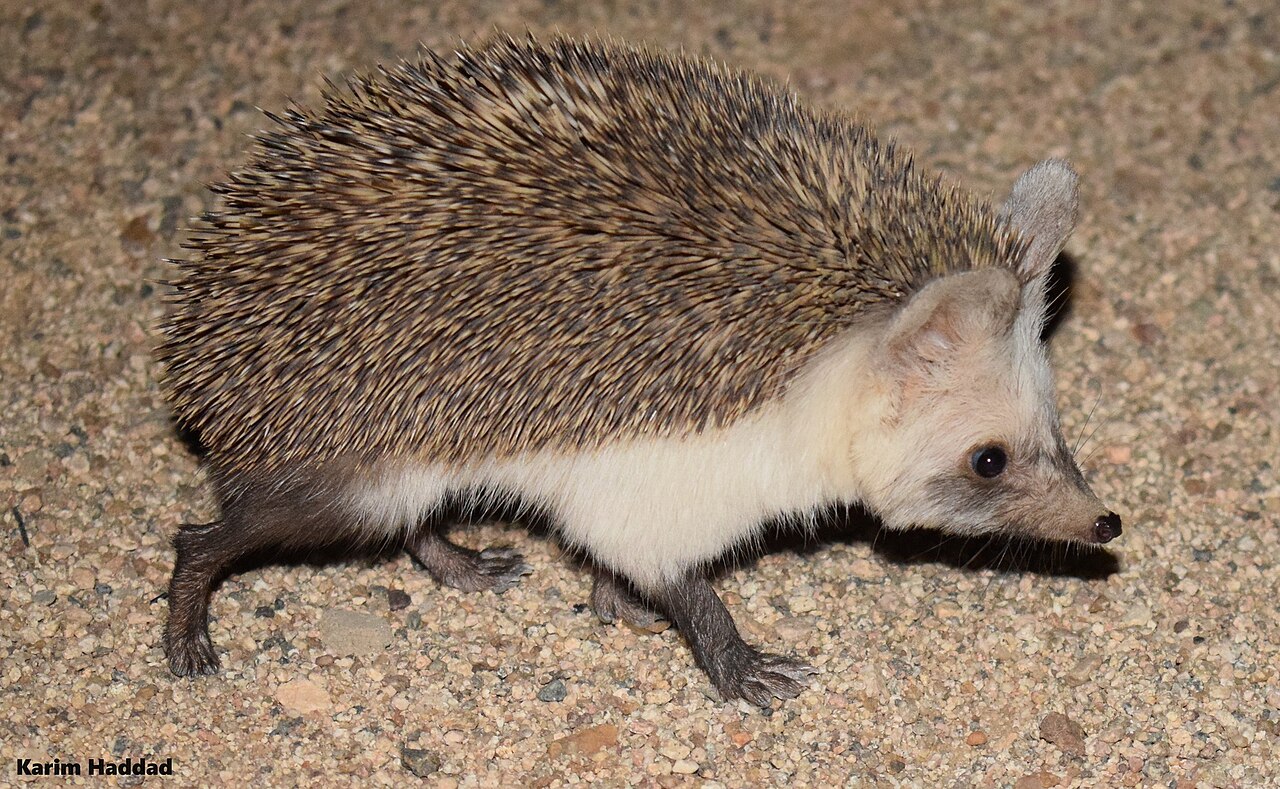
In desert sand the trail of this species is clearer than that of other hedgehogs. The print shows five toes with sharp, far-projecting claw marks; the long legs place the prints well apart and the trail runs in a regular line that can sometimes be followed for hundreds of metres, up to the spot where the animal began to dig. The dropping is small for a hedgehog, two to four centimetres, cylindrical, black and glossy, and contains much beetle grit; in the desert it also contains segments and the sting of scorpions, and sometimes hair or scales of small vertebrates. It lies uncovered on sand, on a track or at the burrow entrance. The burrow is used all year and lies usually under a bush, at the foot of a rock or in the loose ground of a wadi, with a fan of spoil and a worn path. Where a burrow has been used for some time, droppings and prey remains lie around the entrance. In oases and along garden edges conical snout holes show in the soft sand. The species basks; a hedgehog lying still beside a stone in early morning light is therefore not necessarily sick.
Head close-up
Identification
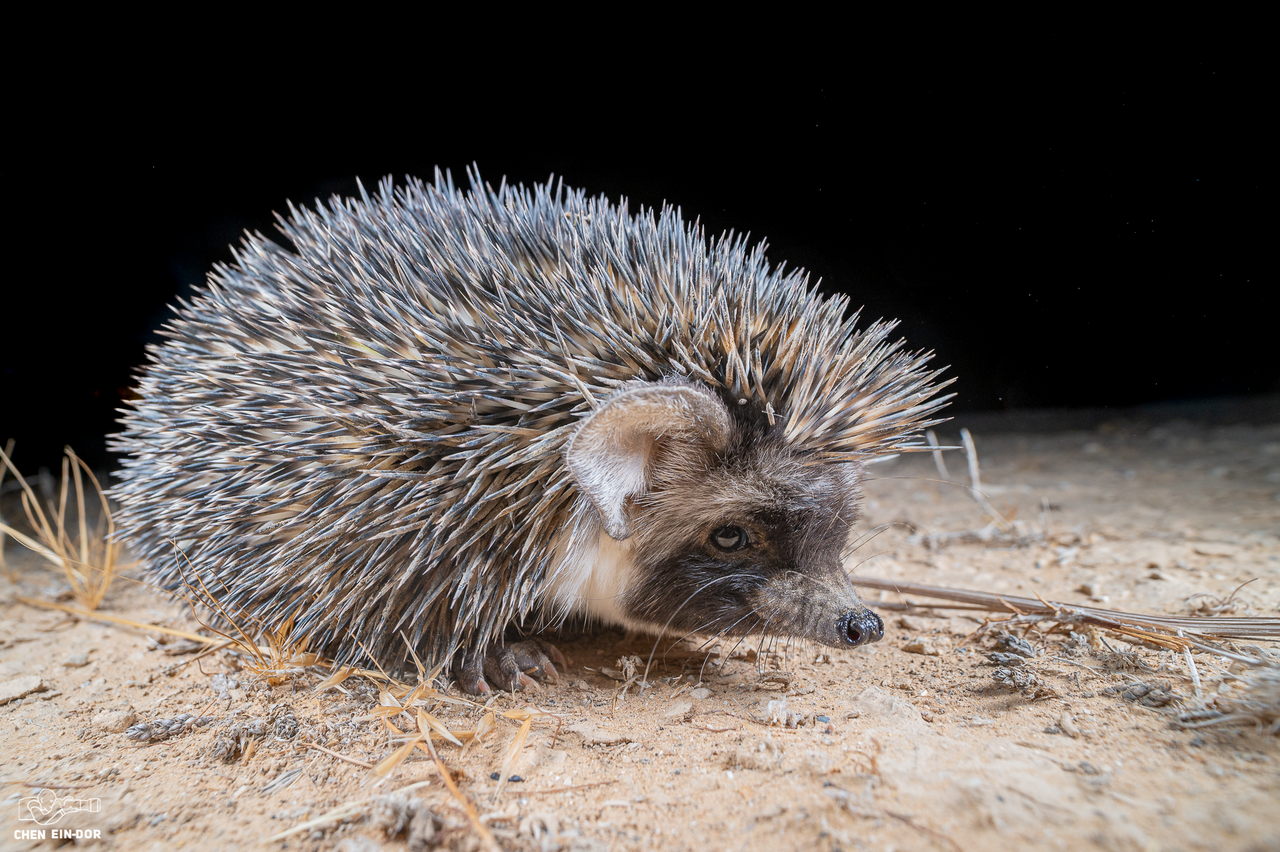
A small hedgehog of thirteen to twenty-four centimetres and two hundred and eighty-five to seven hundred grams, with long legs and a short tail one to three centimetres long. The main character is the facial pattern: across the forehead runs a broad white band from cheek to cheek, and below it lies a grey-black mask around muzzle and eyes, a pattern no other hedgehog in this region has. The ears are large and dark, twenty-three to fifty-eight millimetres, and stand well clear of the spines. The spines are white at the base, carry two black bands separated by white, and end white; the spine coat is therefore pale and finely speckled. The belly is thinly haired and mostly white, with brown patches in places. It walks high on the legs, reaches about ten kilometres an hour and, unlike the European hedgehogs, does not roll up at every disturbance.
Similar species
The Long-eared Hedgehog (Hemiechinus auritus) occurs in the same area in Israel, Jordan and north-eastern Libya and is the species most likely to be confused with it. It also has long legs and large ears, but its face is plain greyish-brown or sandy, without a mask and without a white forehead band, its ears are narrower and more pointed, and its belly is pure white. The Desert Hedgehog is recognised by the contrast between white forehead and dark mask. In the Maghreb the North African Hedgehog (Atelerix algirus) also occurs, a species of moister Mediterranean scrub and farmland, with a pale white forehead and pale cheeks without a mask and a bare parting down the middle of the crown; it is also larger and heavier. In the Levant Erinaceus concolor is added, which is much larger and darker, with small ears and a dark belly, and lives in fields and gardens. The facial pattern is the decisive character in this region: mask with a white forehead band is this species; plain face with very long ears is the Long-eared Hedgehog; pale face with a crown parting is the North African Hedgehog; large, dark and small-eared is Erinaceus.
Habitat
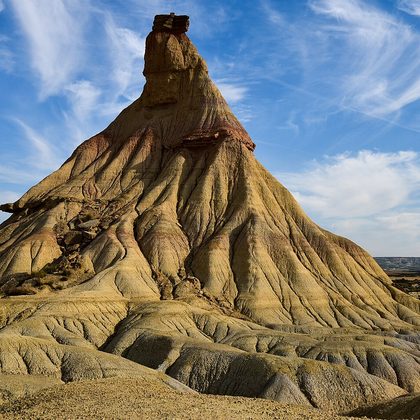
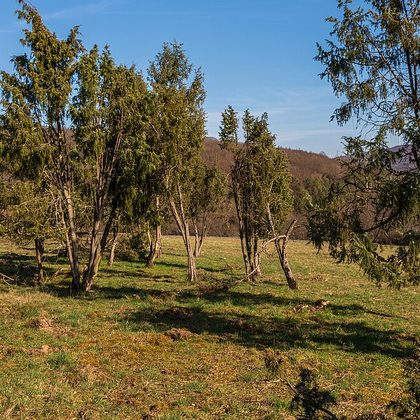
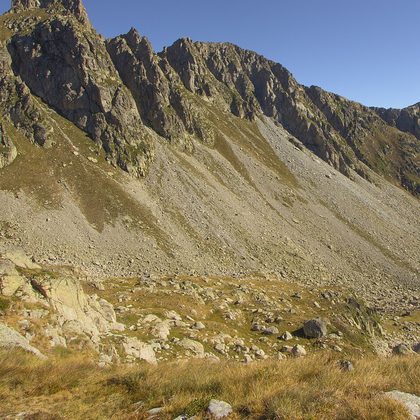
Dry, open terrain: stony plains, dry steppe, desert scrub and mountain desert, and within these mainly the places with more water and cover: oases, wadis with bushes and vegetated valleys. Unlike the Long-eared Hedgehog it can live in very dry country, and it has been recorded throughout the Sahara. Climate models show that nearly the entire desert has a suitable climate for it and also had one at the Last Glacial Maximum; this explains why its genetic material hardly divides into groups across the whole area. It enters villages and gardens where water is provided, and on islands such as Djerba it is common.
Where the animal is most at home, classified with EUNIS — the European standard for habitats.

Distribution
The Sahara and the deserts of the Middle East: from Mauritania east through Morocco, Algeria, Tunisia, Libya and Egypt to Sudan, Eritrea and Ethiopia, and on across the Arabian Peninsula to Iraq and Iran, with island populations on Djerba, Bahrain and Tunb. The species is regarded as monotypic: the DNA shows no clear geographic structure across the whole area, and the subspecies formerly distinguished are no longer recognised. In the north of the range it occurs in the Negev and the Jordan Valley, where most records come from, and in Morocco south of the High Atlas and the Anti-Atlas, in Algeria north to the Saharan Atlas and the M'Sila region, in southern Tunisia and along the coasts of Libya and Egypt. The species does not occur in Europe.
- Native
- dark = core range, pale = thinly spread
Way of life
Nocturnal, solitary and site-faithful: it uses the same burrow all year and spends the hot hours of the day there. Mainly insectivorous, with a broad diet: beetles, ants and other invertebrates, scorpions, spiders and snails, and also frogs, lizards, snakes, birds' eggs and carrion. For a hedgehog, breeding is rapid and frequent: up to four litters a year have been recorded, with peaks in February–March and in June. After a gestation of thirty-four to forty-six days two to seven young of six to nine grams are born; at sixty days they weigh about one hundred and fifty grams, and they are weaned between forty and fifty-eight days. Animals reach six to ten years. Wintering differs by region: in the warmest parts of the range it remains active nearly all year, but where winters are cold, in the uplands of the Maghreb and on the Levantine plateau, it enters torpor for days to weeks at a time. A months-long hibernation as in the common hedgehog is not known from this species; its wintering is therefore classed as winter rest and not as hibernation. It basks to warm up.
Where and when to look
In the Negev or the Jordan Valley, drive slowly along dirt roads in the first hours of darkness and watch the verges: the species walks on the open sand between the bushes and regularly crosses the road. February to April is the best period, because one of the two breeding peaks falls then and the nights are not yet too warm. In North Africa the same method works in oases and along the edges of irrigated fields. By day, look for the burrow under a bush and wait there after sunset; the species uses the same entrance all year, so a known burrow gives a good chance of an observation. Use a torch with a red filter. The hedgehog rarely rolls up and tends to run away. Photograph the face head-on if possible; the mask is the identification character and makes the record verifiable.
Conservation status
Least Concern globally (LC, 2016), with a large range and a presumably large population. The assessors name advancing desertification as a risk: it fragments the patches of scrub and water on which the species depends and isolates populations from each other. In Algeria the species is hunted; in Somaliland cultural beliefs protect it. Nowhere in the range are systematic counts carried out; the assessment therefore rests mainly on the absence of reports of decline. Genetic research shows that the species forms a single unit across the Sahara, that the climate was suitable across nearly the entire desert during the ice age as well, and that the subspecies formerly distinguished have no basis. Hedgehogs from the Negev and from southern Morocco therefore belong to the same species without subspecific distinction.
Scientific name
Paraechinus aethiopicus | (Hemprich & Ehrenberg in Ehrenberg, 1833)
Hemprich & Ehrenberg in Ehrenberg described the species in 1833 as Erinaceus aethiopicus; because it was later moved to another genus, the author and year stand in brackets. Paraechinus is Greek, from para, 'beside, near', and echinos, 'hedgehog': the genus standing beside the hedgehogs. aethiopicus means 'Ethiopian', from Greek Aithiops, usually read as 'of burnt face'; the ancients meant by it Africa south of Egypt, and the type material comes from Sudan. The specimen the first description was based on came from Sudan.