All species › Rodents › Jerboas › Greater Egyptian jerboa
Greater Egyptian jerboa | Jaculus orientalis
Reuzenwoestijnspringmuis | Jaculus orientalis
The Greater Egyptian Jerboa is the large jerboa of the northern edge of the Sahara. It is two to three times as heavy as the Lesser Egyptian Jerboa and makes leaps of up to three metres long and a metre high. It undergoes deep hibernation, during which body temperature falls to about ten degrees and the heart beats nine times a minute. Its trail is the same two-legged trail as that of the other jerboas, but larger.

Tracks
The trail is the same as in the other jerboas, but larger and therefore often the easiest to find. It sets down only the hind feet: pairs of three-toed prints with smooth sand between them, without forefeet and without a drag mark. The leap is long — a fleeing animal jumps one and a half to three metres far and a metre high — so the trail consists of widely spaced pairs; the next pair sometimes lies outside the field of view and can be found in line with the last two. On firm, gritty ground it registers less deeply than the small species on loose sand, and sometimes only the three claw points remain visible. Where it has fed, the two forefeet stand side by side next to a small scrape with root remains. The burrow is larger than that of the smaller species and is dug in firm ground: a tunnel 1 to 2.5 m long reaching 0.75 to 1.75 m deep, with the entrance plugged by day. The winter burrow lies deepest. Search before nine in the morning, before the wind has erased the tracks.
Identification
A robust, sandy-grey to ochre rodent with the build of a jerboa: head-body up to 16 cm and a weight of 134 to 139 g, two to three times as heavy as the Lesser Egyptian Jerboa. Large eyes, rounded ears, a short, broad muzzle with long whiskers, and hind legs about four times as long as the forelegs. The hind foot has three toes with brushes of hair underneath. The tail is longer than the body, thin, and ends in a flat black-and-white tuft. The coat is coarser and duller than in the smaller species, with less pure white on the flank; the belly is white. It moves by leaping, with the body upright; the tail is used for balance and supports the animal when sitting.
Similar species
The only species with which confusion is likely is the Lesser Egyptian Jerboa, which has the same shape and occurs alongside it in much of North Africa. The difference is size and weight: 134 to 139 g against 43 to 73, and a head-body length of up to 16 cm against at most 11 cm. In the hand this is obvious at once; in the field, and certainly in a vehicle's headlights, usually not; a single jerboa at night is then recorded as Jaculus. The ground gives an indication: the Greater Egyptian Jerboa chooses firmer, better vegetated ground — steppe, plateau, field margins, shrubby wadi floors — whereas the smaller species inhabits open, loose sand at dune bases and on hamada. In the trail the leap is longer and the print broader, but without a measuring stick and without a second trail for comparison this is no proof. Otherwise confusion is possible only with gerbils, which run on four feet and have no two-coloured tail tuft.
Habitat
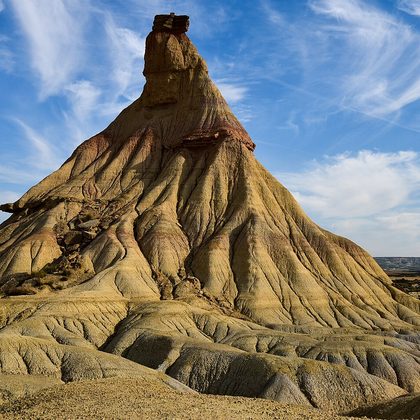
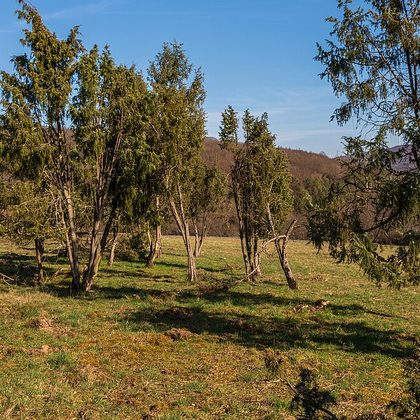
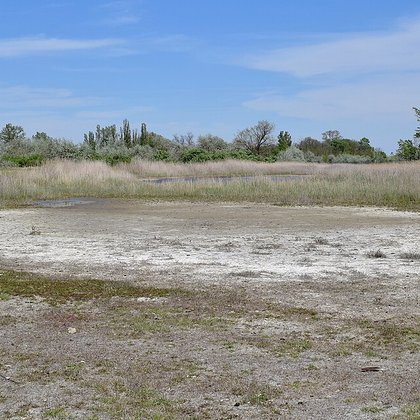
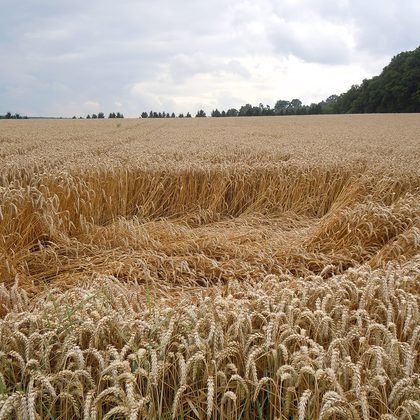
The firmer, less extreme desert margin: steppe and semi-desert with scattered shrubs, plateaux, wadi floors, salt steppe with sebkha edges, sandy coastal strips, and also farmland and the edges of settlements. It is much less tied to loose drifting sand than the Lesser Egyptian Jerboa and lives mainly on the Mediterranean side of the Sahara, in the area between the Atlas and the true desert, where it rains in winter and is dry in summer.
Where the animal is most at home, classified with EUNIS — the European standard for habitats.
Distribution
The northern edge of the Sahara and the Levantine desert: Morocco, Algeria, Tunisia, Libya and Egypt, and further Sinai and southern Israel. Almost the entire range therefore lies within the guide area. In the Negev it may have disappeared. GBIF holds about five hundred records within the guide area, against more than thirteen hundred for the Lesser Egyptian Jerboa; this fits the picture that it is everywhere the scarcer of the two. It does not occur in Europe.
- Native
- dark = core range, pale = thinly spread
Way of life
Nocturnal: it emerges in the last light of dusk and disappears at first light. It is more strictly herbivorous than the Lesser Egyptian Jerboa: succulent roots, shoots, seeds, grain and sometimes crops, with the occasional insect. It undergoes deep hibernation: body temperature falls from 37 degrees to about 10 degrees, and the heart rate from about three hundred to about nine beats a minute. It then lies curled up in the deepest chamber of a burrow 0.75 to 1.75 m below the surface and 1 to 2.5 m long. Breeding takes place between February and July; after a gestation of about forty days two to eight, on average three, young are born, and unlike the Lesser Egyptian Jerboa it has only one litter a year. In captivity it lives more than six years; nothing is known about its age in the wild.
Where and when to look
Look for it where desert gives way to steppe: the plateaux of central Morocco, the Algerian and Tunisian steppe south of the Atlas, the edge of the Egyptian Western Desert. In the first hour after dark drive at walking pace along a track and watch for eyeshine; a startled animal makes a single high leap and is then gone. Warm, windless spring nights are most suitable, because it has just emerged from hibernation and is fully active. From November into February it is underground. By day tracks are the best source: walk a wadi floor at first light and look for pairs of prints a metre and a half or more apart.
Conservation status
Least Concern (LC, 2016). The range is large, the species tolerates farmland and does not depend on a single landscape type. It is, however, almost everywhere the less numerous of the two North African jerboas, and in the Negev, at the north-eastern edge of the range, where the landscape has changed most, it is regarded as possibly extinct. Its preference for firmer, and therefore more easily cultivated, soils makes it more sensitive to conversion to farmland. Other threats are local: conversion of steppe to arable land, overgrazing and poisoning in agricultural areas.
Scientific name
Jaculus orientalis | Erxleben, 1777
Erxleben described the species in 1777 and placed it straight away in the genus where it still stands. Jaculus is Latin for 'thrown, darting', from iacere, 'to throw'; the Romans also used it of a snake that shot out like a javelin. orientalis is Latin for 'eastern', from oriens, 'rising sun, east'. The specimen the first description was based on came from Egypt.