All species › Bats › Vesper bats › Kolombatovic's Long-eared Bat
Kolombatovic's Long-eared Bat | Plecotus kolombatovici
Plecotus kolombatovici | Plecotus kolombatovici
Kolombatovic's Long-eared Bat is a long-eared bat of the coasts and islands of the eastern Mediterranean, from the Adriatic coast of Croatia to Lebanon and Cyprus. Đulić described it in 1980 from the island of Korčula as a subspecies of the Grey Long-eared Bat; in 2001 it was raised to species rank on genetic and morphological grounds. The forearm measures 36 to 39 mm and averages shorter than in the Brown, Grey and Mountain Long-eared Bats; weight is about 7 grams.
No photograph of a living wild animal of this species with a suitable Creative Commons licence exists. Do you have one that meets the rules? Send it in.
Tracks
Maternity colonies roost in rock crevices, karst cavities and old buildings, sometimes together with other bat species; single bats in rock crevices, cracks in walls and caves. In Albania the species uses bunkers as roosts all year, including the breeding season. In winter it changes roosts and hangs singly or in small groups in caves, mines and trees. Droppings and sometimes moth wings lie beneath the hanging spots in a cave or building. With a detector the call can only be recorded at close range and cannot be separated from that of other long-eared bats.
Identification
A small long-eared bat with ears of 29 to 35 mm. The dorsal fur is very dense, 11 to 12.5 mm long, brownish, drab or sand-coloured, with tricoloured hairs; the underparts are whitish, the hairs dark at the base and white or grey at the tip. A characteristic feature is that the fur covers the face and chin almost completely; the muzzle is dark and small, with small warts around the mouth covered in short hair. The wings are almost transparent and weakly pigmented. The claws are short, as in the Grey Long-eared Bat, and the tibia is shorter than 18 mm. Unlike the other species, it lacks vibrissae on the feet. The penis is rounded or club-shaped. Males have a forearm shorter than 38 mm, females up to 39 mm. The skull is small, with a short rostrum and two strong ridges separated by a groove at the front, as in the Grey Long-eared Bat. The call has the structure of all long-eared bats, with two harmonics that usually do not overlap.
Similar species
The Grey Long-eared Bat (P. austriacus) occurs in the same region and has been recorded at the same site in Albania. It is larger (forearm 36.5–43.5 mm), has a dark, bare-looking face with a long muzzle and a longer, broader tragus (over 14 mm); the short claws and club-shaped penis are shared by both species. The Brown Long-eared Bat (P. auritus) has a pale face, a thumb longer than 6.5 mm with long, curved claws and hairy feet. The Mountain Long-eared Bat (P. macrobullaris), which occurs in the Dinaric Alps, Greece and Crete, has a triangular chin pad, a thumb longer than 6.2 mm and a cylindrical penis; both species have been found together in lofts in Croatia. Populations from North Africa and Pantelleria formerly included in P. kolombatovici are now separated as Gaisler's Long-eared Bat (P. gaisleri), which differs only in skull and baculum measurements. In the south-east the range borders that of Christie's Long-eared Bat (P. christii), which is paler, with an almost naked, pale face. Because the measurements of the species overlap, identification by appearance alone is provisional; recent records, such as those from Italy, were confirmed by DNA.
Habitat
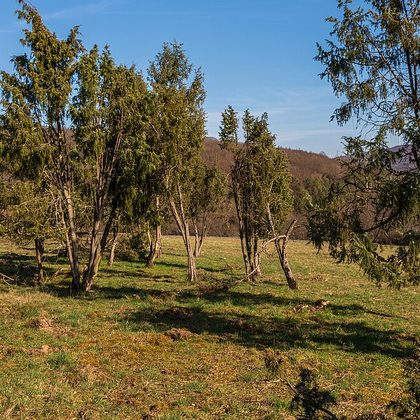
The species occurs in a wide range of habitats: woodland and wooded ground, but also open and semi-open land such as fields and Mediterranean scrub. It has been recorded over small brackish streams, in organic olive groves and in karst areas along the Mediterranean coast. In Croatia it occurs from sea level to 800 m, mainly in dry, warm habitats. It forages in open space, over bushes and forest clearings.
Where the animal is most at home, classified with EUNIS — the European standard for habitats.





Distribution
The Adriatic coast of Croatia and the southern Balkans, Greece, southern Turkey, north-west Syria and Lebanon, and the islands of Crete, Rhodes and Cyprus; probably also Israel, Palestine and Jordan. In 2019 the species was confirmed by DNA for the first time on the Italian mainland; a distribution model predicts suitable habitat along much of the Tyrrhenian coast. A record from Albania points to a wider distribution in the south-western Balkans. Older records from Bosnia and Herzegovina rest on measurements and have not been confirmed genetically. The species is monotypic. The North African populations, for a time treated as subspecies of P. kolombatovici, are now regarded as P. gaisleri.
- Native
- dark = core range, pale = thinly spread
Way of life
The diet consists mainly of moths, beetles and flies, caught both in flight and from surfaces, in a manner similar to that of the Grey Long-eared Bat. Maternity colonies hold a few tens to more than a hundred females. Winter is spent in hibernation, singly or in small groups, in caves, mines and trees. No species-specific data on reproduction, longevity or movements have been published.
Where and when to look
Caves, karst crevices and old buildings along the coasts of Dalmatia, Greece and the Aegean islands are where this species roosts. In the field a photograph can show the furred face and the small, dark muzzle, but an identification without measurements or DNA remains uncertain. Do not disturb roosts in caves; cave tourism is cited as a threat.
Conservation status
Least Concern (LC) on the global Red List, assessed in 2023. There are no population estimates; the species is widespread and flexible in its choice of habitat. European populations may be decreasing. Threats cited in Europe are disturbance of roosts by tourists and pesticides. As a European bat the species falls under Annex IV of the Habitats Directive, the Bern Convention and the EUROBATS Agreement.
Scientific name
Plecotus kolombatovici | Đulić, 1980
Đulić described the species in 1980 and placed it straight away in the genus where it still stands. Plecotus is Greek, from plekein, 'to plait, twist together', and ous, genitive ōtos, 'ear', after the huge ears joined across the forehead. kolombatovici honours the Croatian zoologist Juraj Kolombatović (1843–1908), a schoolmaster in Split who described the fauna of Dalmatia. The specimen the first description was based on came from Croatia, Korčula.