All species › Bats › Vesper bats › Pond bat
Pond bat | Myotis dasycneme
Meervleermuis | Murciélago Ratonero Lagunero
The pond bat is a medium-sized Myotis of lowlands with abundant open water in central and eastern Europe and further east to the Yenisei. It hunts over canals, rivers and lakes and takes prey from the water surface with its large feet. Maternity colonies are mainly in buildings. The species is listed as Near Threatened on the global Red List.
Tracks
Maternity colonies are mainly in buildings: in attics, churches and cavities under roofs, only occasionally in trees, rock crevices or bat boxes. In Denmark colonies of several thousand have occasionally been found. Beneath a maternity roost droppings lie on attic beams and floors. In winter the bats hang singly or in small groups in cellars, caves and bunkers, and change roost during the winter. Over open water, hunting bats can be seen on summer evenings in the light of a lamp as bats flying low over the water.
Identification
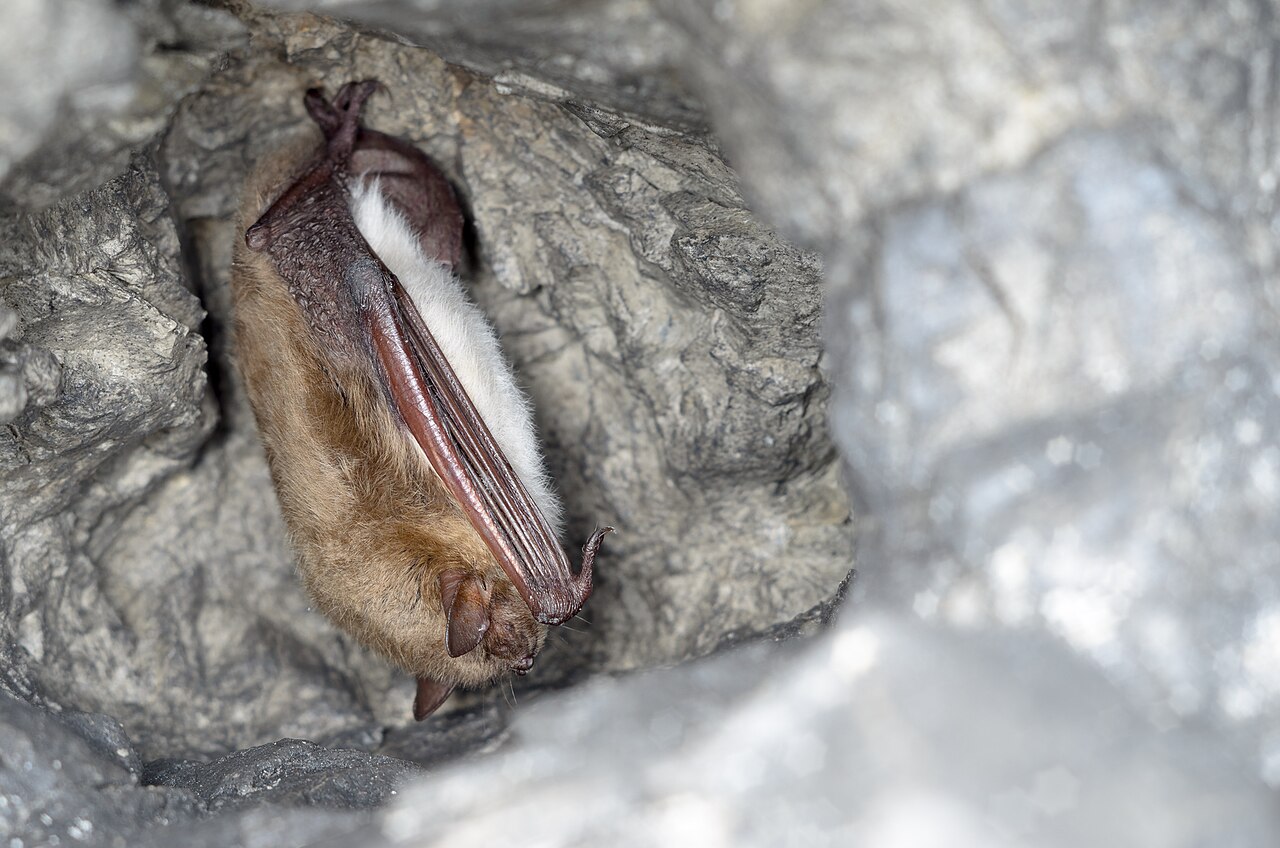
A medium-sized Myotis, clearly larger than Daubenton's bat: forearm 43 to 49 mm, weight 13 to 18 g. The fur is shaggy; the back is brown to greyish brown, the underside paler, grey to yellowish white. Face and forearms are brown, ears and membranes greyish brown, and there are dark warts on either side of the muzzle. The ears are fairly short and without a notch; the tragus is shorter than half the ear height and relatively broad. The wing attaches at the heel, and the feet are large and strong, with long hairs. The calcar is straight and fairly short, reaching about a third of the way along the tail. Echolocation consists of broadband frequency-modulated calls starting at 65 to 85 kHz and ending at 25 to 35 kHz.
Similar species
Daubenton's bat (M. daubentonii) hunts at the same places and in the same way, but is smaller (forearm 33 to 42 mm, weight 6 to 10 g), has the wing attached at the base of the outer toe and a narrower, pointed tragus, and flies lower over the water. The long-fingered bat (M. capaccinii) also has large feet, but a densely haired tibia and a wing attached at the end of the tibia; it lives in the Mediterranean region and barely overlaps with the pond bat. Over water the pond bat can be distinguished from Daubenton's bat by its size and higher and faster flight, but certain identification is only possible with a bat in the hand.
Habitat
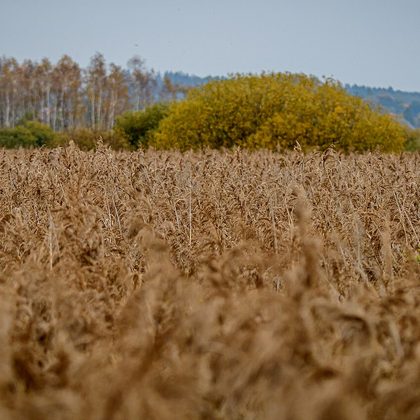
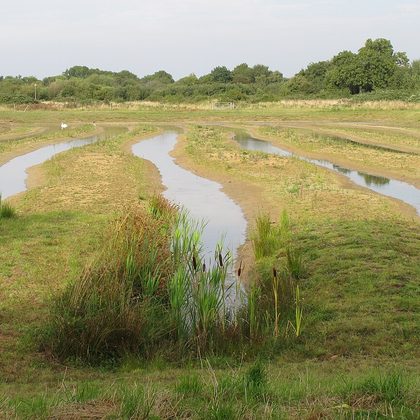
Almost always tied to water: canals, rivers, streams, lakes and ponds, often broad, slow-flowing rivers with open banks. The species occurs from sea level to 1500 m; in summer in lowland meadows and woodland, in autumn and winter in the foothills. Wooded connections are important for commuting between summer and winter roosts. It sometimes also forages along woodland edges and over meadows, and occasionally over the sea.
Where the animal is most at home, classified with EUNIS — the European standard for habitats.





Distribution
Central and eastern Europe, from southern Sweden to northern France, Germany and Poland, and east to the Yenisei in central Russia; isolated populations in Hungary, Romania, Ukraine and northern Kazakhstan. Little is known about the eastern part of the range.
- Native
- dark = core range, pale = thinly spread
Way of life
The pond bat hunts by trawling over open, still water: it takes prey from the surface with its feet or tail membrane, including non-biting midges just emerging from the water. It flies slightly higher and faster (7 to 9 m/s) than Daubenton's and long-fingered bats and prefers banks free of obstacles. Over water it eats mainly gnats, midges and caddisflies, along woodland edges beetles and moths. Maternity colonies usually hold fewer than a hundred females, in a few cases up to 750; males rarely form groups of more than a few dozen. Females breed from their second year; occasionally twins are born. The species is not a long-distance migrant, but summer and winter roosts lie 100 to 350 km apart. The maximum known age is 21 years.
Where and when to look
On summer evenings you can follow hunting pond bats over broad canals and lakes with a bat detector and a weak lamp shining across the water from the side. A large, fast and straight-flying 'Daubenton's bat' over open water may be a pond bat, but certain identification requires a bat in the hand or a combination of a sighting and a good sound recording. Maternity roosts in attics are not entered from May to August.
Conservation status
Near Threatened (NT, 2016). There are no estimates of the total population, but a decline over recent decades is suspected, especially in the Netherlands, and many known maternity colonies have been lost. Reported threats are the degradation of aquatic habitat, water pollution, the destruction of riparian vegetation, and disturbance and loss of roosts. More information is needed from the east of the range. The species is listed in Annexes II and IV of the Habitats Directive, which requires the designation of Special Areas of Conservation for it, and is covered by the Bern Convention and the EUROBATS Agreement.
Scientific name
Myotis dasycneme | (F. Boie, 1825)
F. Boie described the species in 1825 as Vespertilio dasycneme; because it was later moved to another genus, the author and year stand in brackets. Myotis is Greek, from mys, genitive myos, 'mouse', and ous, genitive ōtos, 'ear': 'mouse-ear'. dasycneme is Greek for 'shaggy-shinned', from dasys, 'thickly haired', and knēmē, 'shin, lower leg', after the hair on the tibia. The specimen the first description was based on came from Denmark, Jutland.