All species › Lamiales › Rainbow plant family › Byblis rorida
Byblis rorida
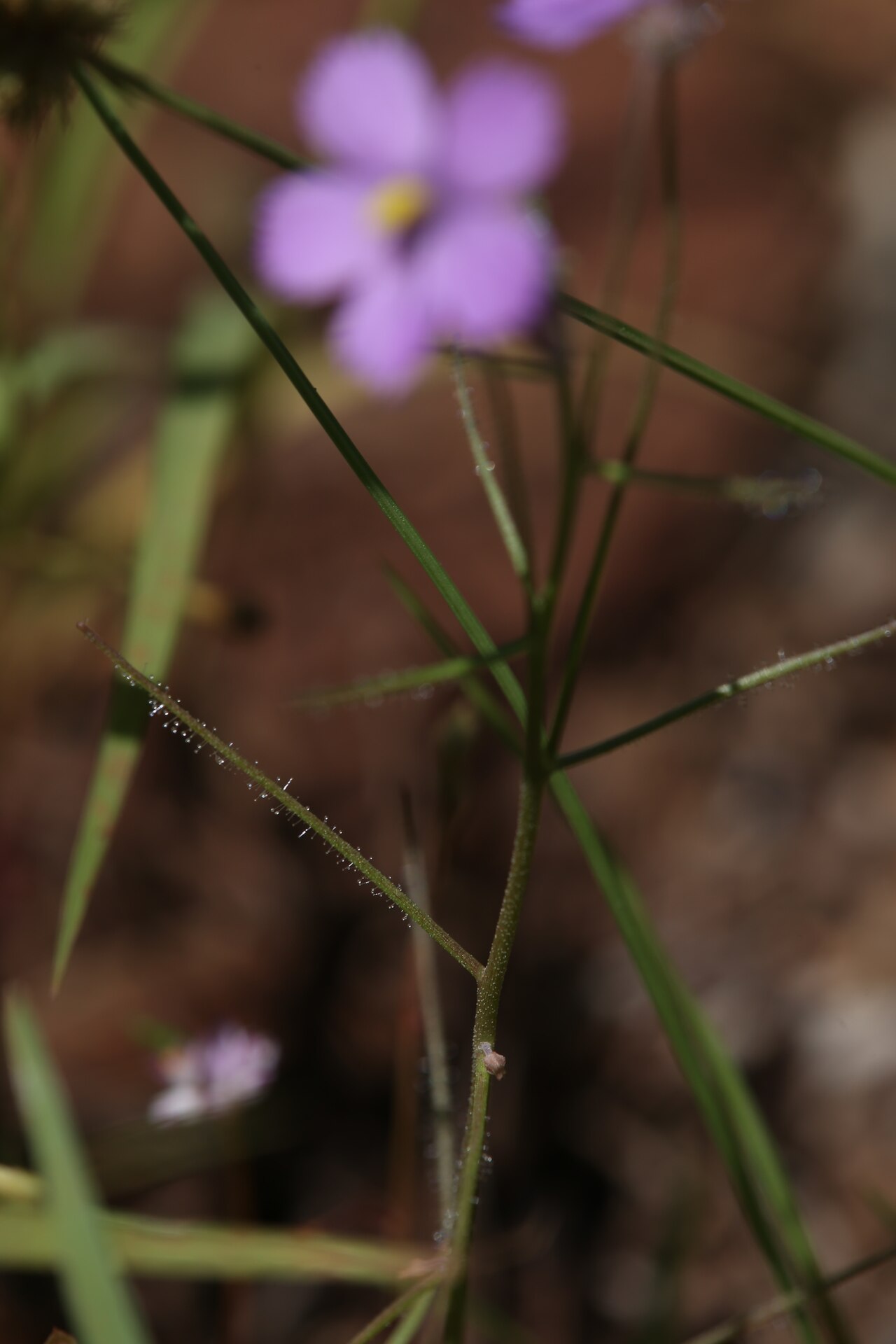
The specific name means 'dewy', and that is exactly what you see: the young, still-expanding tips of Byblis rorida are so densely set with sessile glands that they look dew-covered even at midday. It is the least often found of the northern species; travellers who cross the Kimberley for carnivorous plants come back with hundreds of filifolia and a single rorida, if they are lucky. Whether it really is a separate species is an open question — but anyone who puts a hand lens on the sepals sees at once why it was segregated.

Identification
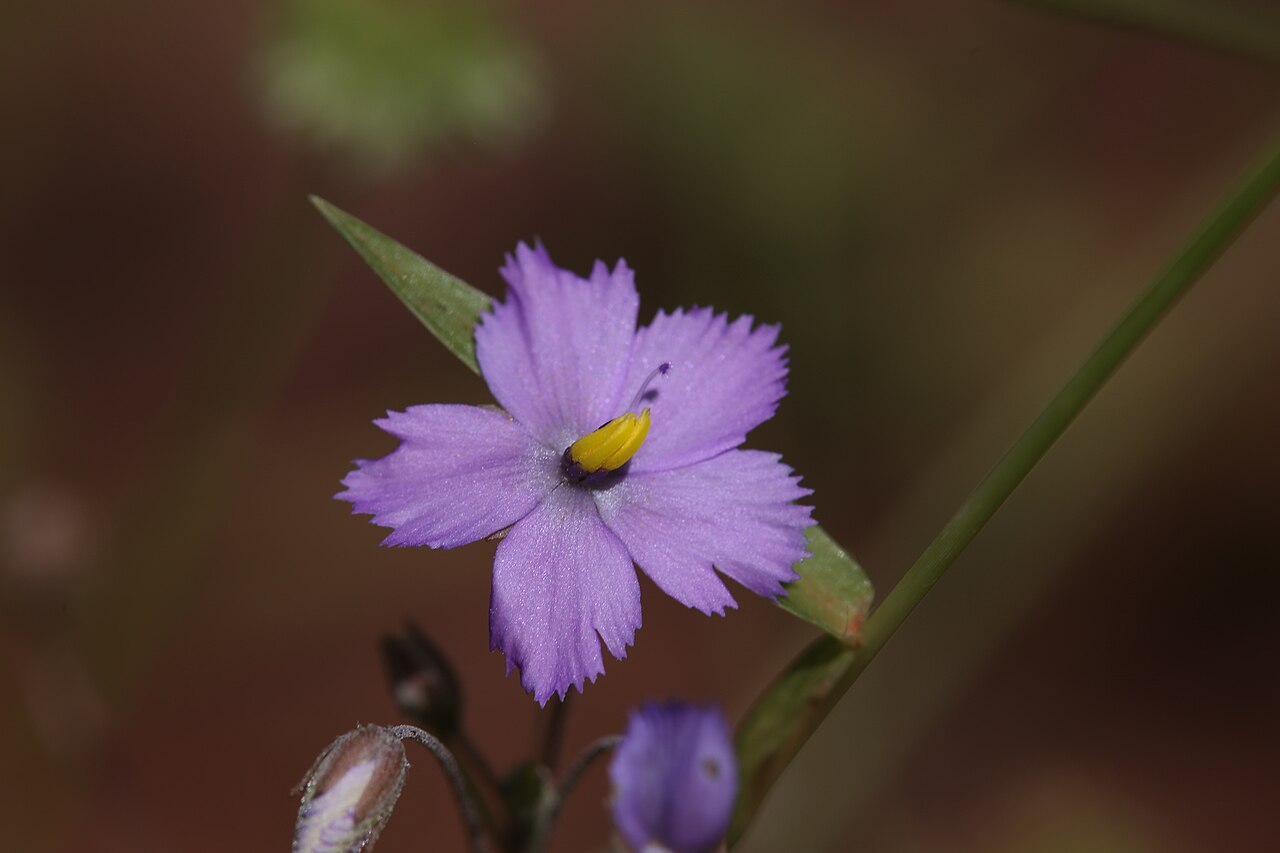
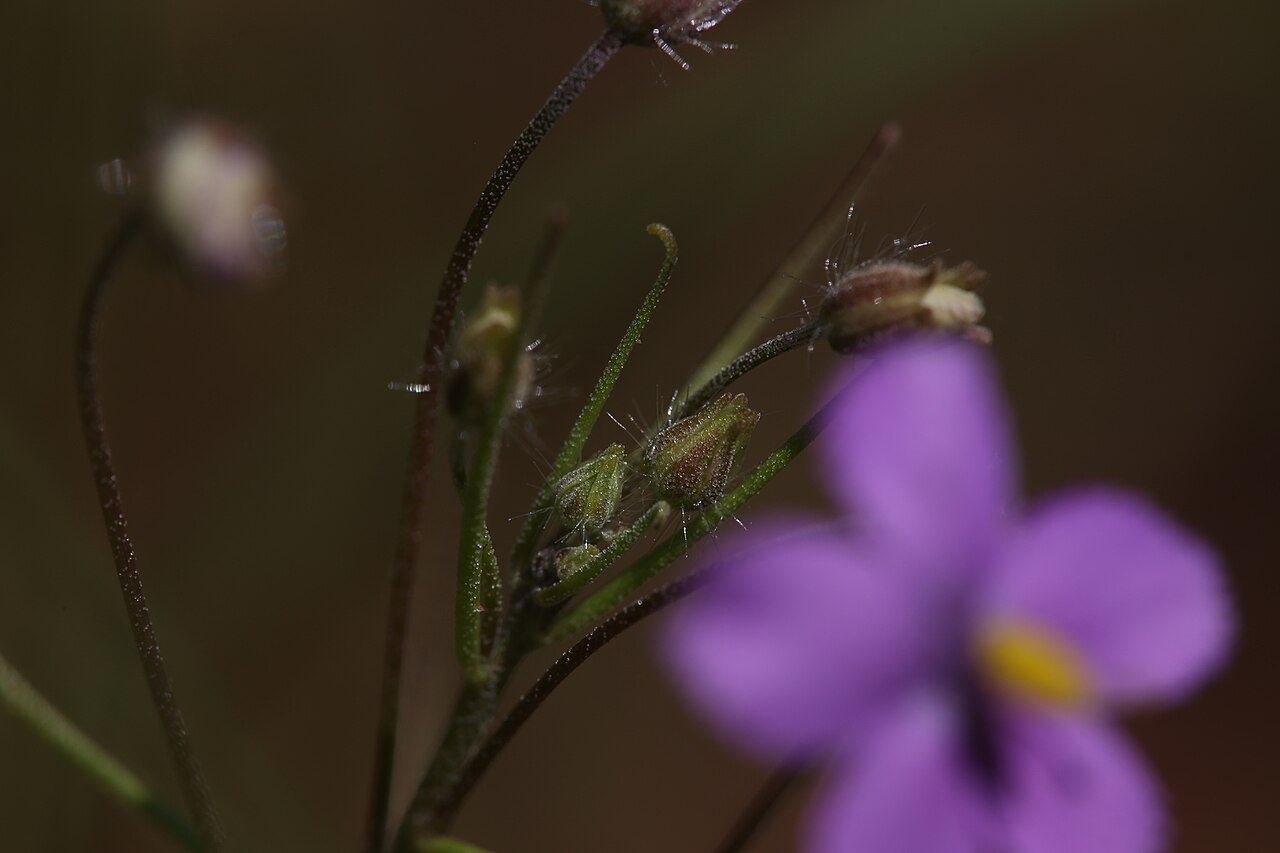
An annual herb 6 to 30 cm tall, erect at first and leaning with age. The leaves are thread-shaped, 2 to 5 cm long, and carry two kinds of trapping gland intermixed: long stalked ones with a sticky droplet and sessile ones between them. The diagnostic feature lies in the young parts: the still-growing apex and the flower stalks are so densely covered with those sessile glands that they look greyish and dewy. The sepals are 3.5 to 4.5 mm long and bear long setae with a glandular head 0.7 to 1.5 mm long — in B. filifolia those setae are only 0.3 to 0.5 mm, and with a hand lens the difference is immediate. The petals are 6.5 to 10 mm, mauve above and white beneath. Notably, the five anthers are unequal: three measure 2.5 to 3 mm and two stay shorter at 1.5 to 2.5 mm; all five exceed the filaments, which are 1 to 1.5 mm. Flowering runs from January to May.
Similar species
The comparison that counts is with Byblis filifolia, which shares the country and the same anther-to-filament ratio. The distinction lies in the glandular setae on the sepals (0.7–1.5 mm here against 0.3–0.5 mm there) and in the densely dewy young tips and flower stalks. B. filifolia also grows far larger, to 60 cm, and becomes woody at the base. Byblis liniflora is smaller and has anthers shorter than the filaments. Byblis guehoi of the Dampier Peninsula likewise resembles filifolia closely and cannot be reliably separated from this species in the field without examining sepal setae and seed. Confusion with a Drosera is impossible once you look closely.
The trap and how it works
A passive flypaper trap in which both gland types are unusually conspicuous. The long stalked glands on the leaves each carry a clear droplet and hold whatever they touch; there is no movement and no processing of stimulus. The far smaller sessile glands do the digesting: they release enzymes once prey is lying on them and then take up the liberated nitrogen and phosphorus. In this species those sessile glands are so numerous on the young parts that they determine the look of the plant. The long glandular setae on the sepals catch insects in their own right; in several carnivorous plants such glandular armouring of stalk and calyx is read as protection of the flower against crawling animals that would take nectar or pollen without pollinating.
Habitat and ecology
Broad, for a species so seldom found. The literature gives three kinds of site: fine pale sand on flat ground, wet clayey sand in depressions flushed during the monsoon, and thin, skeletal soils over outcropping sandstone pavement across which water seeps in the wet season. What they share is full light, poor ground, and water that comes and goes with the season. In the fixed codes: dry sandy ground (D1) that temporarily behaves as a seepage swamp (W3), plus wet rock with seeping water on the sandstone slabs (R1).
Distribution and elevation
Scattered through the Kimberley of Western Australia, from the country around Broome and Dampierland north-east to the Durack River, a belt of roughly 450 kilometres. Within that belt, however, it is nowhere common: the records are isolated and widely separated. It is therefore endemic to Australia and indeed to a single state. It is a lowland plant; no reliably documented altitudinal limit exists, so the elevation field is left empty.
- Recorded (quarter-degree cells)
Forms and variation
Wild variation is barely on record, largely because so little material exists. The interesting debate goes a step further: field workers who have examined all the northern populations consider it possible that B. rorida is no more than a form within a highly variable B. filifolia, together with B. guehoi and possibly B. pilbarana. At the same time the characters on which the species was described in 1998 — the length of the glandular setae on the sepals and the densely dewy young growth — are sharp and repeatable. Until a broad genetic study appears the question stays open. No varieties and no natural hybrids are recognised.
Where and when to see it
February to May, during or just after the wet, is the only sensible window, because that is when it flowers and also when many sites are hardest to reach — which is precisely why the species is so rarely seen. Search not only on open sand flats but along wet sandstone pavements. Photograph the sepals close up with a scale at every find: without that image a report of this species from the Kimberley cannot be checked. Expect that most glittering Byblis plants you come across will be B. filifolia.
Conservation status
The Red List treats the species as Least Concern. That rests on the length of the belt it occupies and on the fact that its habitats — open sand and sandstone in thinly populated country — are under little pressure. Some caution is nonetheless warranted, because the species is found rarely and in small numbers, and almost nothing is known about population sizes. Changes in fire regime and the thickening of the savanna are the main local factors here as well.
Scientific name
Byblis rorida | Lowrie & Conran, 1998
Described by Allen Lowrie and John G. Conran in 1998, in the same revision ("A taxonomic revision of the genus Byblis (Byblidaceae) in northern Australia", Nuytsia 12(1): 59–74) in which B. aquatica was also described. The species occurs in northern Australia; a precise type locality could not be established with certainty. The species name rorida is Latin for "dewy" or "covered in dew" — a reference to the densely packed glandular hairs that give the plant a glistening, dew-covered appearance, similar to the naming of the related genus Roridula.
World Checklist of Vascular Plants (WCVP), via Plants of the World Online (POWO), Royal Botanic Gardens, Kew.