All species › Lamiales › Rainbow plant family › Byblis aquatica
Byblis aquatica
Of all the Byblis species this is the odd one out. Where the rest of the genus stands upright in dry sand, Byblis aquatica does begin as a small erect plant but then sprawls across the wet ground or floats outright, with stems approaching half a metre. The species is tied to depressions that flood in the wet season, and it literally grows up with the rising water. The dark wine-red the plants take on in full sun makes them surprisingly hard to pick out in a shallow pool — until the sun drops low across it and the whole water surface starts to glint with sticky droplets.
Identification
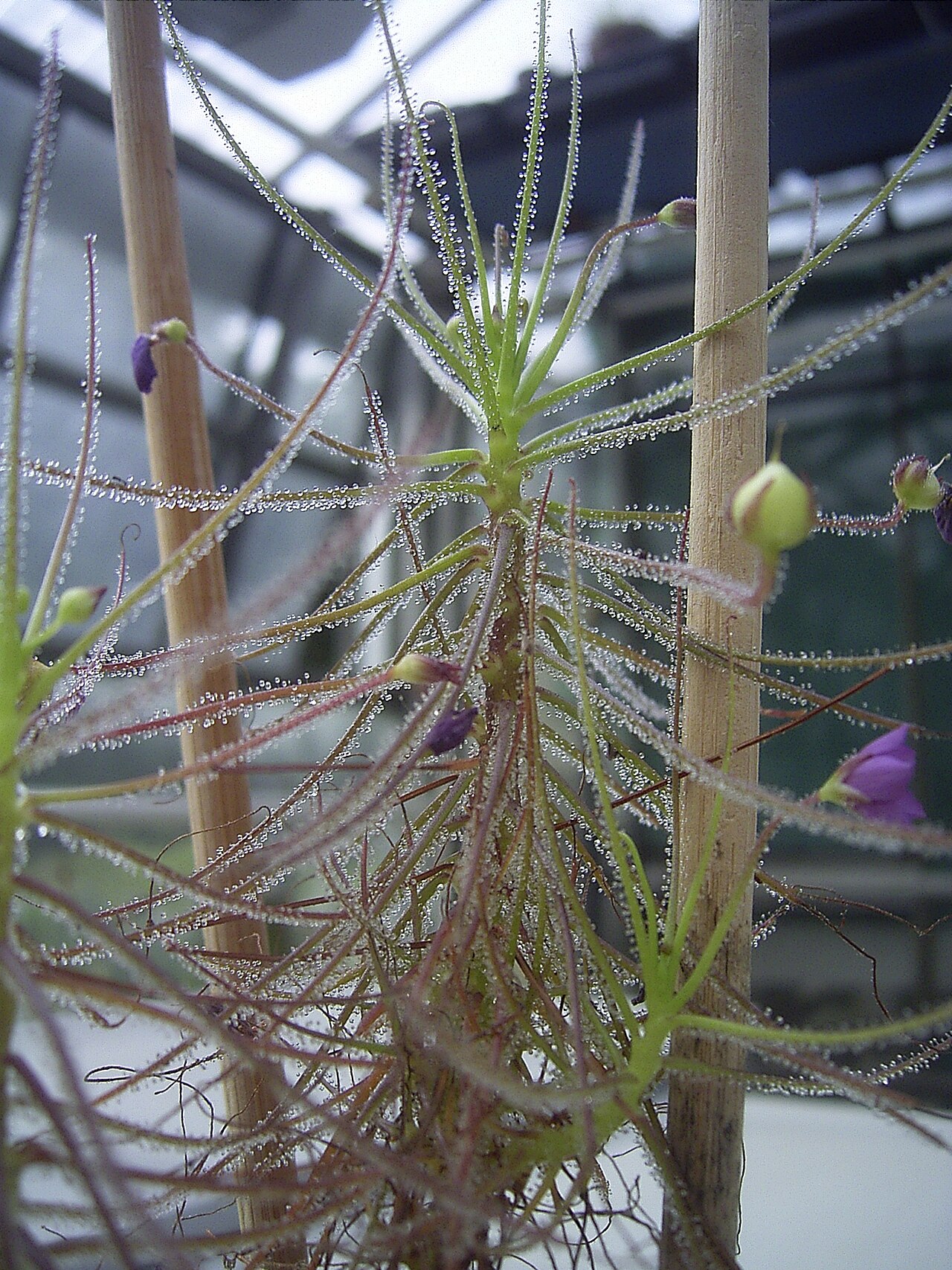
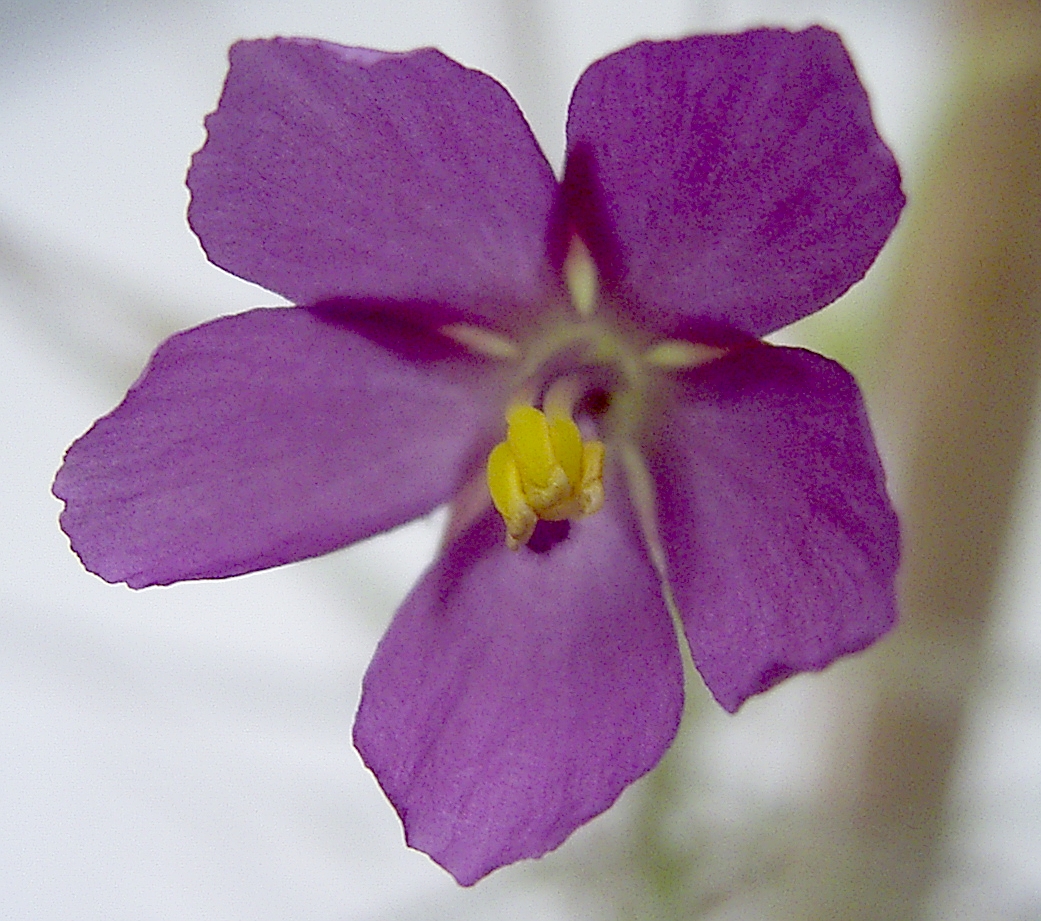
An annual with, at first, a single erect main stem no more than 5 cm tall, which then leans on surrounding plants, finally lies across the ground or floats on the water, and grows 15 to 45 cm long. The leaves are thread-fine and round in cross-section, 2 to 4 cm long and mostly 3 to 3.5 cm, greenish maroon, and set along their whole length with sticky stalked glands. The flower stalks are shorter than the leaves — a useful field character, because in the other small northern species they equal or exceed them. The sepals are 3 to 4 mm long with short stalked glands, the petals 5 to 7 mm and purple on both surfaces. The anthers are small, 0.9 to 1.3 mm, and therefore clearly shorter than the 2 to 2.5 mm filaments. Flowering runs from January to May, that is during and just after the monsoon. The seeds, at 1 to 1.3 mm, are large for the genus.
Similar species
The only species that genuinely invites confusion is Byblis liniflora, which also has anthers shorter than the filaments. That one, however, stays a compact erect bushlet of at most 15 cm, with flower stalks equalling or exceeding the leaves and seeds of 0.6 to 0.8 mm against 1 to 1.3 mm here. In the field the growth form is usually enough: a Byblis lying full length in water is this species. Byblis filifolia is far larger and woodier and has anthers longer than the filaments. Confusion with Drosera species sharing the same depressions is possible at a distance but not close up: there the glandular hairs sit on a flattened blade and move, here they surround a needle-like leaf and stay put.
The trap and how it works
A passive flypaper trap, identical in construction to that of its relatives but set where part of the catch comes off the water surface. The stalked glands each carry a clear droplet; neither leaf nor gland moves. An insect touching the droplets is held, and in struggling only reaches more sticking points. Digestion is the work of the far smaller sessile glands between the stalks, which release enzymes only once prey is lying on them and then take up the liberated nitrogen and phosphorus. Because the stems lie across water, much of the catch comes from the dense clouds of mosquitoes and midges that hang over such depressions. Splitting capture and digestion between two gland types is the heart of the difference from Drosera, where a single tentacle does both and bends besides.
Habitat and ecology
Fine clayey sand in depressions that flood in the wet season, and the shores of freshwater lagoons. The water may stand half a metre deep; plants germinate on the drying bed and grow upward as the water rises. The species tolerates neither shade nor competition from tall swamp grass, so it grows mainly where the water level swings strongly from year to year and keeps the vegetation open. In the fixed codes that amounts to a combination: a seepage swamp on sand (W3), the wet margins of swamp and grassland (W6) and the shoreline of pool and lagoon (W7).
Distribution and elevation
A small area in the Northern Territory: the coastal country around Darwin and south to the neighbourhood of Berry Springs, with additional records from Bathurst Island. The species is therefore endemic to Australia and within Australia confined to one corner of the Top End. Field reports place it further east as well, but those are not confirmed by the herbarium literature and are left aside here. It is a lowland plant close to sea level; no documented altitudinal limit exists, so the elevation field is left empty.
- Recorded (one-degree cells)
Forms and variation
Wild variation is barely described, and the reason is partly taxonomic: until 1998 this plant was hidden inside a broadly drawn Byblis liniflora, and it was recognised as a species only by the revision of Lowrie and Conran. What stands out as variation is mostly plastic: plants in deeper water grow longer and laxer, plants on freshly exposed mud stay shorter and more compact, and the colour runs from greenish to deep maroon with increasing light. No varieties or colour forms are recognised, and no natural hybrids are known.
Where and when to see it
February to April is the best time, when the plants are full grown and flowering. Search along the edges of shallow, seasonal pools and lagoons, and look not straight down but across the surface with the sun low behind you: the glint of the glandular droplets then gives away the sprawling stems. Come late in the dry season and you will find only empty hollows. Be careful about wading in northern Australian water — saltwater crocodiles reach far inland into exactly this kind of seasonal pool, and it pays to inspect a site from the bank first.
Conservation status
The Red List treats the species as Least Concern, and the Western Australian Herbarium likewise records it as not threatened. That judgement rests on the many suitable depressions within the range and on the seed bank that buffers poor years, not on the size of the range itself: that is small and lies against the fastest-growing city of the Top End. Drainage, development and changes to the water regime around Darwin are accordingly the factors to watch.
Scientific name
Byblis aquatica | Lowrie & Conran, 1998
Described by Allen Lowrie and John G. Conran in 1998, in their taxonomic revision "A taxonomic revision of the genus Byblis (Byblidaceae) in northern Australia", published in Nuytsia 12(1): 59–74. The type area lies in the Northern Territory, between Darwin and Berry Springs, where the species grows in seasonally flooded depressions and along the shallow margins of freshwater lagoons; it has also been recorded on Bathurst Island. The species name aquatica (Latin for "living in water") refers to the plant's semi-aquatic habitat and to the fact that its seeds only germinate after being submerged in water.
World Checklist of Vascular Plants (WCVP), via Plants of the World Online (POWO), Royal Botanic Gardens, Kew.