All species › Caryophyllales › Sundew family › Drosera allantostigma
Drosera allantostigma
Drosera allantostigma is a pygmy sundew so rare that the IUCN lists it as critically endangered and possibly already extinct. The name refers to a detail visible only with a hand lens: the stigmas are sausage-shaped (Latin allantoideus). The plant was originally described by Marchant and Lowrie as a subspecies and later raised to species rank by Lowrie and Conran.
Identification
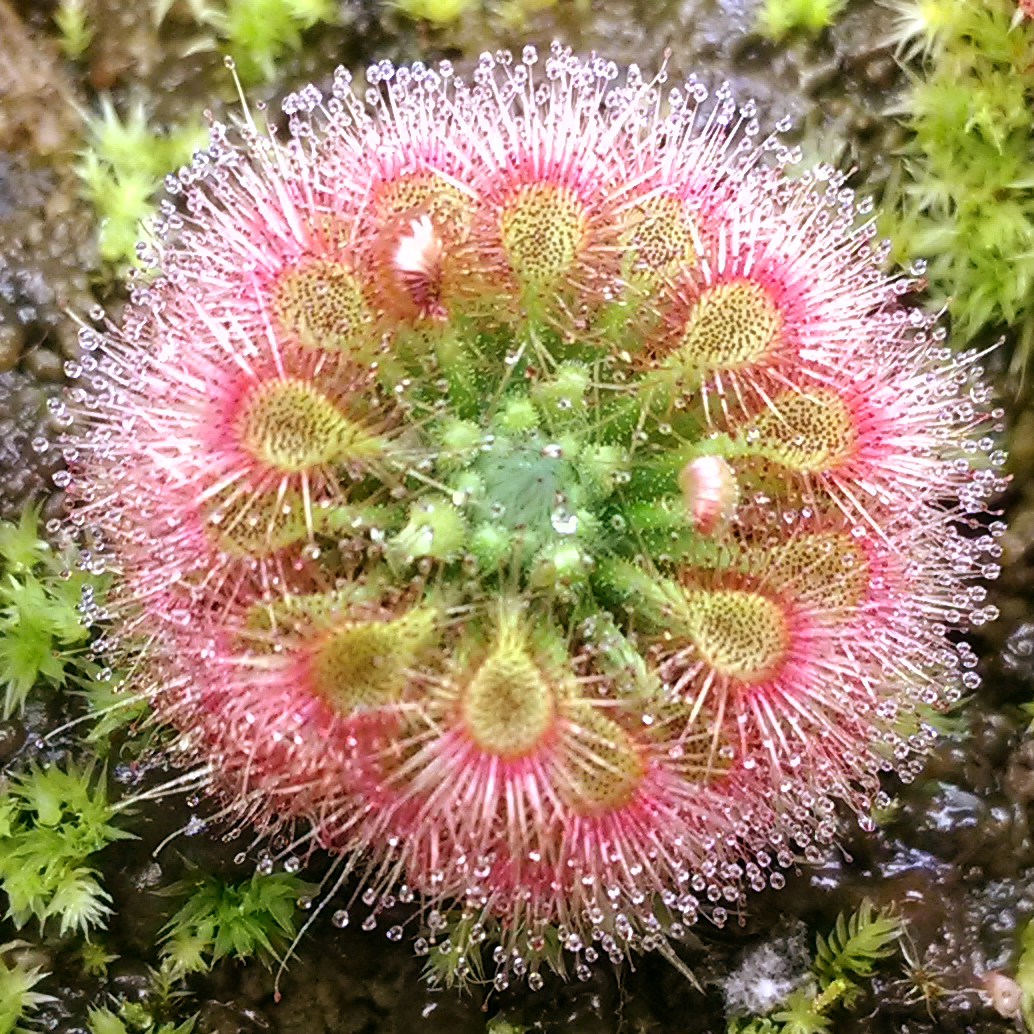
A perennial rosette plant with fibrous roots, up to 8 cm tall, which is tall for a pygmy sundew: in older plants the rosette rises on a short stem. As in all pygmy sundews, the centre of the rosette holds a cone of silvery, papery stipules, and small leaves carrying stalked glands. The flowers are white and appear late in the season, in November and December. The decisive feature lies in the flower: the styles end in elongated, sausage-shaped stigmas. Precise leaf measurements could not be found in the accessible sources.
Similar species
The species belongs to the group around Drosera nitidula and Drosera leucostigma, which also form a short stem and bear white flowers; D. leucostigma was raised from subspecies to species at the same time as D. allantostigma. The difference lies mainly in the shape and colour of the stigmas and can hardly be made without a flower. Its late flowering, in November and December, sets it apart from most other pygmy sundews in its surroundings.
The trap and how it works
An active flypaper trap. Each small leaf carries stalked glands with a glistening, sticky droplet. A small insect settling on it is caught; the tentacles then bend towards the prey and secrete digestive enzymes, after which the dissolved nutrients are absorbed. In pygmy sundews the prey is the very smallest, such as springtails and minute gnats living among the sand and litter.
Habitat and ecology
According to FloraBase the species grows on loam, silica sand or peaty soil at the margins of depressions that are flooded in winter (W7, D1). This is a typical site for pygmy sundews that need moisture into late spring: the edge of a seasonal swamp dries out late, which explains the late flowering. In the hot summer the plant retreats to a resting bud of stipules.
Distribution and elevation
Endemic to the south-west of Western Australia, in the northern sandplains (Geraldton Sandplains). Because the species is listed as critically endangered, this guide gives no more precise localities.
- Recorded (one-degree cells)
Forms and variation
No varieties are recognised. Taxonomically the name does have a history: it was described in 1992 by Marchant and Lowrie as a subspecies of Drosera nitidula, and later treated as a species in its own right by Lowrie and Conran. Older literature therefore lists it as D. nitidula subsp. allantostigma.
Where and when to see it
This species is less a field tip than a search task for specialists. Anyone looking for pygmy sundews in the northern sandplains in November and December who finds a white-flowered plant with a short stem at the edge of a drying depression should examine the stigmas with a hand lens and report the record through official channels, without making location data public.
Conservation status
The IUCN assesses the species as critically endangered (CR), noting that it may already be extinct. In Western Australia it is Priority One, the category for species known from very few sites and possibly under threat. It is not listed in CITES. Seasonal wetlands on the sandplains are under pressure from drainage, clearing and changing rainfall patterns; for a species with so few sites a single intervention can be decisive. The data in this text rest largely on FloraBase and the original description; detailed field data are not public.
Scientific name
Drosera allantostigma | (Marchant & Lowrie) Lowrie & Conran, 1996
Originally described as Drosera nitidula subsp. allantostigma by N.G. Marchant & Lowrie, in Kew Bulletin, volume 47, no. 2, p. 325 (29 June 1992). Raised to full species rank by Lowrie & Conran, in Taxon, volume 56, no. 2, p. 538 (15 June 2007), as part of a revision of the D. omissa/D. nitidula complex. The precise type locality could not be established with certainty. The species occurs in Western Australia. From the Greek/Latin allantoideus ("sausage-shaped") and stigma (the receptive part of the style) — refers to the sausage-shaped stigma, a diagnostic feature distinguishing it from related pygmy sundews.
World Checklist of Vascular Plants (WCVP), via Plants of the World Online (POWO), Royal Botanic Gardens, Kew.