All species › Caryophyllales › Sundew family › Drosera callistos
Drosera callistos
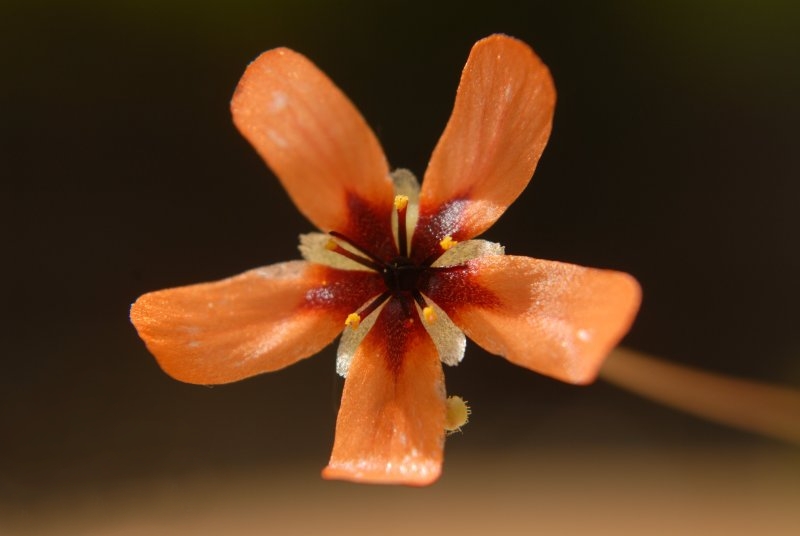
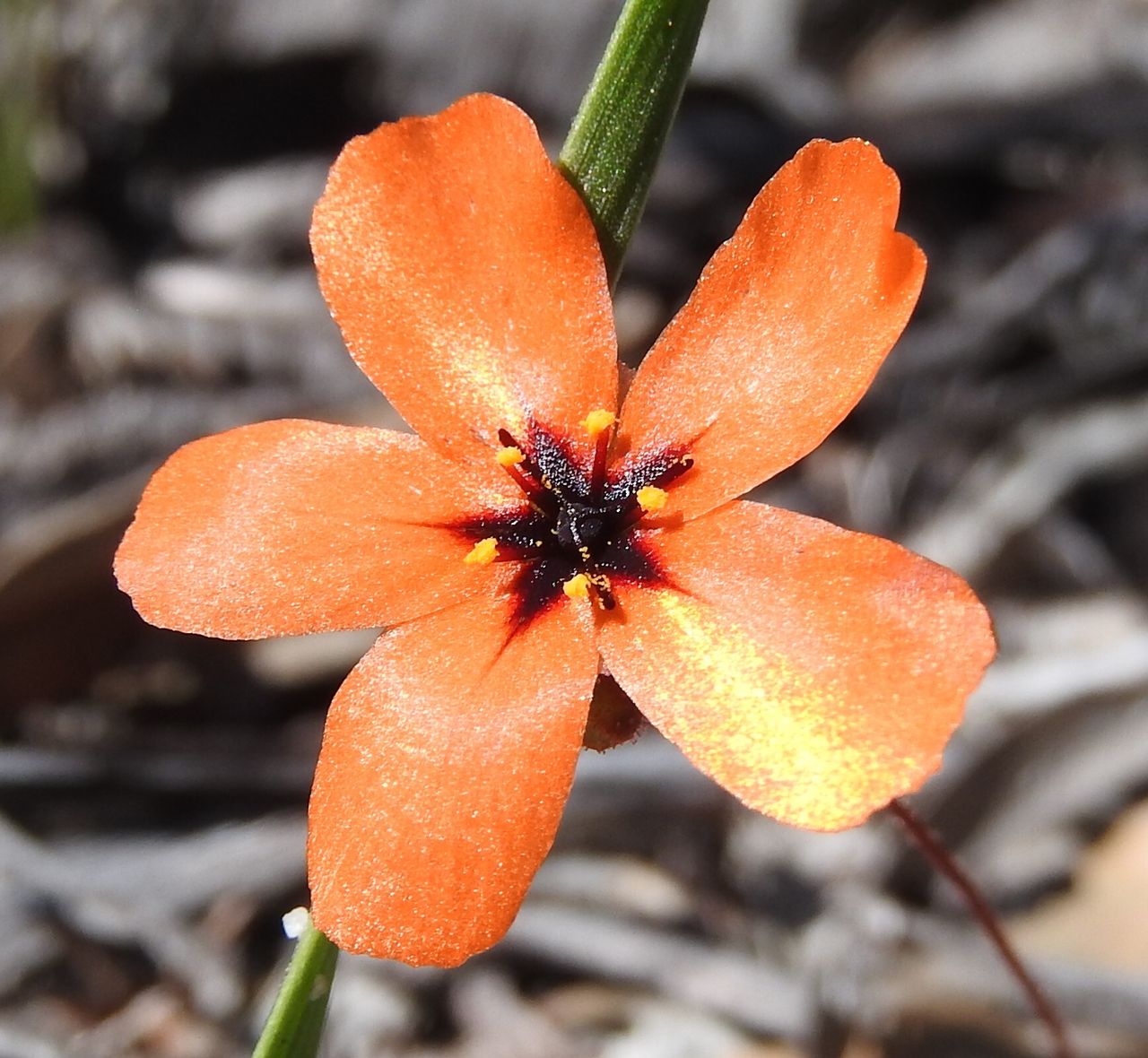
Neville Marchant and Allen Lowrie chose a name in 1992 that leaves little room for doubt: callistos is Greek for 'most beautiful'. Drosera callistos is an orange-flowered pygmy sundew from the northern jarrah forest and the edge of the coastal plain north of Perth, and one of the late bloomers among the orange-flowered species.

Identification
A perennial, fibrous-rooted pygmy sundew with a small rosette, up to 7 cm tall including the flowering stem. At the heart of the rosette stands the cone of silvery stipules typical of pygmy sundews, which protects the plant as a resting bud in summer. The flowers are bright orange and appear in October and November. Leaf and flower measurements were not available in the accessible sources; the trap-size field is left empty.
Similar species
It shares its orange flower colour with Drosera barbigera, Drosera miniata, Drosera echinoblastus and Drosera albonotata, among others. D. barbigera and D. miniata usually flower earlier, from August; D. echinoblastus flowers at the same time but grows on sandy, winter-damp soil and can be taller. Reliable identification requires examining the stipules, gemmae and details of the flower centre under a lens.
The trap and how it works
An active flypaper trap. The leaves bear stalked glands with sticky droplets. Small insects landing on or walking over them get stuck; the tentacles bend towards the prey and secrete digestive enzymes. On poor lateritic soil this provides a real supplement to the scarce supply of nitrogen and phosphorus.
Habitat and ecology
Lateritic soil (FloraBase): the gravelly, iron-rich soils of the plateau and open jarrah forest (D3, B6). In winter and early spring these gravels are moist; in summer they dry out completely and the plant withdraws into its bud of stipules.
Distribution and elevation
Endemic to the south-west of Western Australia. FloraBase lists the Jarrah Forest and Swan Coastal Plain bioregions, in the Dandaragan Plateau and Northern Jarrah Forest subregions, north and north-east of Perth.
- Recorded (one-degree cells)
Forms and variation
No subspecies or varieties have been described. Like all pygmy sundews, D. callistos forms gemmae at the heart of the rosette in autumn; raindrops splash them away and they grow into new plants. This mode of propagation means the species is widely grown in cultivation, with no need for wild plants.
Where and when to see it
Come late in spring, in October or early November, when many other pygmy sundews have finished flowering. Search open patches on the gravel under the jarrah forest. The flowers open on sunny afternoons and then stand out as small orange dots. Keep to paths; lateritic gravel recovers slowly from trampling.
Conservation status
Assessed as Least Concern (LC) on the IUCN Red List and listed as not threatened in Western Australia. Not in CITES. Lateritic soils in the northern jarrah forest are locally affected by gravel and bauxite extraction and by clearing, but the species occurs in several protected areas.
Scientific name
Drosera callistos | Marchant & Lowrie, 1992
Described by N.G. Marchant & Lowrie, in Kew Bulletin, volume 47, no. 2, p. 321 (29 June 1992). The precise type locality could not be established. From the Greek callistos ("most beautiful") — a laudatory name for this species.
World Checklist of Vascular Plants (WCVP), via Plants of the World Online (POWO), Royal Botanic Gardens, Kew.