All species › Caryophyllales › Sundew family › Drosera chrysolepis
Drosera chrysolepis
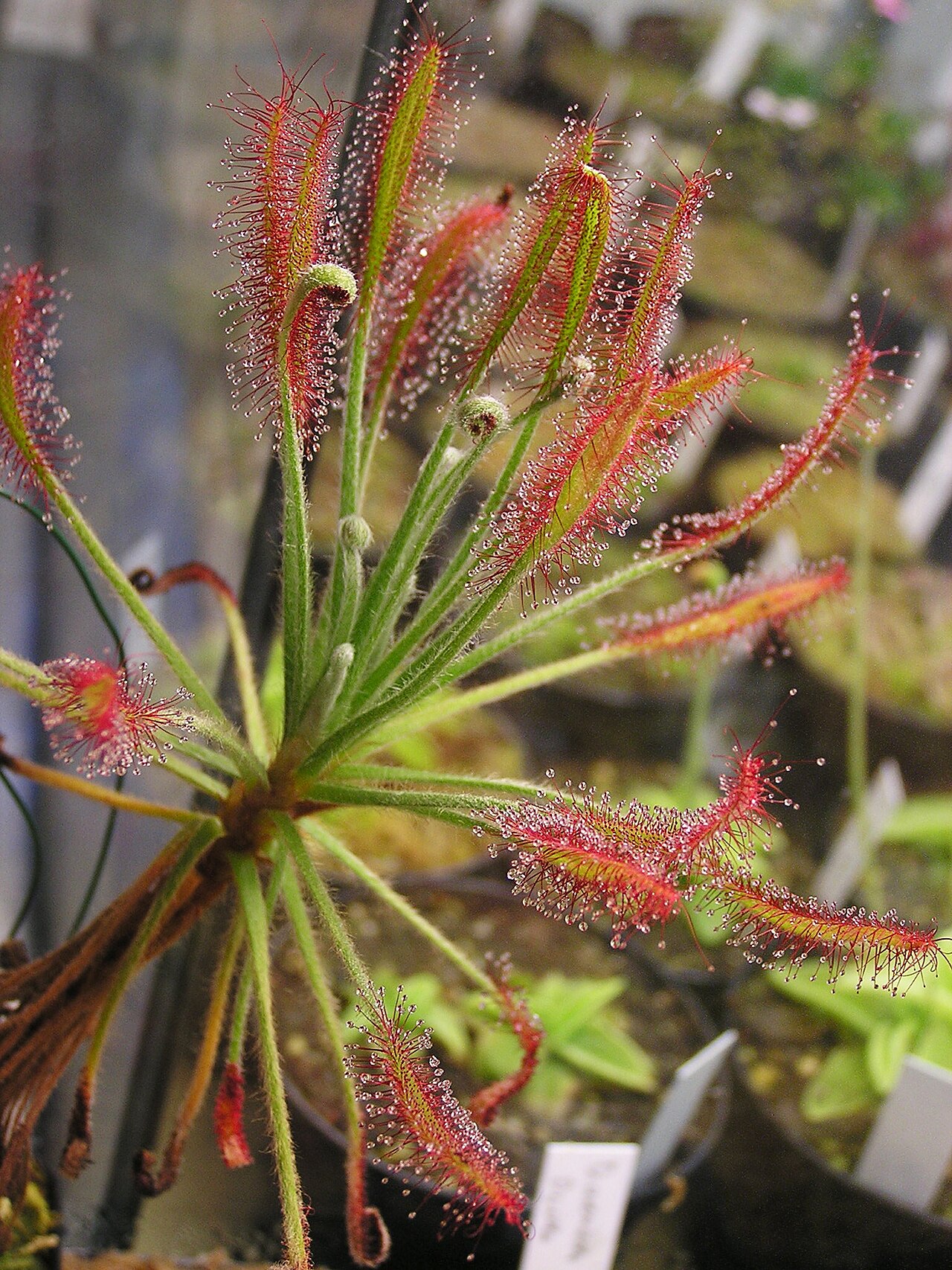
The golden scales in the name are meant literally. Drosera chrysolepis, described by the German botanist Taubert, bears conspicuous golden-brown stipules at the base of each leaf, which on older plants form a glossy mantle around the stem. It is one of the more robust sundews of the Brazilian mountains: a species that grows upwards over the years on a column of old leaves.

Identification
A perennial rosette on an upright stem that lengthens with age and becomes clothed in dead leaves and the characteristic golden-brown, triangular stipules. The leaves are semi-erect, with a narrow petiole and a lanceolate to oblong blade densely set with red tentacles. The scape is long and carries pink flowers. The description of D. quartzicola shows that D. chrysolepis differs from that sister species in forming a stem, in a petiole clearly narrower than the blade, and in longer scapes. Exact measurements have not been adopted here.
Similar species
Its nearest relative is Drosera quartzicola, which grows only in a small area of Minas Gerais and remains stemless or forms only short columns, with a petiole about as wide as the blade. Other stem-forming species in the area, such as Drosera camporupestris and Drosera graomogolensis, lack the strikingly golden stipules. When in doubt always look at the stipules at the leaf bases.
The trap and how it works
An active flypaper trap. The tentacles on the blade catch small insects in their mucilage droplets and then bend towards the prey; because the rosette stands on a stem above the vegetation, the leaves catch both crawling and flying prey. Digested remains often stay visible on older leaves.
Habitat and ecology
Open, sunny campos rupestres on quartzite in the mountains of central-eastern Brazil: wet sandy ground and seepages along rock slabs, but also somewhat drier, gravelly sand where the water table is high in the wet season (R1, D2, W4). Forming a stem helps the plant grow above competing grasses and resprout after fire.
Distribution and elevation
Brazil, centred on the Espinhaço range in Minas Gerais; unlike its sister species D. quartzicola it is not listed in the 2022 synopsis among the species confined to Minas Gerais, so it also occurs in neighbouring states. The precise limits of the range could not be checked here. A published altitudinal range has not been adopted.
- Recorded (one-degree cells)
Forms and variation
No varieties are recognised. The species is closely related to D. quartzicola, described only in 2011 from plants that might previously have passed as an aberrant form of D. chrysolepis. Older records from the area of D. quartzicola should therefore be read with caution.
Where and when to see it
In the wet season scan the sandy, quartzite-rich slopes of the Espinhaço range, especially where water seeps over rock slabs. The golden-brown stipules shine in low morning light and make the plant recognisable even without flowers. Keep to paths: campos rupestres recover slowly.
Conservation status
Not assessed for the global IUCN Red List and not listed in CITES. The range is larger than that of many relatives, and part of it lies in protected areas. Fire, invasive grasses, mining and climate change threaten the campos rupestres in general; for the sister species D. quartzicola exactly these factors are named as the main threats.
Scientific name
Drosera chrysolepis | Taubert, 1893
Described by Paul Hermann Wilhelm Taubert in 1893, in Botanische Jahrbücher für Systematik, volume 17, p. 505. A lectotype was only designated in 1997 (Silva & Giulietti), based on material by Glaziou (no. 18857) from Serra do Cipó, Minas Gerais, Brazil, 1891/92, held at Kew (K), with isolectotypes at B and P. Serra do Cipó, Minas Gerais, Brazil (lectotype locality, designated in 1997; Taubert's own original type locality is not separately confirmed). From the Greek chrysos ("gold") and lepis ("scale") — probably refers to the golden-brown stipules of the plant.
World Checklist of Vascular Plants (WCVP), via Plants of the World Online (POWO), Royal Botanic Gardens, Kew.