All species › Caryophyllales › Sundew family › Drosera villosa
Drosera villosa
The hairy sundew, and the namesake of a whole group of Brazilian mountain species. Drosera villosa was described by Saint-Hilaire in 1826 and for almost two centuries afterwards served as the name for almost any long-leaved sundew of the south-east Brazilian mountains. The 2015 revision, tellingly titled Exhuming Saint-Hilaire, restored the old species concepts and left a much smaller species of the broad D. villosa.
Identification
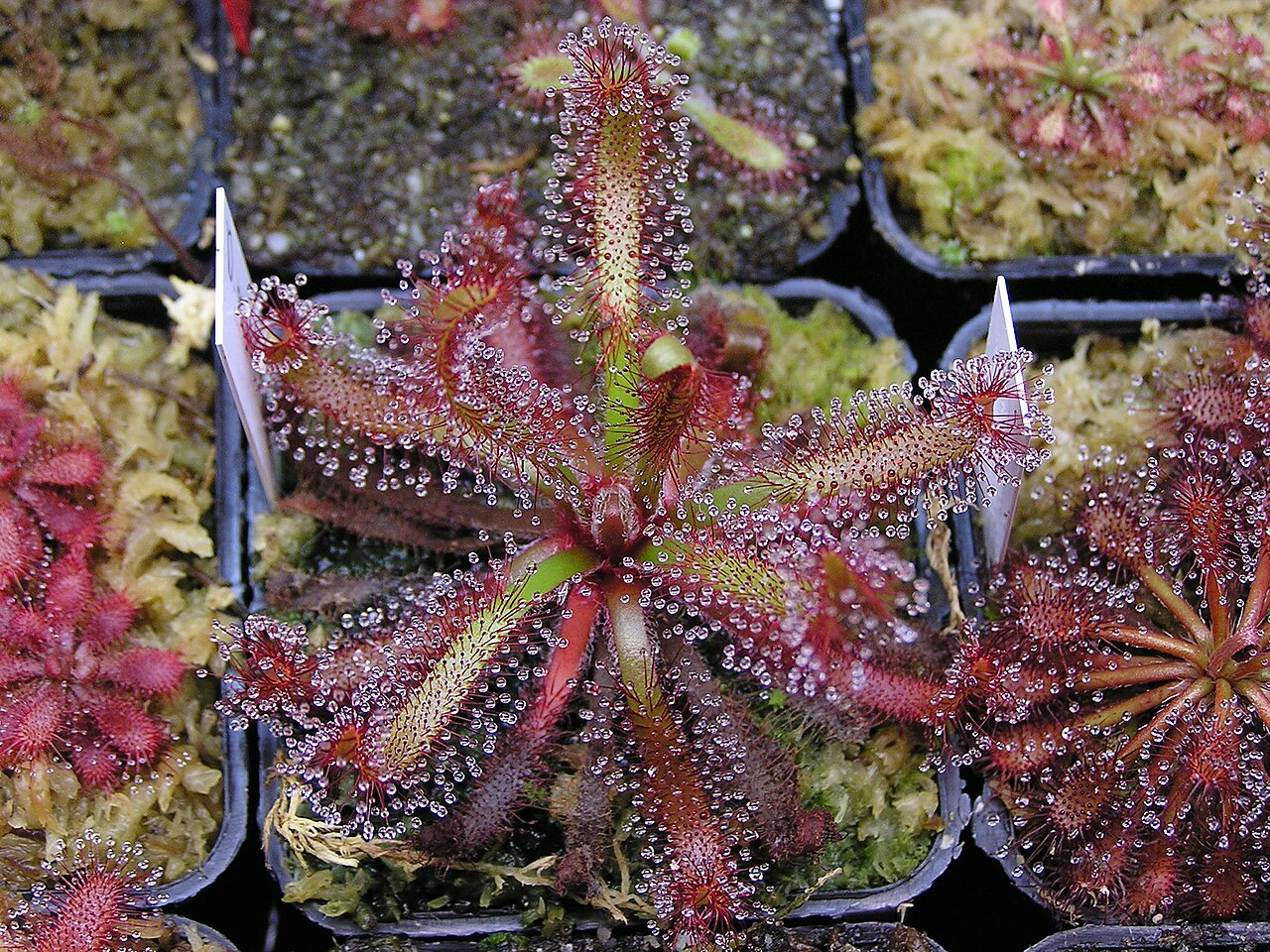
A perennial rosette of semi-erect leaves with a long, hairy petiole and a clearly defined, oblong to spatulate blade full of red tentacles. Young leaves unroll from an inwardly coiled tip. The scape is long, hairy at the base and carries a series of pink flowers. Because the measurements in the revision could not be consulted, the size fields are left empty.
Similar species
Within the complex Drosera latifolia differs in shorter petioles, often much shorter than the blade, and in sparser hairs; Drosera graminifolia has grass-like leaves without a clearly defined blade; Drosera ascendens and Drosera chimaera are other Minas Gerais species of the same group. Because in older literature and in cultivation almost all these plants were called D. villosa, a recent key is indispensable.
The trap and how it works
An active flypaper trap. The tentacles on the oblong blade catch gnats, small flies and ants in their mucilage droplets; the surrounding tentacles bend towards the prey and the leaf can curl lengthwise around the catch. The semi-erect leaves also catch flying insects.
Habitat and ecology
Permanently wet, acid places in the mountains: seeping rock faces, boggy seepage and spring areas in mountain grassland, and bog-moss mires along streams (R1, W4, W1). The plant often sits half hidden among grasses, sedges or bog moss, in full sun or light shade.
Distribution and elevation
In the current, narrow sense endemic to the state of Minas Gerais in south-eastern Brazil, according to the distribution maps in the 2022 Brazilian synopsis. The former, much larger range from Bahia to southern Brazil belongs largely to other species in the complex, above all D. latifolia. A published altitudinal range has not been adopted.
- Recorded (one-degree cells)
Forms and variation
No varieties are recognised any more. The former D. villosa var. latifolia has been the separate species D. latifolia since the revision. Because almost all older texts, photographs and cultivated plants under the name D. villosa may in fact concern one of the split-off species, caution with old data is needed.
Where and when to see it
In the wet season search spring and seepage areas in the mountains of Minas Gerais, where the long, red-glistening leaves stick out of the grass. Note the hairs on petiole and scape and the ratio of petiole to blade; those characters separate it from its relatives.
Conservation status
Not assessed for the global IUCN Red List and not listed in CITES. After the revision the species turns out to be far less widespread than assumed, confined to a single state. Threats are fire, invasive grasses, tourism and changes to the water supply of springs and seepages.
Scientific name
Drosera villosa | Saint-Hilaire, 1824
Drosera villosa was described in 1826 by the French botanist Augustin Saint-Hilaire, published in Histoire des plantes les plus remarquables du Brésil, volume 1(6), page 267. The species was described by Saint-Hilaire based on material from Brazil; a precise type locality with collector and collection date could not be established with certainty. The name villosa is Latin for "hairy" or "downy" (from "villus", hair/down) and likely refers to the hairy leaves, stems or flower stalks of this species; an original explanation of the naming by Saint-Hilaire could not be located.
World Checklist of Vascular Plants (WCVP), via Plants of the World Online (POWO), Royal Botanic Gardens, Kew.