All species › Caryophyllales › Sundew family › Drosera camporupestris
Drosera camporupestris
A sundew named after its landscape: the campos rupestres, the rocky mountain grasslands on quartzite that form one of the most species-rich plant communities in the world in eastern Brazil. Drosera camporupestris was described in 2003 by Fernando Rivadavia, together with three other new Brazilian sundews, in a paper in Carnivorous Plant Newsletter. That paper is still the main source on the species.
Identification
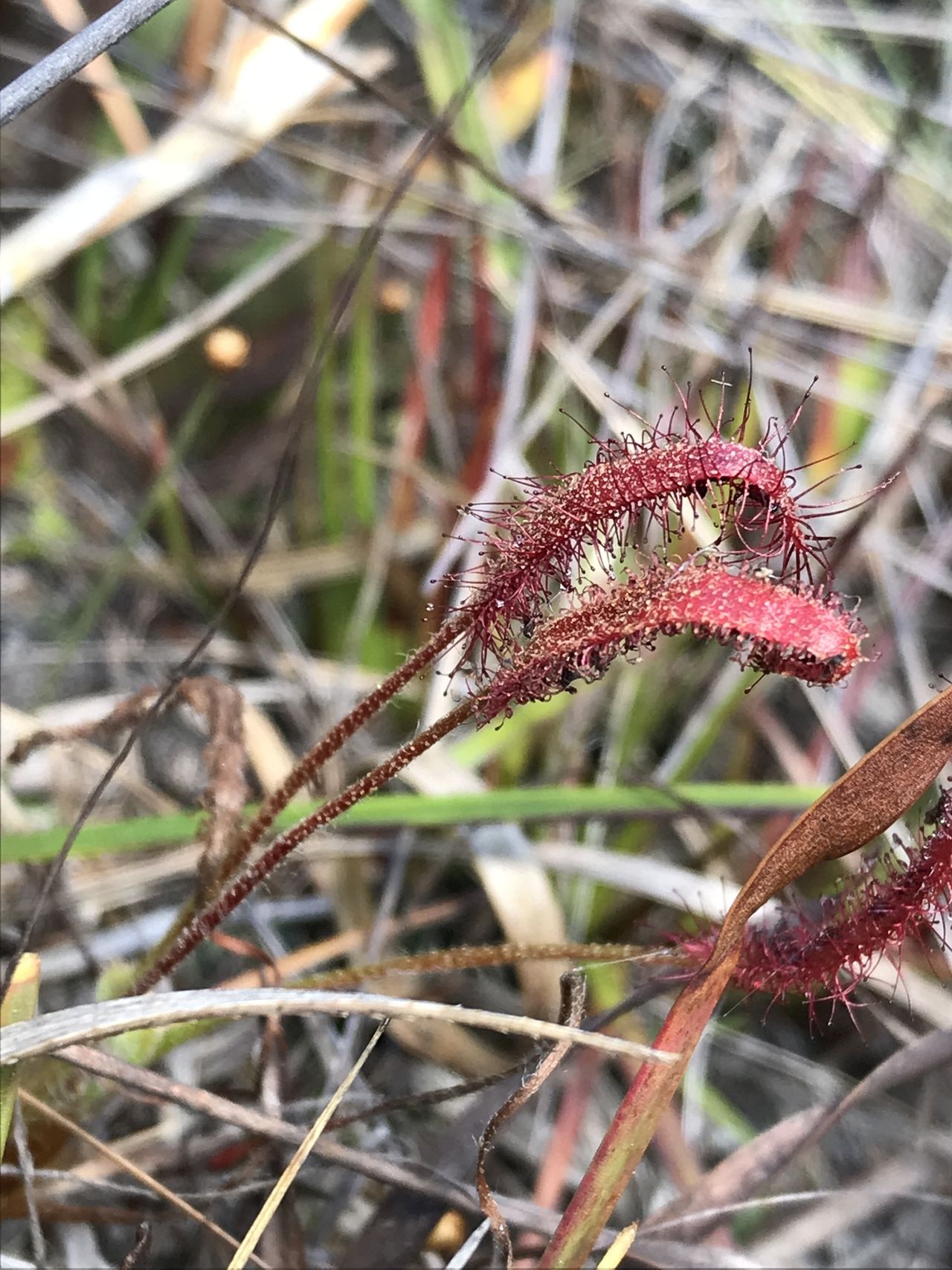
A perennial plant that with age forms an upright or sprawling stem densely clothed in the dead leaves of previous seasons; the living rosette sits on top of that column. The leaves are narrow and semi-erect, with tentacles on the upper part. The scape carries pink flowers. Exact measurements have not been adopted here, because the original description could not be fully consulted.
Similar species
Other stem-forming sundews grow in the same mountains. Drosera graomogolensis from northern Minas Gerais also has a column of old leaves; Drosera chrysolepis stands out for its golden-brown stipules. Members of the D. villosa complex, such as Drosera latifolia, usually form only short columns and have broader blades. Identification needs attention to stipules, scape hairs and leaf shape.
The trap and how it works
An active flypaper trap. The tentacles on the narrow leaves catch small insects, which are then enclosed and digested by surrounding tentacles. Because the rosette stands on a column above the ground, the plant catches many flying as well as crawling prey.
Habitat and ecology
Campos rupestres on quartzite: open, sunny places with white sand and gravel, seepages along rock slabs and seepage zones that are soaked in the wet season and partly dry out in the dry season (R1, D2, W4). The stem of old leaves holds moisture and protects the growing point from the fires that regularly sweep this landscape.
Distribution and elevation
According to the 2022 Brazilian synopsis endemic to the state of Minas Gerais in south-eastern Brazil, in the mountains of the Espinhaço range. Older records from outside Minas Gerais are not confirmed in the recent treatment. A published altitudinal range has not been adopted.
- Recorded (one-degree cells)
Forms and variation
No varieties are recognised. The species is one of many sundews described from the campos rupestres only in recent decades; the area is considered a centre of speciation within the genus, with many species growing on only one or a few ridges.
Where and when to see it
The wet season, roughly November to March, is the best time. On the wet edges of sand flats and rock slabs in the Espinhaço mountains, look for small columns of brown dead leaves topped by a red-glistening rosette. Do not walk across the wet sand flats themselves: the ground is fragile and many small species grow mixed together there.
Conservation status
Not assessed for the global IUCN Red List and not listed in CITES. The species is confined to a single state and a specific landscape type. Threats to the campos rupestres are quarrying of quartzite and mining of gemstones, overly frequent fire, invasive grasses and tourism.
Scientific name
Drosera camporupestris | Rivadavia, 2003
Described by Fernando Rivadavia in 2003, in Carnivorous Plant Newsletter, volume 32, p. 85-87. Serra do Cipó, in "campos rupestres" within Fazenda da Serra do Cipó, Jaboticatubas municipality, Minas Gerais, Brazil, at 1215 m elevation; collected by Rivadavia-Lopes on 6 July 1995 (holotype SPF-00155000). From the Latin campus ("field, plain") and rupestris ("growing among rocks") — refers directly to the "campo rupestre" habitat: rocky grassland vegetation of the Brazilian highlands.
World Checklist of Vascular Plants (WCVP), via Plants of the World Online (POWO), Royal Botanic Gardens, Kew.