All species › Caryophyllales › Sundew family › Drosera felix
Drosera felix
A tiny sundew of the Guiana Shield with a name that means happy. Drosera felix was described by the American botanists Julian Steyermark and Lyman B. Smith, two of the great authorities on the flora of Venezuelan Guayana. It is one of the least known species in this guide: little has been published on it, and its relationship to the closely related Drosera kaieteurensis has not been resolved.

Identification
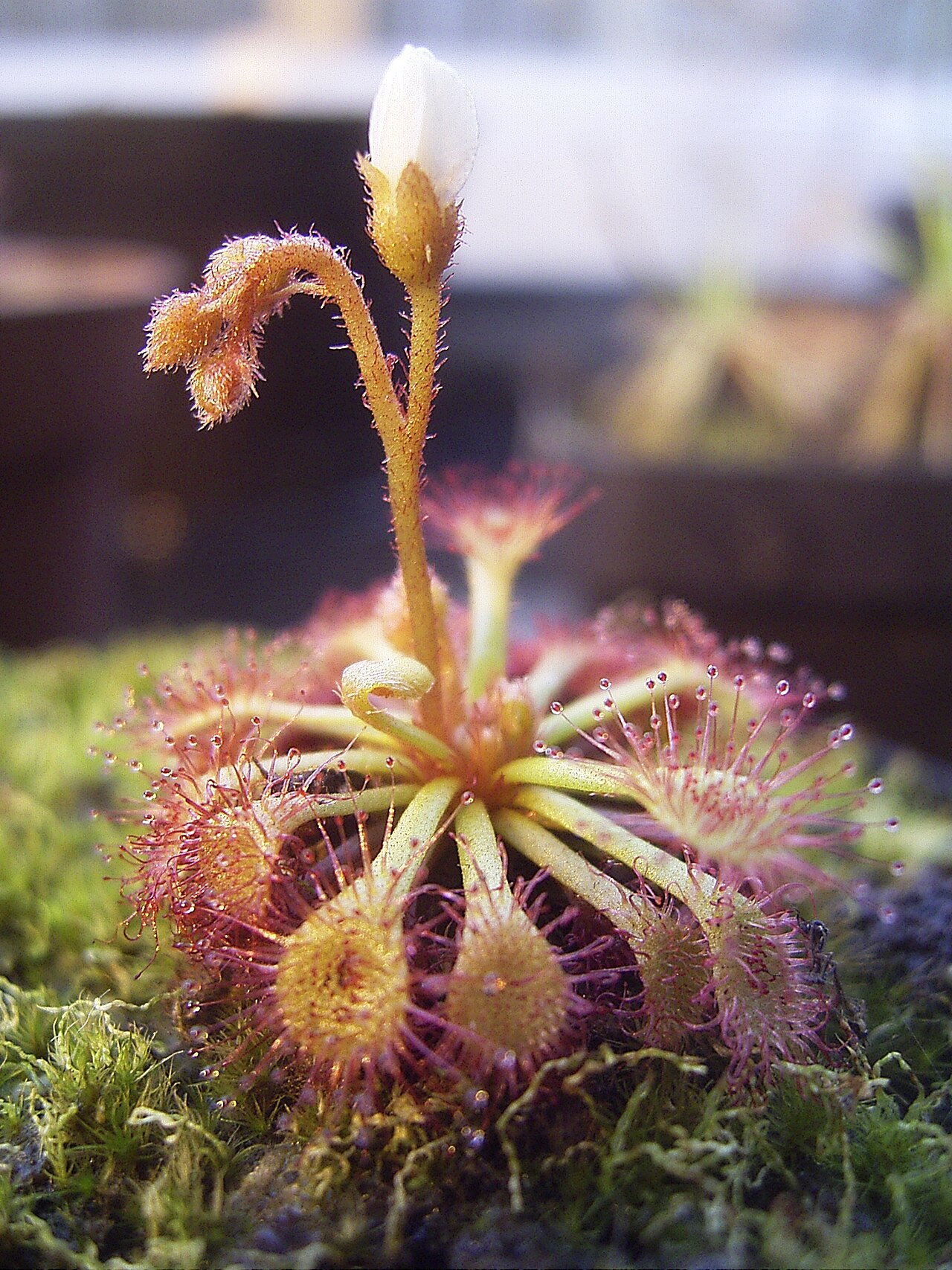
A very small, flat rosette of roundish to ovate leaves on short petioles, almost entirely red in sun and densely set with tentacles. A thin scape with a few flowers rises from the centre. Because it is not settled which published descriptions refer to D. felix in the strict sense and which to D. kaieteurensis, no measurements or flower colour are entered here.
Similar species
Drosera kaieteurensis is almost identical in shape and size; some treatments regard D. felix as its synonym, others keep both as separate species. Drosera solaris from Guyana is considered the closest relative of both. The equally small Drosera biflora and Drosera esmeraldae also grow on white sands in the same region; with such dwarf rosettes identification without a flower and a hand lens is often impossible.
The trap and how it works
An active flypaper trap in miniature. The tentacles on the minute blades catch springtails, mites, ants and the smallest flies; the rosette lies so flat on the ground that mainly crawling prey is caught. The principle is the same as in larger sundews: stick, enclose, digest.
Habitat and ecology
Open, nutrient-poor places on the sandstone plateau of the Guiana Shield: wet white sands in savannas, damp sand flats and seepages on rock (B6, D1, R1). The plant often grows among other dwarf plants such as Xyris, Eriocaulaceae and Utricularia, in full sun.
Distribution and elevation
The Guiana Shield in northern South America; reported from Venezuela and adjacent areas. The area column of this guide lists Brazil, but according to the available data the core of the range lies in Venezuela; Brazilian records, if any, would concern the border region. Because of the unclear boundary with D. kaieteurensis the exact range is uncertain.
- Recorded (one-degree cells)
Forms and variation
No varieties are recognised. The main point is taxonomic: whether D. felix and D. kaieteurensis are one species, and if so under which name, is an open question that only a modern revision of the Guiana species can answer. This guide keeps them apart for now, following the species list supplied to it.
Where and when to see it
A species for the very dedicated: search bare, wet white-sand patches in the savannas of the Guayana region with a hand lens at the ready. The rosettes are often smaller than a fingernail. Record locality and habitat carefully and photograph the flower close up; such observations are valuable for resolving the taxonomic questions.
Conservation status
Not assessed for the global IUCN Red List and not listed in CITES. Almost nothing is known about numbers and trends. The habitat lies largely in sparsely populated, hard-to-reach country; illegal gold mining is a growing threat to savannas and riverbanks in parts of the Guiana Shield. The taxonomic uncertainty makes a meaningful assessment difficult at present.
Scientific name
Drosera felix | Steyermark & Smith, 1974
Described by Steyermark & L.B. Smith in 1974, in Rhodora, volume 76, p. 491. The name is now considered a synonym of the closely related D. kaieteurensis. The precise type locality could not be established. From the Latin felix ("happy, fruitful") — the exact reason for this name in this species could not be confirmed.
World Checklist of Vascular Plants (WCVP), via Plants of the World Online (POWO), Royal Botanic Gardens, Kew.