All species › Caryophyllales › Sundew family › Drosera meristocaulis
Drosera meristocaulis
One of the great puzzles of the genus. Drosera meristocaulis grows only on Cerro de la Neblina, the highest mountain in South America outside the Andes, on the border between Venezuela and Brazil. Yet its closest relatives are not South American sundews but the pygmy sundews of Australia. The species was discovered on expeditions in 1953–1954 and described in 1957 by Bassett Maguire and John Wurdack.

Identification
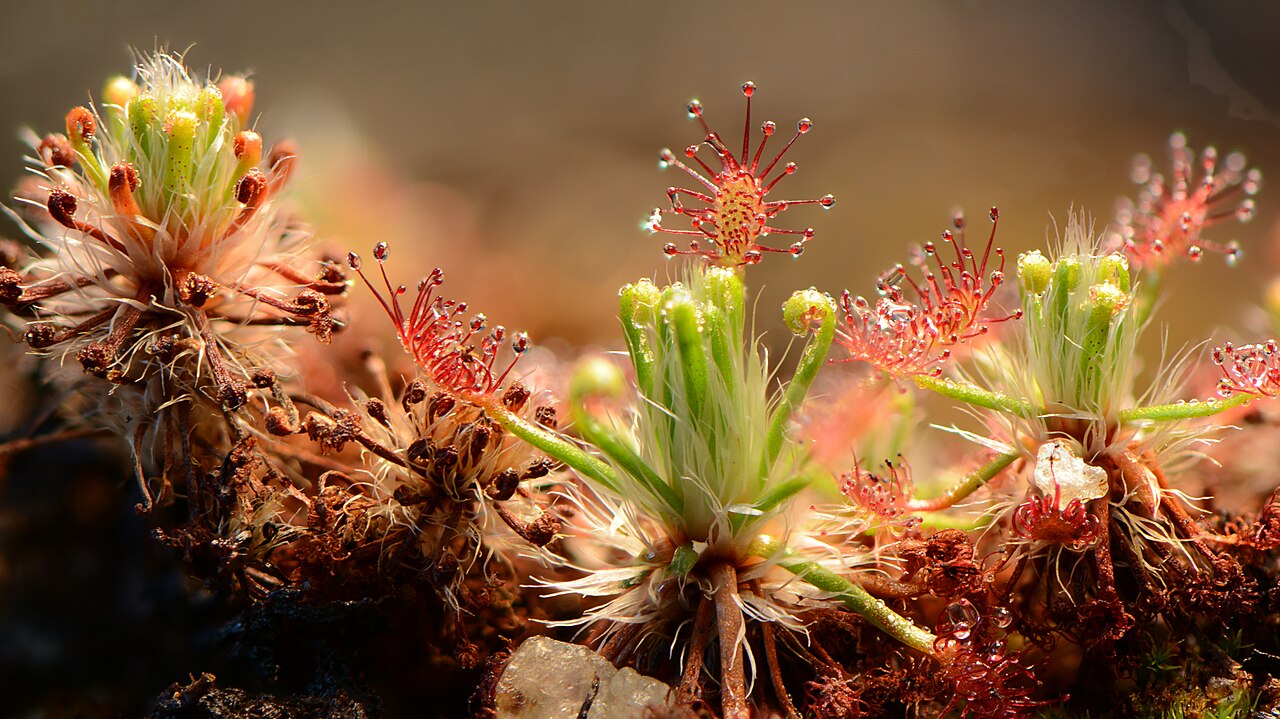
A cushion-forming plant with branching stems that reach about 15 cm and stay clothed in the dead leaves of earlier years; each branch ends in a small rosette. The leaves are spatulate, 5 to 12 mm long and red, with silvery stipules at the base. The pink flowers are about 20 mm across, large for such a small plant. An important character lies in the flower: the styles are undivided, whereas in the other South American sundews they are forked.
Similar species
Drosera roraimae and other tepui sundews also grow on Neblina, but they have long-petioled leaves and white or pale pink flowers and do not form branching cushions. The combination of branching stems clothed in dead leaves, small red spatulate leaves and large pink flowers with undivided styles is unique. In appearance the plant recalls an Australian pygmy sundew more than its neighbours.
The trap and how it works
An active flypaper trap as in other sundews. The small leaves are crowded at the branch tips and mainly catch minute insects such as springtails and gnats. In the cool, wet climate of the mountain the catch is modest, but on this extremely nutrient-poor substrate it remains an important source of nitrogen.
Habitat and ecology
Open bogs and wet savannas on the Neblina plateau, boggy places along streams and wet, bare rock slabs (W1, W4, R5), at 1,900 to 2,200 m. The climate is cool and wet almost all year. The plant grows among characteristic tepui vegetation of low shrubs, grasses and cushion plants.
Distribution and elevation
Known only from Cerro de la Neblina on the Venezuela–Brazil border, and there, according to the available data, confined to a few northern valleys. Remarkably, it has never been found on other tepuis with similar habitats, although many of them are well explored.
- Recorded (one-degree cells)
Forms and variation
There are no varieties. The species alone forms subgenus Meristocaulis, raised from section to subgenus in 1996. DNA studies placed it close to the Australian pygmy sundews; the explanation for that distant relationship, either a very old lineage from the days of Gondwana or long-distance dispersal, is still debated.
Where and when to see it
Neblina is one of the most remote and inaccessible mountains on the continent; visits are possible only on rare scientific expeditions with permits from both countries. For most readers this species therefore remains a plant of photographs and herbarium sheets. Anyone who does get there: keep off the fragile peat cushions.
Conservation status
Not assessed for the global IUCN Red List and not listed in CITES. The range is extremely small but lies within national parks on both sides of the border and is practically inaccessible, so direct human threats are slight. Climate change, which may warm and dry the cool tepui summits, is considered the greatest long-term risk for such summit species.
Scientific name
Drosera meristocaulis | Maguire & Wurdack, 1957
Drosera meristocaulis was described in 1957 by Bassett Maguire and John Julius Wurdack, in Memoirs of the New York Botanical Garden, volume 9, p. 332. The same authors erected the monotypic section Drosera sect. Meristocaulis in that same work. The holotype (NY 39379, New York Botanical Garden) was collected by B. Maguire on 5 January 1954 at Cerro de la Neblina, along the Río Yatua, 4 km south of Cumbre Camp, Venezuela, at about 1900 m elevation, during the 1953–1954 NYBG expedition. The name is a compound of Greek meristos ("divided, divisible"; the root of "meristem") and Latin caulis ("stem"), referring to this species' unusual true, repeatedly branching stem with an active growing point — a feature unique within Drosera that was the reason for placing it in its own section. The authors' own original rationale could not be traced, but the literal meaning of the compound name is clear.
World Checklist of Vascular Plants (WCVP), via Plants of the World Online (POWO), Royal Botanic Gardens, Kew.