All species › Caryophyllales › Sundew family › Drosera echinoblastus
Drosera echinoblastus
A pygmy sundew with a prickly name: echinoblastus means 'with spiny buds', referring to the gemmae, which in this species have a rough, spiny surface. Neville Marchant and Allen Lowrie described it in 1992 together with the related Drosera leioblastus, 'with smooth buds'. The pair of names already tells you how to tell the two apart.
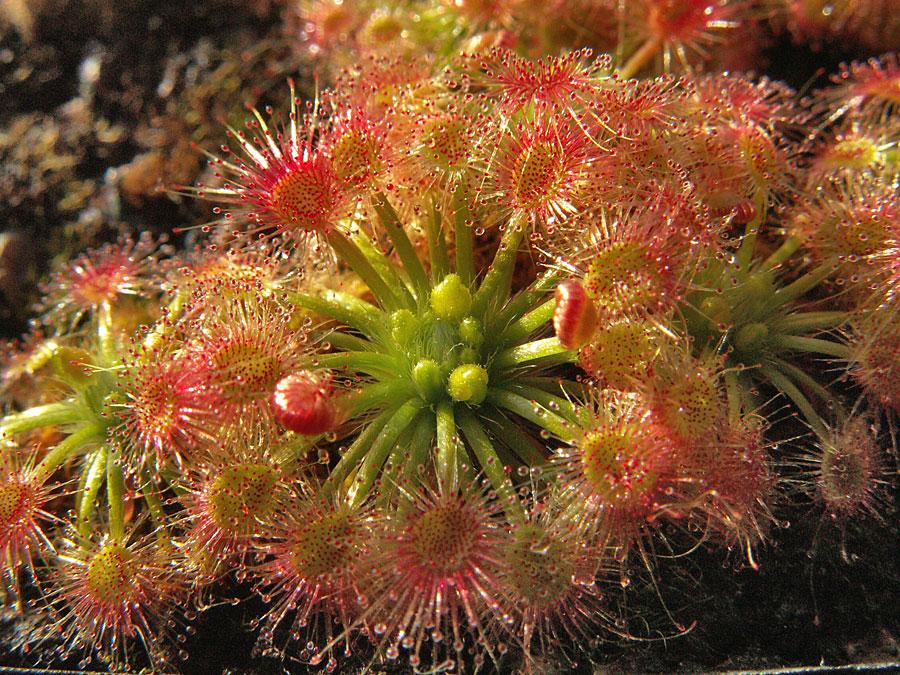
Identification
A perennial, fibrous-rooted pygmy sundew that can reach 12 cm with its flowering stem, large for a pygmy sundew. The heart of the rosette carries the cone of silvery stipules. The flowers are orange and appear late, in October and November. The characteristic detail is the gemmae formed at the centre of the rosette at the end of autumn: in this species they have a spiny, knobbly surface. Precise leaf and flower measurements were not available in the accessible sources.
Similar species
Its counterpart is Drosera leioblastus, described in the same publication, which has smooth gemmae. Several other pygmy sundews flower orange, including Drosera callistos, which flowers in the same months but grows on lateritic soil, and Drosera barbigera and Drosera miniata, which flower earlier in the season. The spiny gemmae are the best character outside flowering, although they are present only in autumn and winter.
The trap and how it works
An active flypaper trap. The small leaves bear stalked glands with droplets of glue in which small insects are caught; the tentacles bend towards the prey and secrete digestive enzymes. On the damp sandy soil where the species grows, springtails and small gnats are the main prey.
Habitat and ecology
Sandy soils in places that are damp in winter (FloraBase): depressions and flat parts of the sandplains where water stands or sits high in the soil during the wet season (W7, D1). The late flowering fits the late drying of these sites.
Distribution and elevation
Endemic to the south-west of Western Australia. FloraBase lists the Geraldton Sandplains and Swan Coastal Plain bioregions, in the Lesueur Sandplain and Perth subregions.
- Recorded (one-degree cells)
Forms and variation
No subspecies or varieties have been described. Reproduction by gemmae is especially conspicuous in this species because of their spiny form. The gemmae are splashed out of the heart of the rosette by raindrops and grow into new plants.
Where and when to see it
For the flowers: October to early November, in the damp depressions of the sandplains. For the gemmae: come in winter, June or July, and look into the heart of the rosette with a hand lens. To see both features you will have to visit the site twice.
Conservation status
Assessed as Least Concern (LC) on the IUCN Red List and listed as not threatened in Western Australia. Not in CITES. The sandplains north of Perth are under pressure from clearing and falling groundwater, but large protected heathland areas lie within the range.
Scientific name
Drosera echinoblastus | Marchant & Lowrie, 1992
Described by N.G. Marchant & Allen Lowrie in 1992, in "New Names and New Combinations in 34 Taxa of Western Australian Tuberous and Pygmy Drosera", Kew Bulletin, volume 47, no. 2, p. 322 (29 June 1992). South-western Australia, with two cited localities: near Hill River, north of Cataby, and at Cranbrook, Western Australia. Greek for "spiny" or "hedgehog-like" — refers to the plant's spiny, hedgehog-like resting bud (turion).
World Checklist of Vascular Plants (WCVP), via Plants of the World Online (POWO), Royal Botanic Gardens, Kew.