All species › Caryophyllales › Sundew family › Drosera walyunga
Drosera walyunga
A pygmy sundew of Western Australia, described in 1992 by N.G. Marchant and Allen Lowrie. The name walyunga matches that of Walyunga National Park in the Avon Valley north-east of Perth, and presumably refers to the area where the plant was found. The sources accessible for this guide contain few particulars about this species; the text is therefore short.
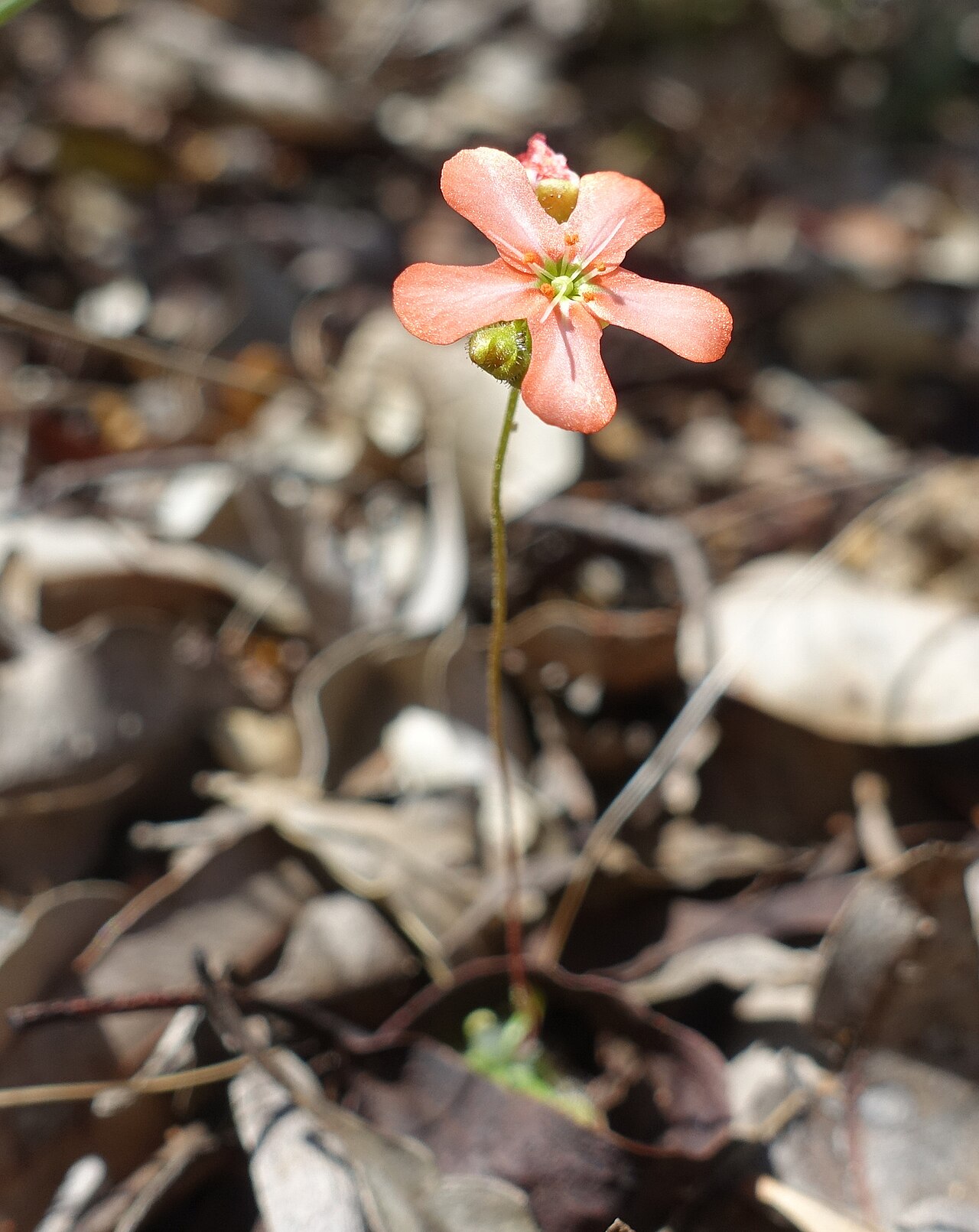
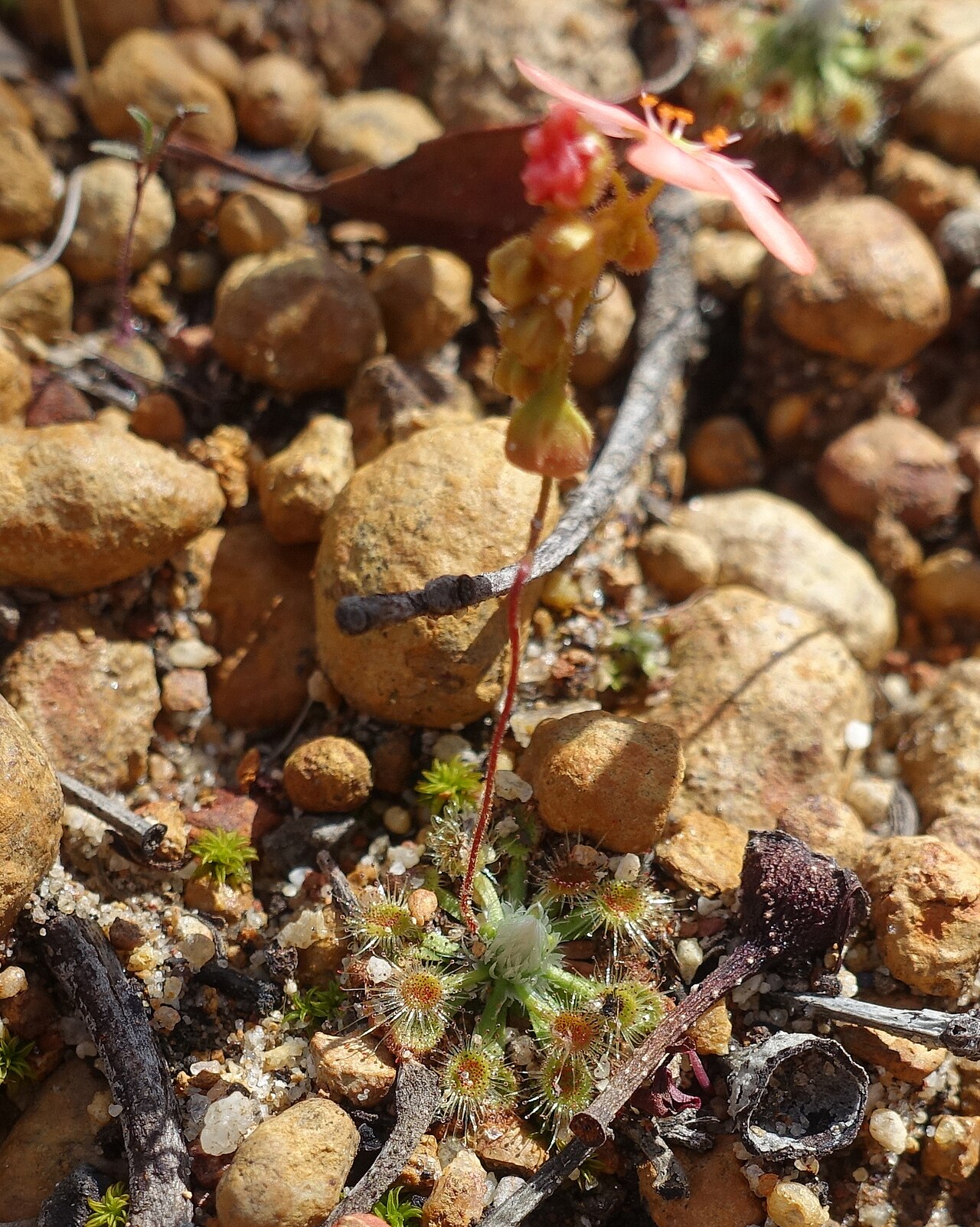


Identification
A pygmy sundew with the build typical of the group: a small rosette of stalked round blades with tentacles around a bud of stipules, from which a slender inflorescence rises. Flower colour, flowering time and leaf and flower measurements are not given in the sources consulted; all measurement fields are left empty.
Similar species
Without published characters, no reliable distinction from related pygmy sundews can be given here. Use an up-to-date key, such as that in Lowrie (2013), and look at the stipule bud, hairiness and stigmas.
The trap and how it works
An active flypaper trap in miniature. Each leaf blade, often no larger than a pinhead to a few millimetres, carries stalked glands on its margin and upper surface, each holding a glistening sticky droplet; the marginal tentacles are usually the longest. A small animal that touches the droplets sticks fast, after which the tentacles bend towards the centre of the blade and press the prey against the digestive glands. The glands secrete enzymes and absorb nitrogen, phosphorus and minerals from whatever dissolves. Given the scale, the catch consists of the very smallest: springtails, mites, aphids, thrips and minute midges moving over or just above the sandy ground.
Habitat and ecology
Habitat details were not found in the sources consulted. The codes assigned — laterite and open woodland (D3, B6) — are a provisional estimate based on the landscape of the Darling Range and the Avon Valley, to which the name seems to refer, not a published observation.
Distribution and elevation
Endemic to south-west Australia; presumably around the Avon Valley north-east of Perth. No closer delimitation was found in accessible sources. Altitudinal limits are not published.
- Recorded (one-degree cells)
Forms and variation
Described by N.G. Marchant and Allen Lowrie in 1992 and placed in section Lamprolepis, the pygmy sundews. No subspecies or varieties are recognised.
Where and when to see it
Before a visit, consult FloraBase or a local plant society. Walyunga National Park is easily reached from Perth and rich in flowering plants in late winter and spring; look for pygmy sundews in open spots along the paths, and stay on those paths.
Conservation status
Assessed as Least Concern (LC) on the IUCN Red List; not listed in CITES. Further data on populations and threats were not found in the sources consulted.
Scientific name
Drosera walyunga | Marchant & Lowrie, 1992
Drosera walyunga was described in 1992 by Neville Gordon Marchant and Allen Lowrie, published in Kew Bulletin, volume 47(2), page 328. The holotype was collected on 8 November 1984 by A. Lowrie, "on O'Brien Road, ca. 12 km N of Toodyay Road" in southwestern Australia — the area of present-day Walyunga National Park, where the species grows in and around winter-moist springs and seepages. The name walyunga is a toponym: it refers directly to Walyunga National Park in Western Australia, the only known locality where this species occurs.
World Checklist of Vascular Plants (WCVP), via Plants of the World Online (POWO), Royal Botanic Gardens, Kew.