All species › Caryophyllales › Sundew family › Drosera lasiantha
Drosera lasiantha
A pygmy sundew of the granite ranges on the south coast of Western Australia, with one of the smallest ranges in its group. The name lasiantha means 'with hairy flower': scape and sepals are clothed in long woolly hairs, a feature that makes the species recognisable within the whole pygmy group. Allen Lowrie and the American plant anatomist Sherwin Carlquist described it.
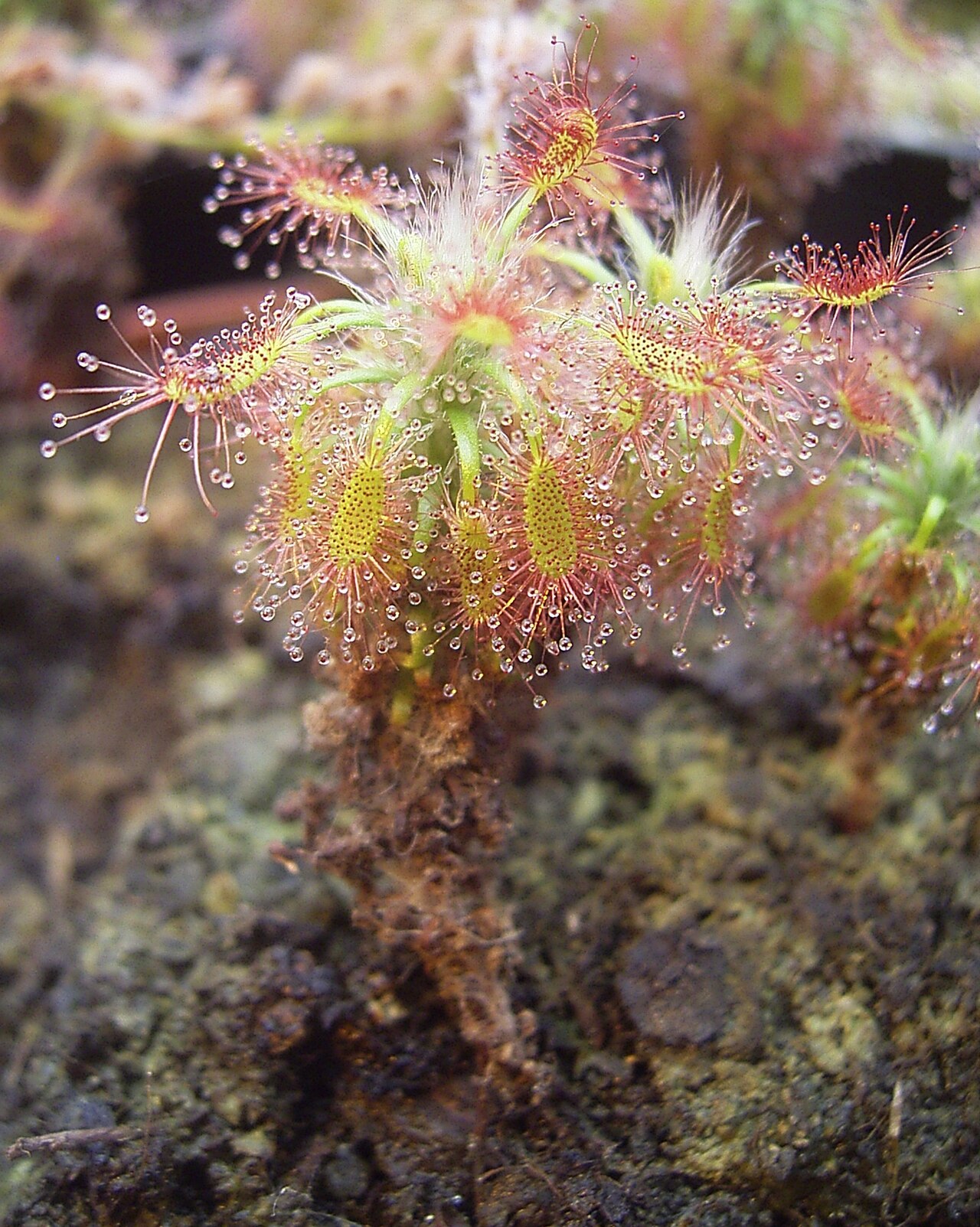
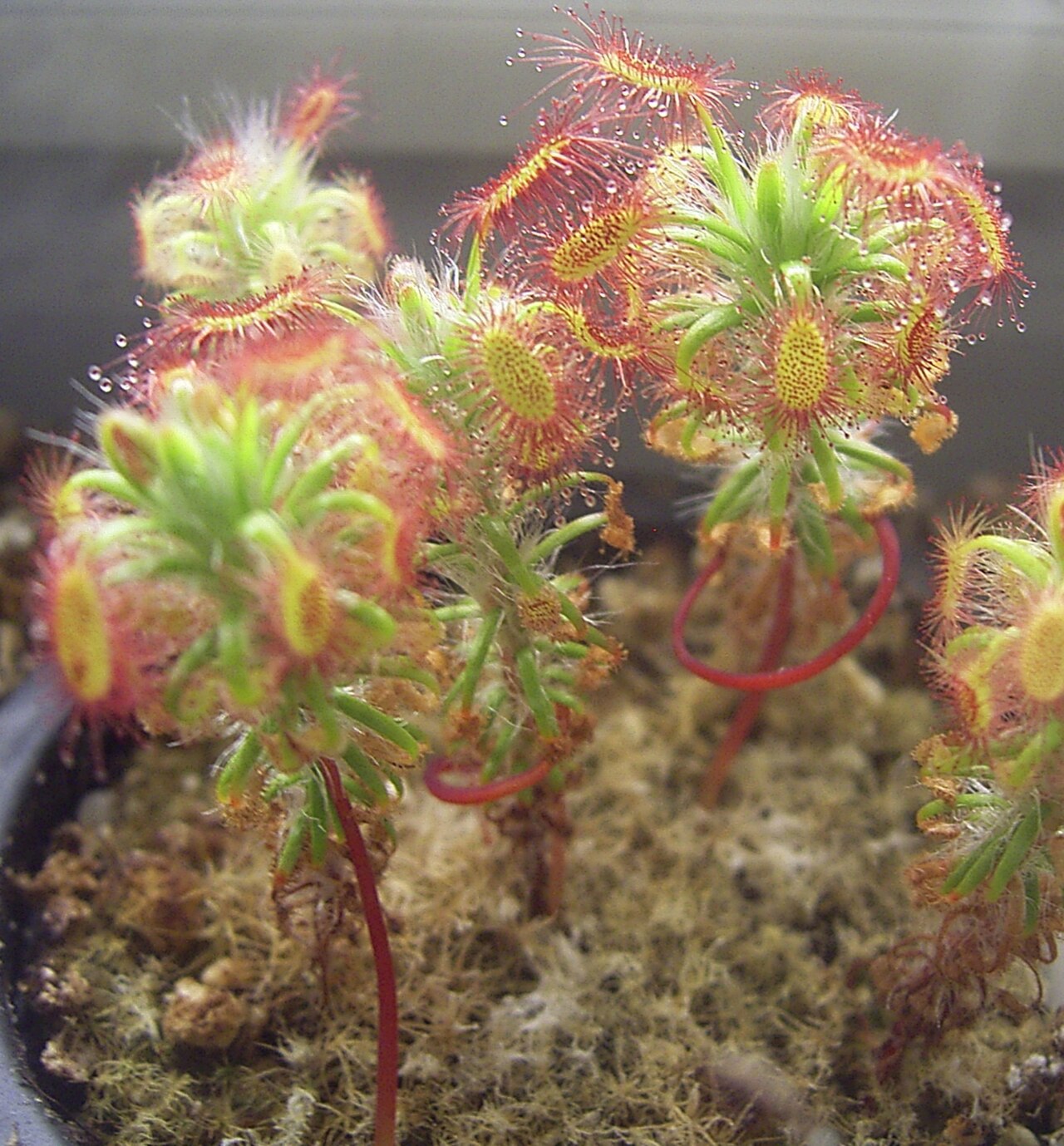
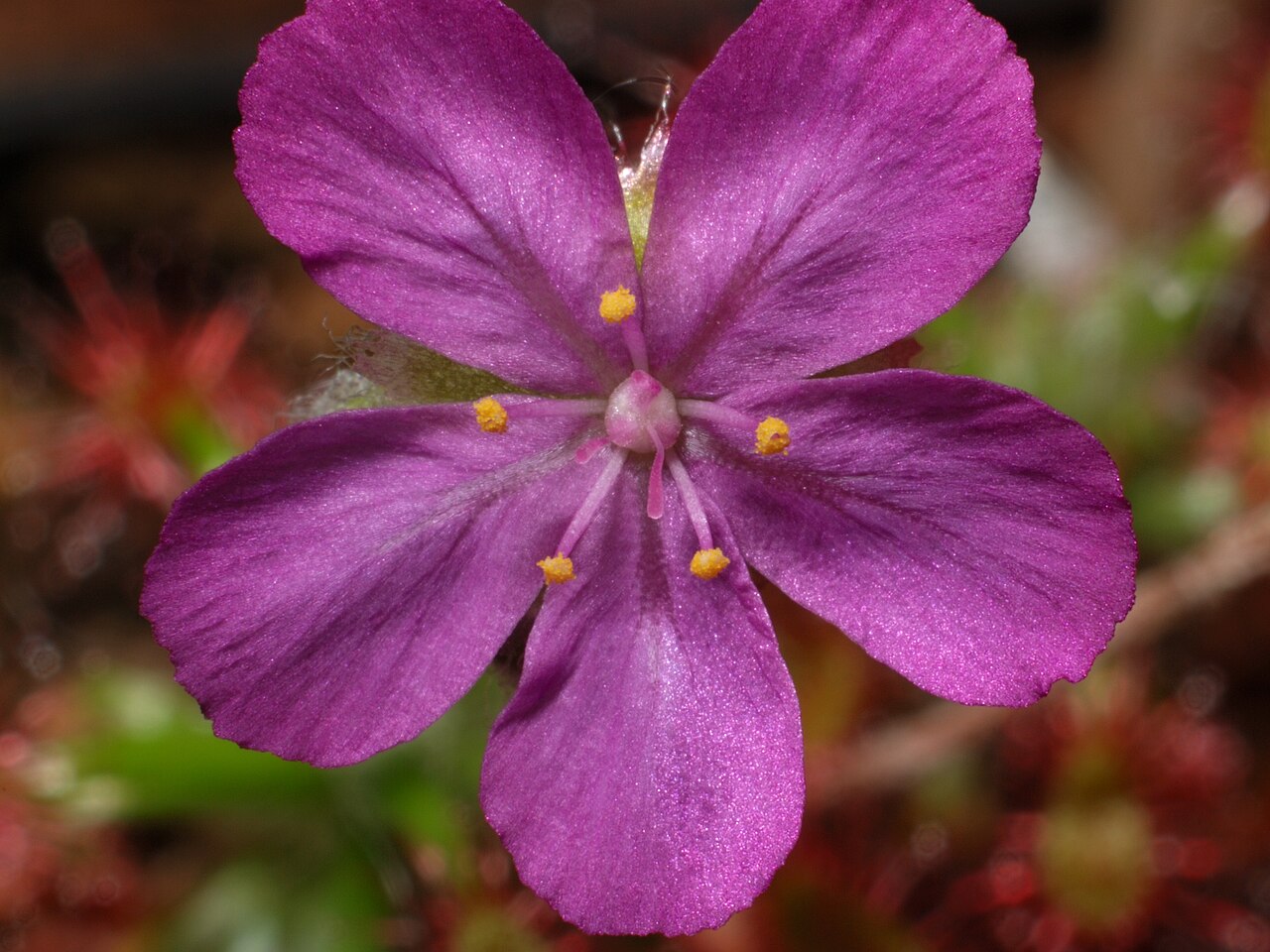
Identification
A small rosette of raised leaves; FloraBase gives a height of up to 2 cm. Older plants often stand on a little stem of old, dead leaf remains that can reach a few centimetres — a growth habit found in several pygmy sundews. The flowers are pink and appear in November. The decisive feature is on the scape and sepals: long woolly hairs without glands, mixed with short hairs that do carry a gland at the tip.
Similar species
Three related species grow in the same way on a stem of old leaf remains: Drosera gibsonii, D. scorpioides and D. dichrosepala. They are told apart by the hairiness of the scape. D. gibsonii has a dense covering of glandular hairs without long hairs; D. scorpioides has long glandular hairs; D. dichrosepala is almost glabrous. Only D. lasiantha combines long, woolly eglandular hairs with short glandular ones.
The trap and how it works
An active flypaper trap in miniature. The small leaf blades carry stalked glands with a sticky droplet; the long marginal tentacles catch the prey and bend it to the centre of the leaf. The catch consists of springtails, mites and the smallest flies moving over the bare ground between the rocks.
Habitat and ecology
Slopes of laterite scree and shallow, skeletal soils on top of granite (D3, R3), in open patches among low vegetation (B5). It is a cooler and moister setting than the inland laterite where many other pygmy sundews grow: the granite ranges of the south coast catch cloud and rain.
Distribution and elevation
Endemic to the south of Western Australia: the Porongurup Range and the nearby Mount Lindesay National Park, in the Jarrah Forest bioregion (Southern Jarrah Forest subregion). Within that area the species grows only on the laterite scree slopes of a few mountains.
- Recorded (one-degree cells)
Forms and variation
No subspecies or varieties have been described. Like most pygmy sundews the plant forms gemmae in the heart of the rosette at the end of the growing season, which are dispersed by raindrops and grow into new plants.
Where and when to see it
Go in late October or November, when the pink flowers are open, and take a hand lens: the woolly hairs of the scape are the character that matters. Keep to the walking tracks of the Porongurup Range; laterite scree slides easily, and the plants grow precisely on those unstable slopes.
Conservation status
On the global IUCN Red List the species is listed as Vulnerable (VU); in Western Australia it is listed as Priority Two among poorly known, possibly threatened flora. It is not listed in CITES. The small range lies largely within national parks, but for that very reason a single event — too hot or too frequent a fire, an outbreak of the root rot Phytophthora in the surrounding vegetation, trampling along popular walking tracks — can affect a large part of the population.
Scientific name
Drosera lasiantha | Lowrie & Carlquist, 1992
Described by Lowrie & Carlquist in 1992, in Phytologia, volume 73, no. 2, p. 100 (7 October 1992). Only "Western Australia" is stated, without a more precise locality. From the Greek lasios ("woolly, hairy") and anthos ("flower") — "hairy-flowered".
World Checklist of Vascular Plants (WCVP), via Plants of the World Online (POWO), Royal Botanic Gardens, Kew.