All species › Caryophyllales › Sundew family › Drosera androsacea
Drosera androsacea
One of the older pygmy sundew names, described by Ludwig Diels in 1904 in the run-up to his major monograph of the family. The epithet refers to Androsace, the rock-jasmines: the flat, open rosette recalls those cushion and rosette plants. In English it is called the cone sundew, after the cone of stipules at the heart of the rosette.
Identification
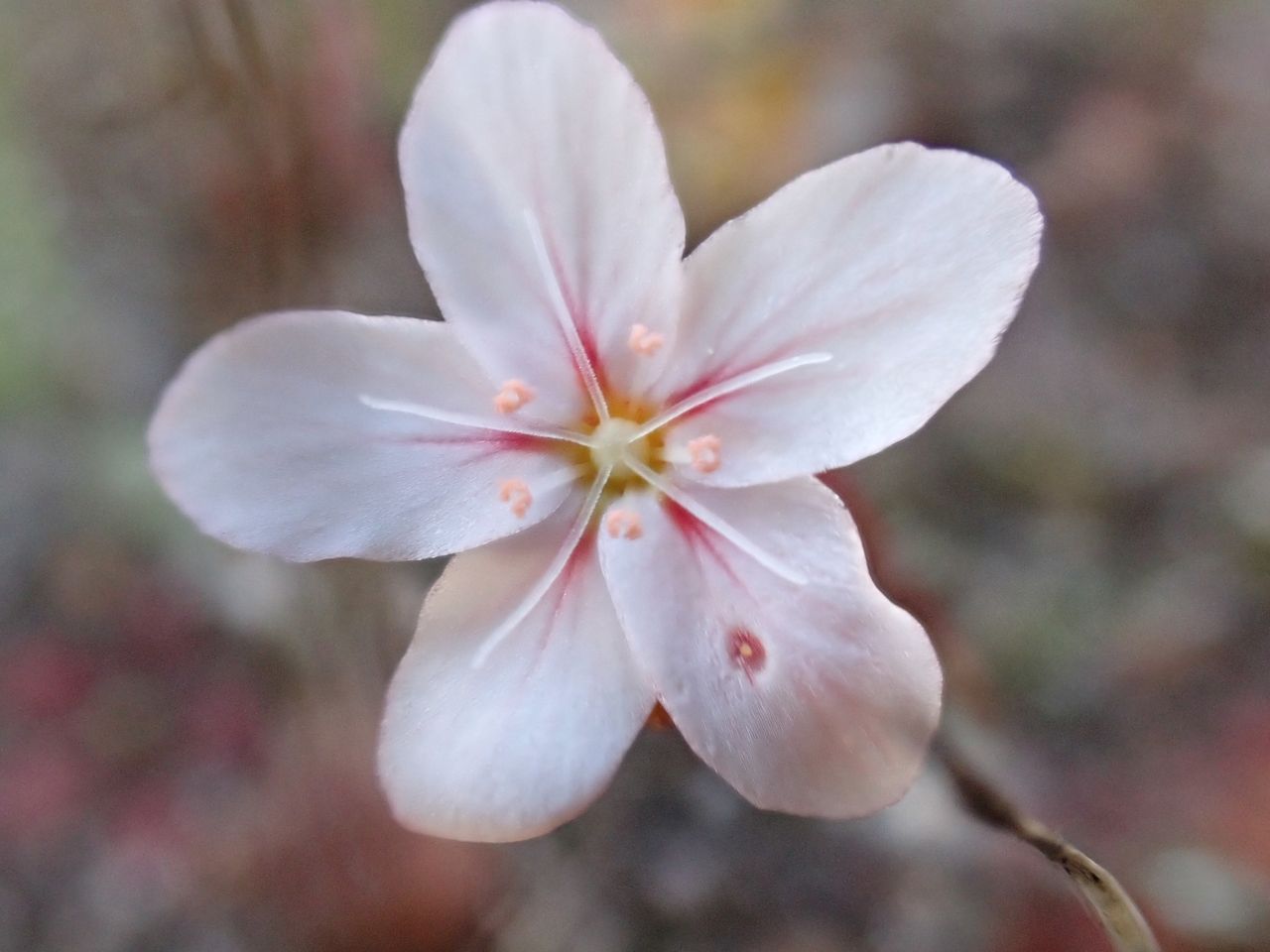
A perennial pygmy sundew no more than 5 cm tall that forms flat, open rosettes: the leaves lie spread flat instead of forming a dense bud as in many relatives. In the centre stands the cone of silvery, papery stipules typical of pygmy sundews. The flowers are pinkish white and appear in September and October. No accessible source gave precise leaf or flower measurements, so those fields are left empty.
Similar species
Among the many pygmy sundews of the south-west, the open, flat rosette is the first clue; species such as Drosera dichrosepala form more compact, semi-erect rosettes. It shares its pinkish white flowers with several species, so in doubtful cases the shape of the stipules, sepals and styles must decide. Without a hand lens reliable identification in this group is often impossible.
The trap and how it works
An active flypaper trap. The flat-spread leaves lie like tiny flypapers on the ground, exactly at the height where springtails, mites and ants move about. The stalked glands carry droplets of glue; on contact the tentacles bend towards the prey and secrete digestive enzymes. The catches are small, but on poor, stony ground every extra source of nitrogen counts.
Habitat and ecology
Stony, sandy-loam or clayey soils (FloraBase). The species grows in the open vegetation of heath, shrubland and open woodland in the south-west (B5, B6), where the ground is moist in winter. In summer, when the soil dries out, the plant retreats to a bud of stipules.
Distribution and elevation
Endemic to the south-west of Western Australia. FloraBase lists the Avon Wheatbelt, Esperance Plains, Jarrah Forest and Mallee bioregions: a fairly large area in the interior and along the south coast.
- Recorded (quarter-degree cells)
Forms and variation
No subspecies or varieties have been described. Like other pygmy sundews, the species forms gemmae at the heart of the rosette in late autumn; these are splashed away by raindrops and grow into new, genetically identical plants, so dense clusters can form locally.
Where and when to see it
September and October are the best months, when the rosettes are full grown and the pinkish white flowers are open. Look in the open patches between shrubs, on the bare, stony ground where competition is low. Crouch down and scan the ground at eye level: a flat rosette a few centimetres across stands out only when you are close.
Conservation status
Assessed as Least Concern (LC) on the IUCN Red List (2020 assessment) and listed as not threatened in Western Australia. Not in CITES. The range is large and spans several bioregions, giving the species some buffer against local clearing.
Scientific name
Drosera androsacea | Diels, 1904
Described by Ludwig Diels, published 6 December 1904, in Botanische Jahrbücher für Systematik, volume 35, no. 2-3, p. 205. The precise type locality could not be established with certainty. The species is a pygmy sundew from Western Australia. The name likely refers to a resemblance to the genus Androsace (rock-jasmine, family Primulaceae), but this could not be confirmed with a source.
World Checklist of Vascular Plants (WCVP), via Plants of the World Online (POWO), Royal Botanic Gardens, Kew.