All species › Caryophyllales › Sundew family › Drosera erythrogyne
Drosera erythrogyne
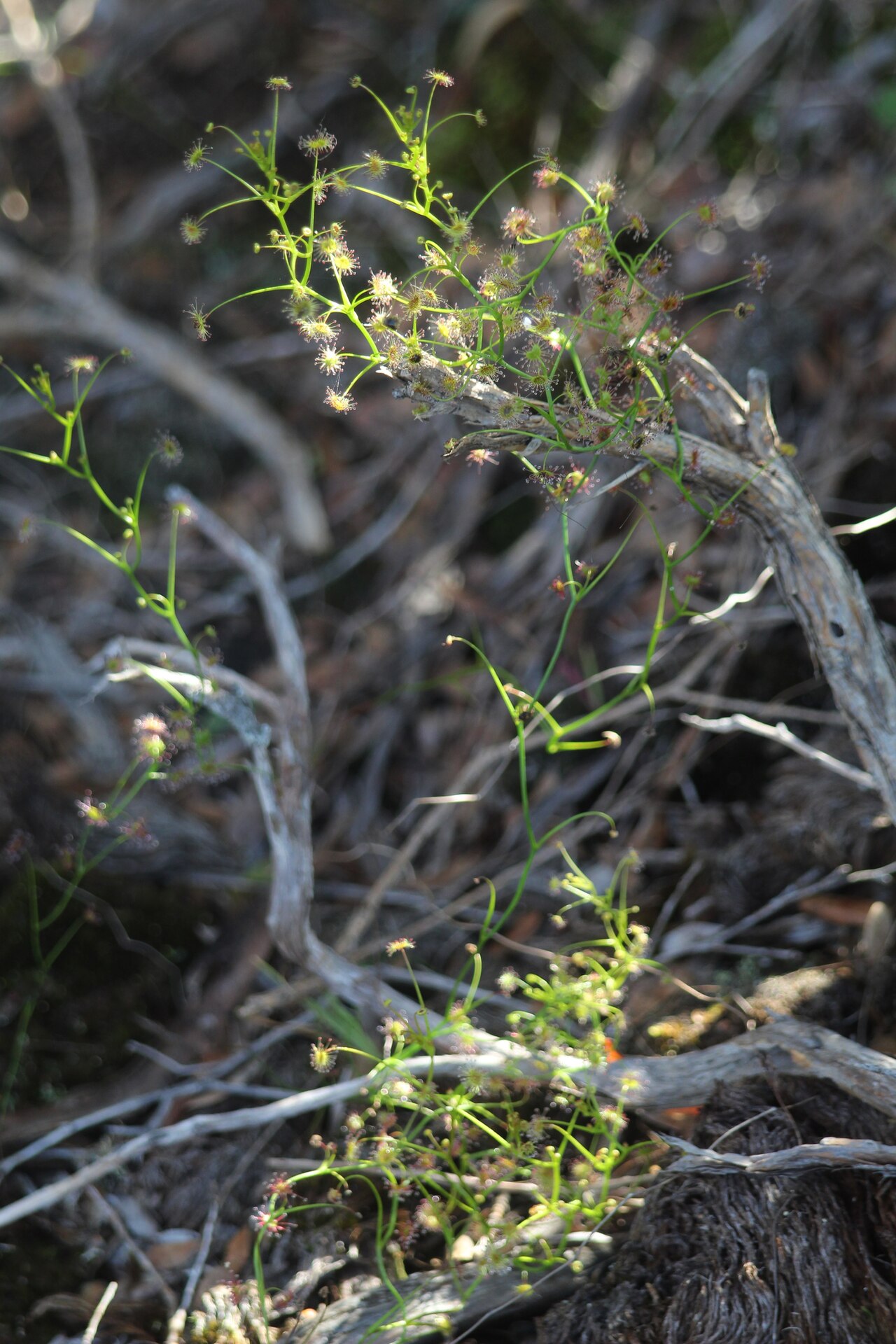
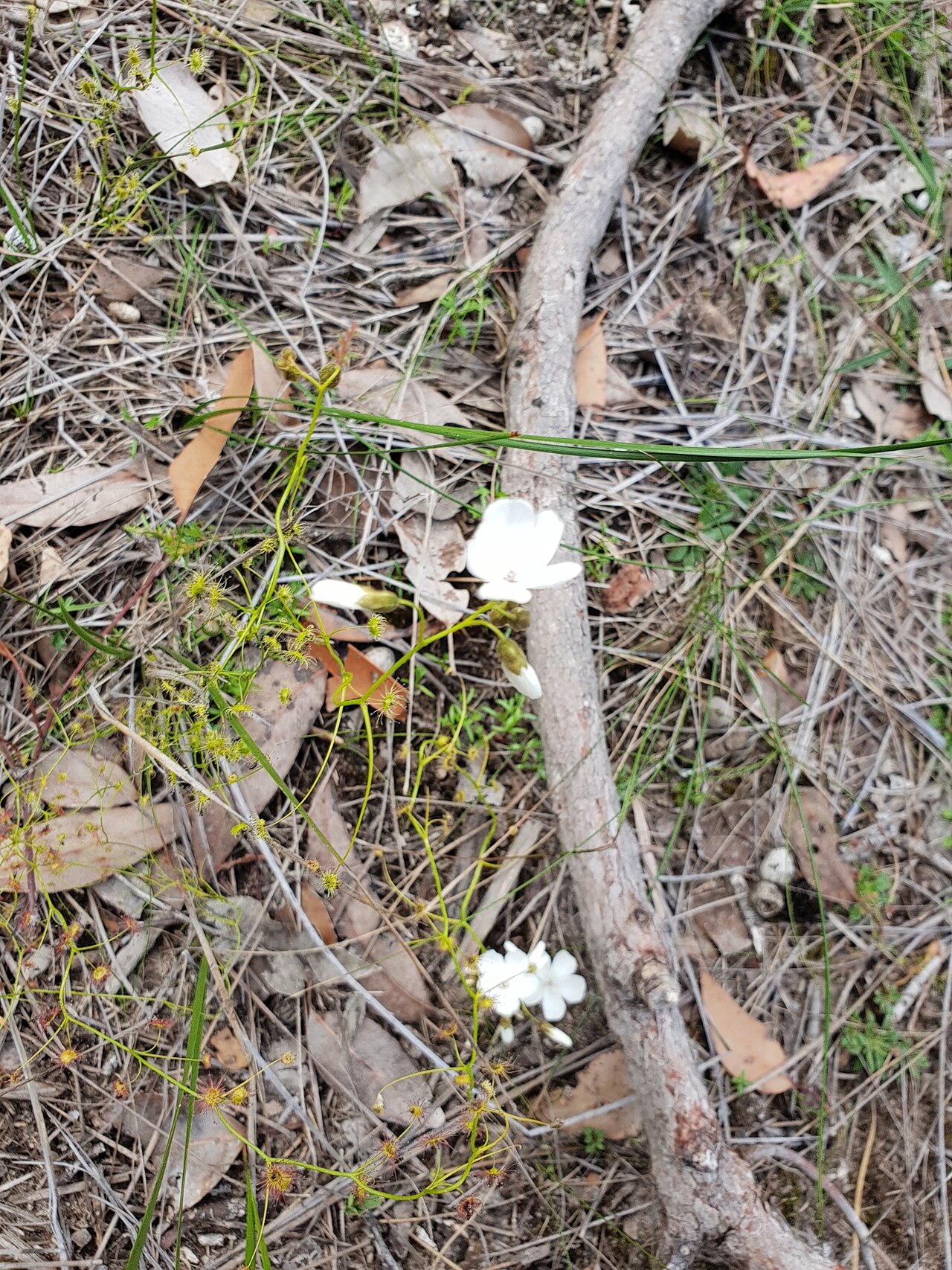
A two-metre sundew: Drosera erythrogyne is a climbing tuberous sundew that attaches itself to surrounding shrubs with its sticky leaves and so reaches far above the ground. Neville Marchant and Allen Lowrie described it in 1992. The name means 'with red female organs' and refers to the red pistil (ovary and styles) in the otherwise white flower.
Identification
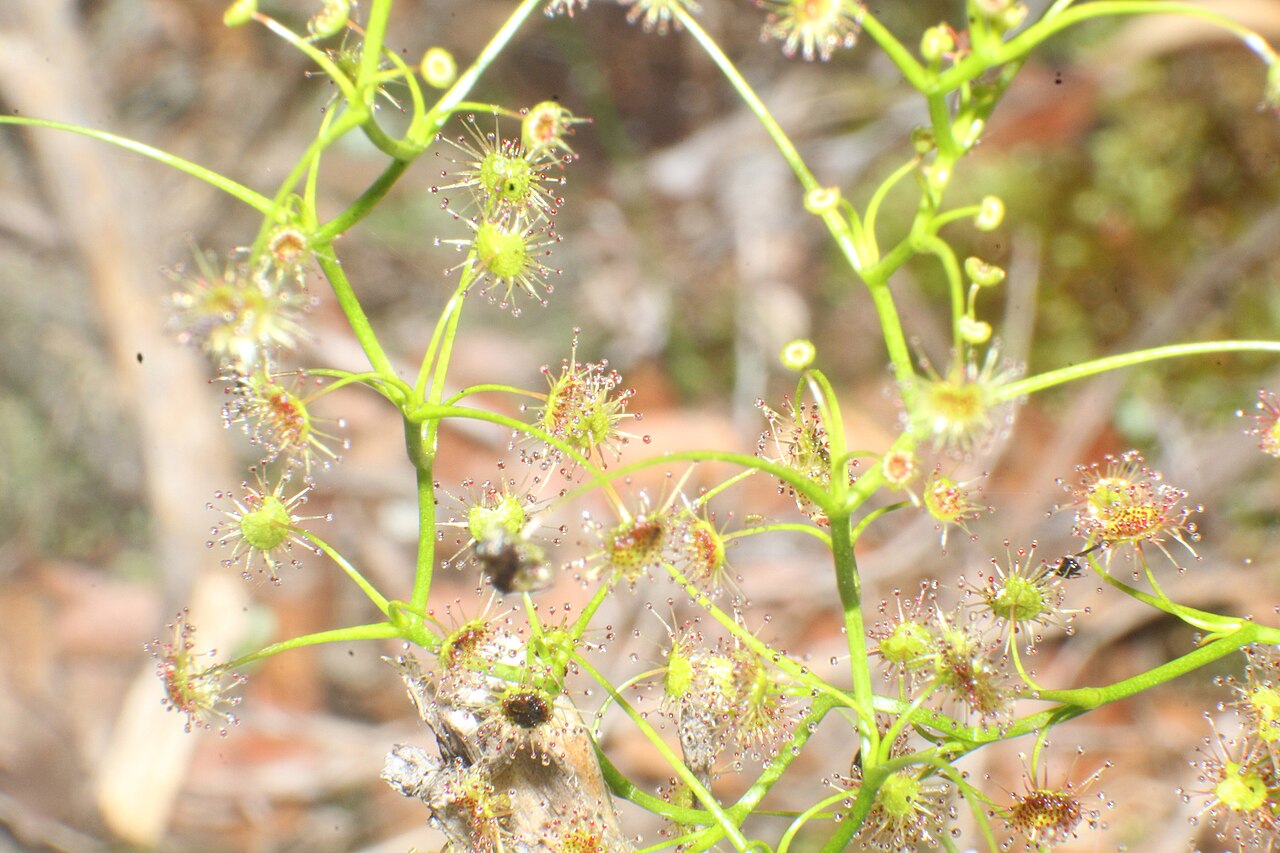
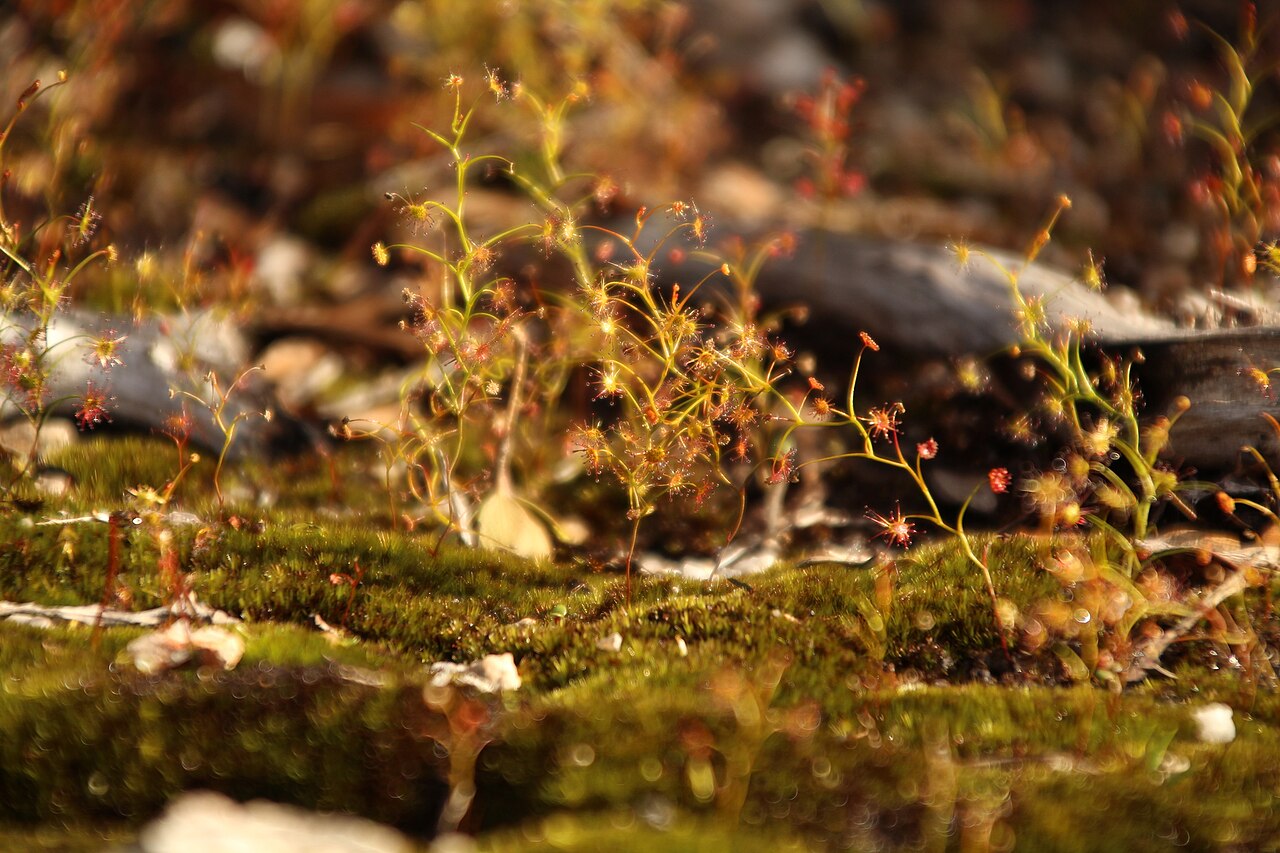
A perennial tuberous plant that forms a new, slender stem every year. The stem scrambles or climbs through the vegetation and can reach 2 m, by some accounts 2 to 3 m. Along the stem are scattered small, shield-shaped trapping leaves with tentacles, which the plant also uses as climbing organs. The flowers are white with, as the name indicates, a red pistil, and appear from August to October. Precise leaf and flower measurements were not available in the accessible sources.
Similar species
There are several climbing tuberous sundews in the south-west, including Drosera macrantha, Drosera menziesii and Drosera pallida. The combination of white flowers with a red centre and a habitat in swamps and near granite rocks in the south distinguishes D. erythrogyne. A look at the red styles and ovary is needed for a sure identification.
The trap and how it works
An active flypaper trap that doubles as a climbing aid. The shield-shaped leaves along the stem bear stalked glands with droplets of glue. Flying insects moving between the shrubs get stuck on them; the tentacles bend towards the prey and secrete enzymes. Because the plant reaches high into the vegetation it catches different prey from the ground rosettes of related species.
Habitat and ecology
Peaty sand and gritty loam in swamps and near granite outcrops (FloraBase) (W4, R3). The plant needs shrubs or reeds to climb on. It survives the dry summer as an underground tuber; with the winter rains a new stem shoots up.
Distribution and elevation
Endemic to the south-west of Western Australia, along the south coast, according to the descriptions mainly in the coastal belt west of Albany. FloraBase lists the Esperance Plains, Jarrah Forest and Warren bioregions, in the Fitzgerald, Southern Jarrah Forest and Warren subregions.
- Recorded (quarter-degree cells)
Forms and variation
No subspecies or varieties have been described. The species is placed in subgenus and section Ergaleium, the group of erect and climbing tuberous sundews.
Where and when to see it
September is a good month. Search swamp margins and around granite rocks in the southern coastal belt, and look not only at the ground but into the shrubs: the stems hang like threads with glistening droplets between the branches. They are best seen against the light.
Conservation status
Assessed as Least Concern (LC) on the IUCN Red List and listed as not threatened in Western Australia. Not in CITES. The southern coastal belt is relatively well protected in national parks, but swamps are sensitive to drainage and changes in fire regime.
Scientific name
Drosera erythrogyne | Marchant & Lowrie, 1992
Described by N.G. Marchant & Lowrie in 1992, in Kew Bulletin, volume 47, no. 2, p. 316 — the same publication as earlier species in this golf. The precise type locality could not be established. The species occurs along the southern Western Australian coast west of Albany, in swamps or near granite outcrops. Notably, D. erythrogyne is considered the tallest sundew species in the world, with stems up to 200 cm (exceptionally up to 310 cm). Probably from the Greek erythros ("red") and gyne ("female, pistil") — possibly referring to red styles or a reddish pistil, though this is not confirmed with a source.
World Checklist of Vascular Plants (WCVP), via Plants of the World Online (POWO), Royal Botanic Gardens, Kew.