All species › Caryophyllales › Sundew family › Drosera ericgreenii
Drosera ericgreenii
A rosetted sundew from the Western Cape described only in 2008, the work of Andreas Fleischmann, Richard Gibson and Fernando Rivadavia. Drosera ericgreenii is named after Eric Green, a connoisseur of Cape carnivorous plants. Its description shows that even in a well-studied flora such as that of the Cape, undescribed sundews remained to be found.
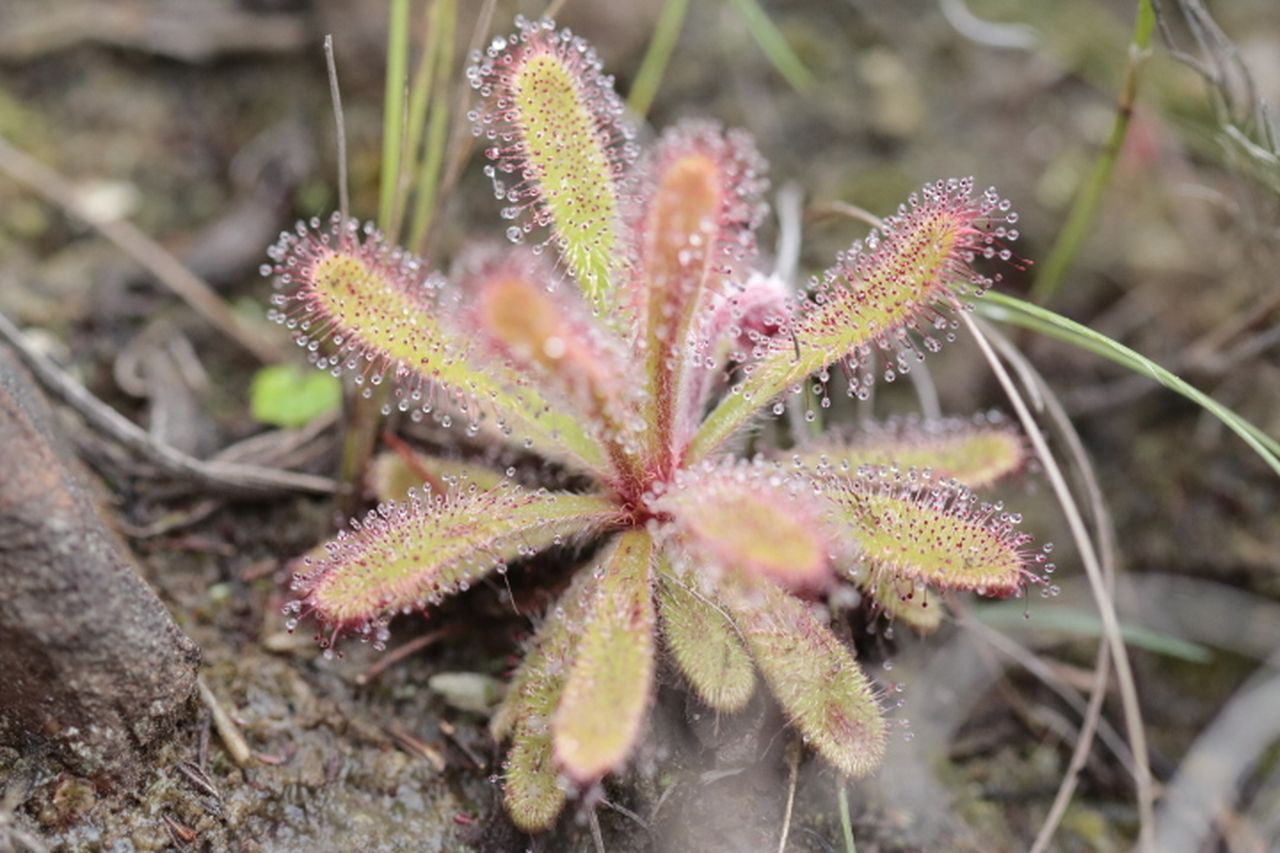
Identification
A rosetted sundew with glandular trapping leaves and a scape from the centre of the rosette. Reliable measurements and a flower colour from the original description were not available for this text; the measurement fields are left empty.
Similar species
Before its description the species was presumably included in one of the familiar Cape rosetted sundews, such as D. aliciae, D. slackii or D. hilaris. Fleischmann's (2018) overview in Willdenowia, covering all rosetted sundews of the Western Cape, is the appropriate source for telling them apart.
The trap and how it works
An active flypaper trap: stalked glands with sticky droplets hold small insects, after which the tentacles bend towards the prey and the glands secrete digestive enzymes.
Habitat and ecology
Wet, nutrient-poor places in mountain fynbos, such as seeps and stream banks on sandstone (R1, W4, B5). Specific habitat data were not available.
Distribution and elevation
Endemic to the Western Cape of South Africa. A more precise range could not be established from the sources consulted; altitudinal limits were not found.
- Recorded (one-degree cells)
Forms and variation
No varieties. The 2008 description fell in a period when Fleischmann, Rivadavia and colleagues were systematically revising the Cape sundews, partly with molecular methods; D. ericgreenii is one of the few new species to come out of that work and be generally accepted.
Where and when to see it
Search in the wet months along seeps in the mountains of the Western Cape. Anyone who finds a rosetted sundew that does not fit the familiar species can record it with photographs of rosette, leaf and flower and have it checked.
Conservation status
Not assessed for the global IUCN Red List and not listed in CITES. The range is probably small; the threats are those of mountain fynbos in general: alien trees, drying out and a disturbed fire regime.
Scientific name
Drosera ericgreenii | Fleischmann, Gibson & Rivadavia, 2008
Described by A. Fleischmann, R.P. Gibson & F. Rivadavia in 2008, in Bothalia, volume 38, no. 2, p. 141-144 (14 October 2008). Franschhoek/Worcester area, Western Cape Province, South Africa, at about 600-850 m elevation, on rocky sandy slopes in fynbos. Holotype at herbarium NBG. Named in honour of Eric Green, for his contributions to the knowledge of carnivorous plants in the Western Cape.
World Checklist of Vascular Plants (WCVP), via Plants of the World Online (POWO), Royal Botanic Gardens, Kew.