All species › Caryophyllales › Sundew family › Drosera esmeraldae
Drosera esmeraldae
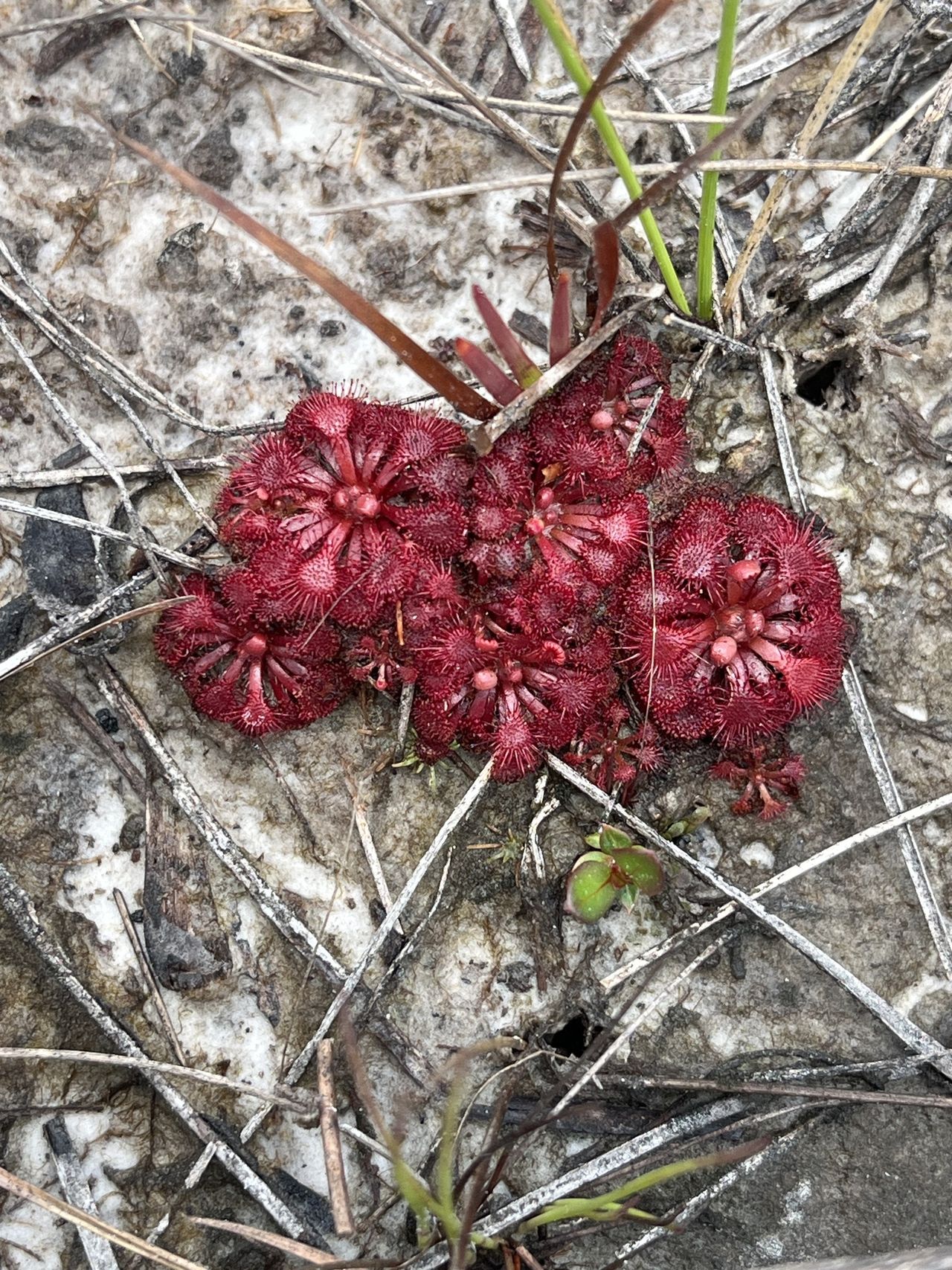
A sundew of the white sands of Venezuelan Amazonia, named after Esmeralda, a small village on the upper Orinoco at the foot of Cerro Duida. Julian Steyermark originally described the plant as part of another species; Bassett Maguire and John Wurdack later raised it to species rank. Little has been published on it since.
Identification
A small, flat rosette of short, densely glandular leaves that turn red in sun, with a thin scape bearing a few flowers. Further details, such as measurements and a confirmed flower colour, could not be checked in the available sources; the size fields are therefore left empty. Identifying the species requires the Flora of the Venezuelan Guayana and a hand lens.
Similar species
More small sundews grow on the white sands of the Orinoco and Rio Negro basins: Drosera biflora, Drosera sessilifolia with sessile, wedge-shaped leaves, Drosera cayennensis and the miniature species Drosera felix and Drosera kaieteurensis. The differences lie in leaf shape, hairs on scape and calyx and the structure of seed and stipules, and often need a lens or microscope.
The trap and how it works
An active flypaper trap on a small scale. The tentacles catch ants, springtails and other small arthropods walking over the white sand; the rosette lies flat on the ground. The white sand is almost entirely leached, so prey makes a real contribution to nutrition.
Habitat and ecology
Open lowland savannas on white quartz sand, the so-called white-sand savannas, and wet, bare sandy patches that may flood in the rainy season and dry out in the dry season (D1, B6, W7). The soils are extremely poor, acid and fast-draining. The plant grows among dwarf grasses, Xyris and Eriocaulaceae.
Distribution and elevation
Venezuelan Amazonia, in Amazonas state, in the area of the upper Orinoco. As far as known endemic to Venezuela; records from neighbouring Colombia or Brazil, conceivable given similar white-sand savannas, are unconfirmed.
- Recorded (one-degree cells)
Forms and variation
No varieties are recognised. The naming history, first as an infraspecific taxon and later as a species, is typical of the small sundews of the Guiana Shield, whose boundaries remain uncertain. A modern revision including DNA work is lacking.
Where and when to see it
A species for the very dedicated field botanist; the area can be reached only by boat or small plane and requires permits. Search bare, wet white-sand patches in the savannas in the rainy season with a hand lens at the ready. Document finds carefully, as reliable observations are rare.
Conservation status
Not assessed for the global IUCN Red List and not listed in CITES. Nothing is known about numbers. The area is sparsely populated and partly protected, but illegal gold mining has done great damage to rivers and savannas in Venezuelan Amazonia in recent years.
Scientific name
Drosera esmeraldae | (Steyermark) Maguire & Wurdack, 1957
Basionym by Julian Steyermark, recombined by Maguire & Wurdack in 1957, in Memoirs of the New York Botanical Garden, volume 9, p. 335. Type material collected on 22 August 1944 by J. Steyermark (no. 57850), between the Esmeralda Savanna and the south-eastern base of Cerro Duida, Amazonas, Venezuela; holotype at F (Field Museum), isotypes at NY, US and VEN. Between the Esmeralda Savanna and the south-eastern base of Cerro Duida, Amazonas state, Venezuela. The species also occurs in Colombia and Brazil and is often confused with the closely related D. biflora (golf 39); suspected hybridisation with D. roraimae. Named after the Esmeralda Savanna, Venezuela, the type locality — not a person's name.
World Checklist of Vascular Plants (WCVP), via Plants of the World Online (POWO), Royal Botanic Gardens, Kew.