All species › Caryophyllales › Sundew family › Drosera grievei
Drosera grievei
One of the smallest pygmy sundews in this guide, reaching no more than 3 cm in total. Allen Lowrie and Neville Marchant described Drosera grievei in 1992 in the journal Nuytsia, in a paper with four new sundew taxa from the south-west that also included D. browniana and the pygmy sundew D. sargentii. The name presumably honours a collector or enthusiast named Grieve; the accessible sources give no certainty on this.
Identification
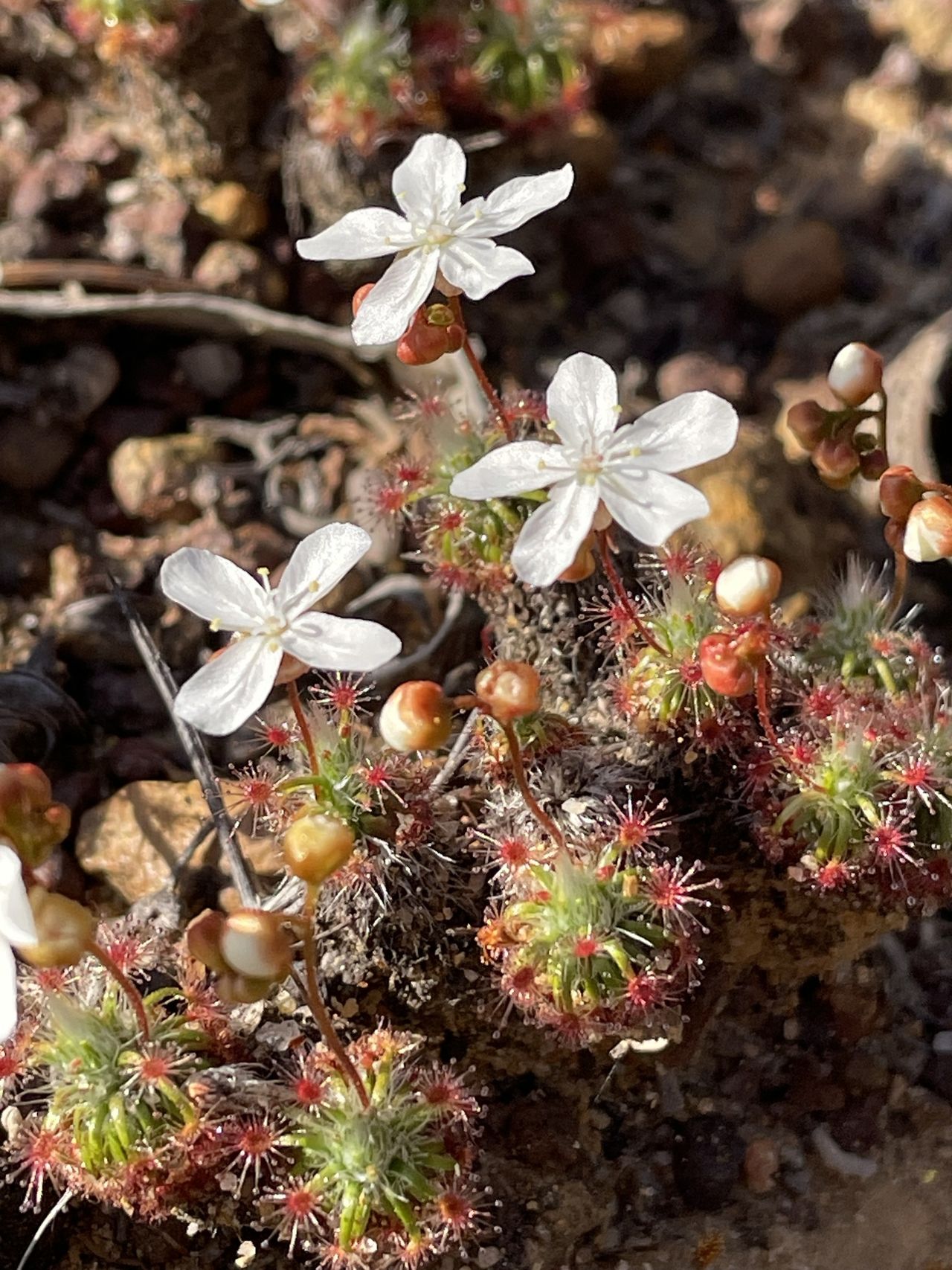
A perennial, fibrous-rooted pygmy sundew reaching 3 cm with its flowering stem. As in all pygmy sundews, the heart of the small rosette holds a cone of silvery stipules, which protects the plant as a resting bud in summer. The flowers are white and appear in September. Precise measurements of leaves, stipules and flowers are in the original description in Nuytsia 8, which could not be consulted for this guide.
Similar species
There are dozens of white-flowered pygmy sundews in the south-west. D. grievei stands out for its small height, its flowering in September and its habitat on clayey sand. A sure identification requires the features of stipules, calyx and styles under a lens, and comparison with the original description.
The trap and how it works
An active flypaper trap on the smallest scale. The leaves, only a few millimetres long, bear stalked glands with droplets of glue in which springtails, mites and minute insects are caught. The tentacles bend towards the prey and secrete digestive enzymes.
Habitat and ecology
Clayey sand (FloraBase), in the open vegetation of heath and shrubland in southern Western Australia (B5). The ground is moist in winter; in summer it dries out and the plant rests as a bud of stipules.
Distribution and elevation
Endemic to the south-west of Western Australia. FloraBase lists the Esperance Plains, Jarrah Forest and Mallee bioregions, the southern part of the area between the jarrah forest and the south coast.
- Recorded (one-degree cells)
Forms and variation
No subspecies or varieties have been described. Like all pygmy sundews the species also reproduces by gemmae, which form at the heart of the rosette in late autumn and are splashed away by raindrops.
Where and when to see it
September is the month. Search bare, clayey-sandy patches in open heath in sunshine around midday. A rosette one centimetre across with a flower a few centimetres high calls for patience and a hand lens; kneel and scan the ground systematically.
Conservation status
The IUCN code in this guide is Least Concern (LC). In Western Australia, however, the species is listed as Priority Three, the category for species known from several sites but possibly under threat and in need of further survey. Not in CITES. The difference between the two assessments mainly reflects the scarcity of data.
Scientific name
Drosera grievei | Lowrie & Marchant, 1992
Described by Allen Lowrie & Neil G. Marchant in 1992, in Nuytsia, volume 8, p. 328. The precise type locality could not be established. The species is restricted to south-western Australia and is considered very rare (Priority One status in Western Australia). Named after Professor Brian Grieve, who made a significant contribution to knowledge of the Western Australian flora.
World Checklist of Vascular Plants (WCVP), via Plants of the World Online (POWO), Royal Botanic Gardens, Kew.