All species › Caryophyllales › Sundew family › Drosera hartmeyerorum
Drosera hartmeyerorum
An annual sundew from the tropical north of Australia, and so an outsider in a series otherwise made up mostly of south-west Australian tuberous and pygmy sundews. Drosera hartmeyerorum belongs to the circle of Drosera indica: plants that come up from seed in the wet season, flower and set seed within a few months, and vanish again with the dry. The name honours Siegfried and Irmgard Hartmeyer, the German couple who found the plant in the field in 1995.
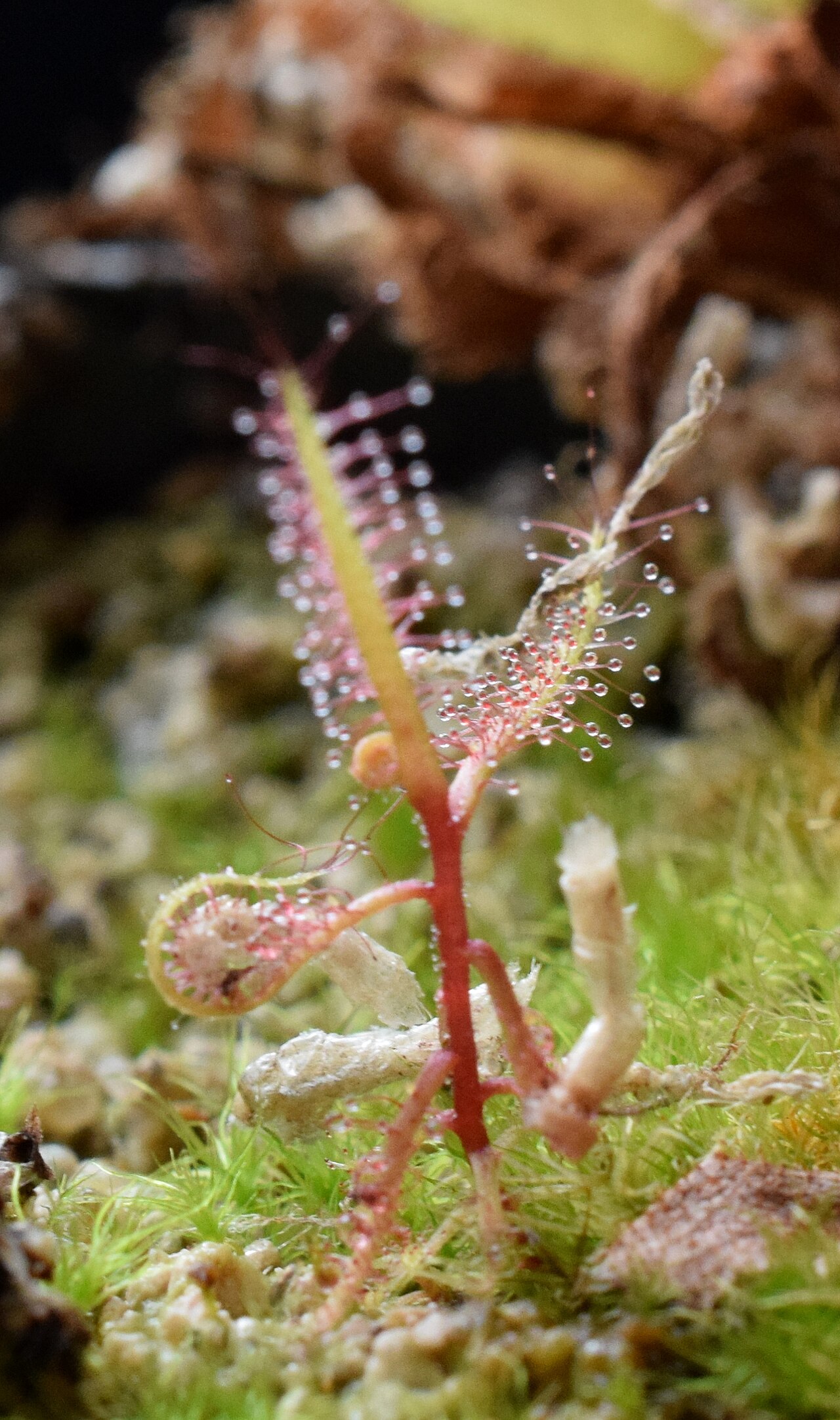
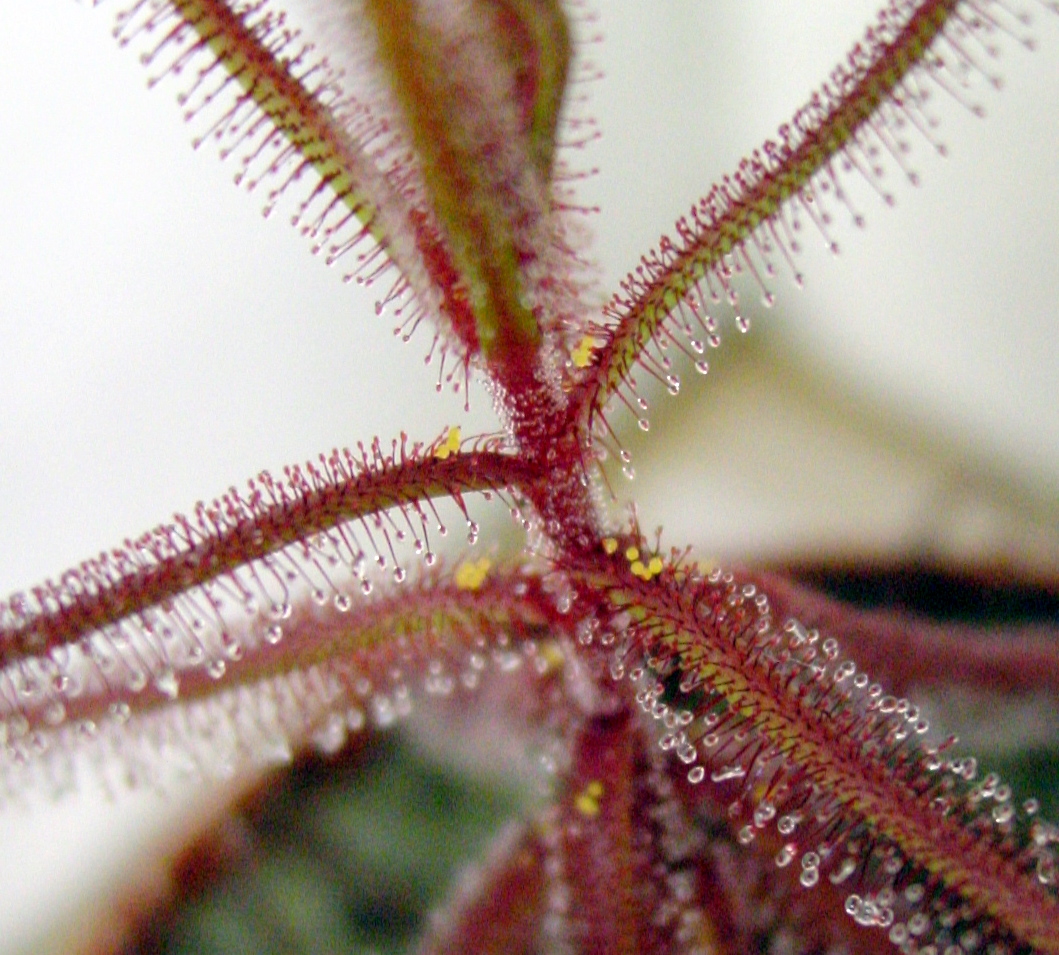
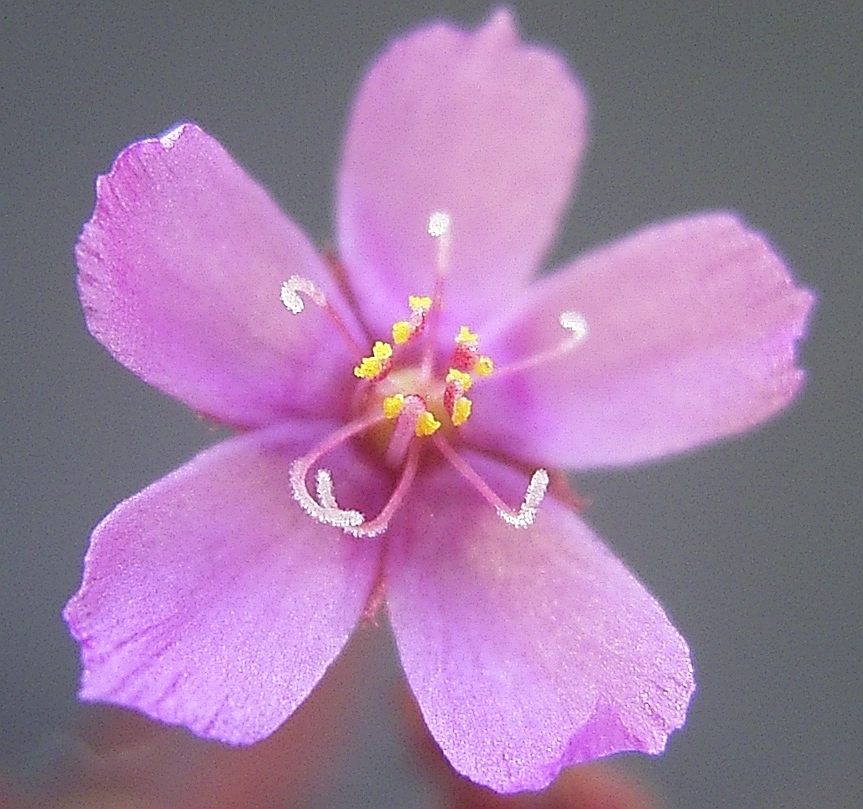

Identification
Not a flat rosette but an ascending or sprawling plant with long, thread-like leaves that criss-cross each other and the surrounding vegetation. The most striking feature sits at the base of the leaves: round yellow hair-like structures, like small knobs on stalks, whose function is still unclear. Those yellow knobs are the quickest way to recognise the species in the field. We have not been able to check published measurements of leaf, stem or flower in a source, so the measurement fields are left empty.
Similar species
The closest relative and the obvious confusion is Drosera indica in the broad sense, in which the plant was first included. Together they form section Arachnopus: annuals with long, ribbon-like trapping leaves along a stem. D. hartmeyerorum stands apart through the yellow knob-shaped hairs at the leaf base, which the other members of the group lack. Other annual species of the same section in northern Australia can only be told apart reliably with flower and leaf base in hand.
The trap and how it works
An active flypaper trap. The long leaves are covered along their whole length with stalked glands each holding a sticky droplet. An insect that lands sticks fast, and then not only the tentacles but the whole leaf slowly bends around the prey: the leaves literally curl around a captured insect. The glands then secrete enzymes and absorb the released nutrients. What role the yellow knobs at the leaf base play — lure, extra digestive gland or something else — has not been worked out.
Habitat and ecology
Warm, wet, sandy and peaty places with high humidity and extremely nutrient-poor soil. In northern Australia that mainly means seasonal swamps and wet hollows in open woodland and savanna that flood in the wet season and dry out in the dry (W7, W4, B6). As an annual the plant survives the dry months only as seed.
Distribution and elevation
Northern Australia. Its occurrence in the Kimberley, in the north of Western Australia, is well documented; records from Queensland and the Northern Territory could not be confirmed in a primary source. Because the exact range is uncertain, the distribution is deliberately kept broad.
- Recorded (quarter-degree cells)
Forms and variation
The plant was discovered in 1995, was first regarded as a form of D. indica, and was described as a species in its own right by Jan Schlauer in Carnivorous Plant Newsletter in 2001. Within section Arachnopus the classification has changed greatly over recent decades: what used to be called a single widespread D. indica has been split in Australia into a series of separate species. No varieties or colour forms of D. hartmeyerorum itself are recognised.
Where and when to see it
Search in the wet season, when the plants are large and in flower; outside those months there is nothing to see. Look along the edges of temporary pools and in wet sandy hollows, and focus on the leaf bases: the yellow knobs stand out at once against the light. The leaves are brittle and easily tangled in the surrounding vegetation; leave them be.
Conservation status
On the global IUCN Red List the species is listed as Least Concern (LC); it is not listed in CITES. As an annual of seasonal swamps it does depend on intact hydrology and on the yearly flooding. Uncertainty: we could not check the name and range (especially the Queensland occurrence) against a primary source, and for measurements we were unable to consult the original description.
Scientific name
Drosera hartmeyerorum | Schlauer, 2001
Described by Jan Schlauer in 2001, in "Drosera hartmeyerorum spec. nov. (Droseraceae), a new sundew in sect. Arachnopus from Northern Australia", Carnivorous Plant Newsletter, volume 30, no. 4, p. 104-106. Australia, Western Australia (Kimberley region), Ord River near Kununurra. Holotype in J. Schlauer's herbarium, isotype at Kew (K). Collected by S. and I. Hartmeyer on 30 April 2001. Named after Siegfried and Irmgard Hartmeyer, who discovered the species in 1995 — six years before its formal description by Schlauer. The same Hartmeyers who also supplied this species' habitat photo in the guide (see "Reeks-van-drie-afwerking", golf 10, above). The species has a yellow, non-glandular appendage thought to help attract insects.
World Checklist of Vascular Plants (WCVP), via Plants of the World Online (POWO), Royal Botanic Gardens, Kew.